


You’ll need to size your carburetor based on your engine’s displacement, RPM, and intended use to get the right airflow (measured in CFM) for efficient fuel delivery. Choosing the correct carburetor size is essential for optimal engine performance and fuel efficiency.
Too small restricts power; too large wastes fuel and causes rough idling.
Most engines run around 80% volumetric efficiency, so calculate CFM using that, then pick a carb size that matches or slightly exceeds it.
Understanding how engine type and operating conditions impact carburetor size helps you optimize performance and reliability.
Proper sizing ensures smooth acceleration, better fuel economy, and overall engine longevity.
Key Takeaways
- Calculate carburetor CFM using engine RPM, displacement, and ~80% volumetric efficiency for precise sizing.
- Match carburetor size to engine displacement: Inline-4 (150-200 CFM), V6 (250-300 CFM), V8 (350-600 CFM).
- Choose a carburetor size slightly above calculated CFM for upgrades and performance enhancement.
- Avoid too small or too large carburetors to prevent poor fuel atomization, rough idling, or restricted airflow.
- Adjust carburetor size based on driving conditions, altitude, and climate for optimal engine efficiency and power.
How to Calculate the Right Carburetor Size for Your Engine
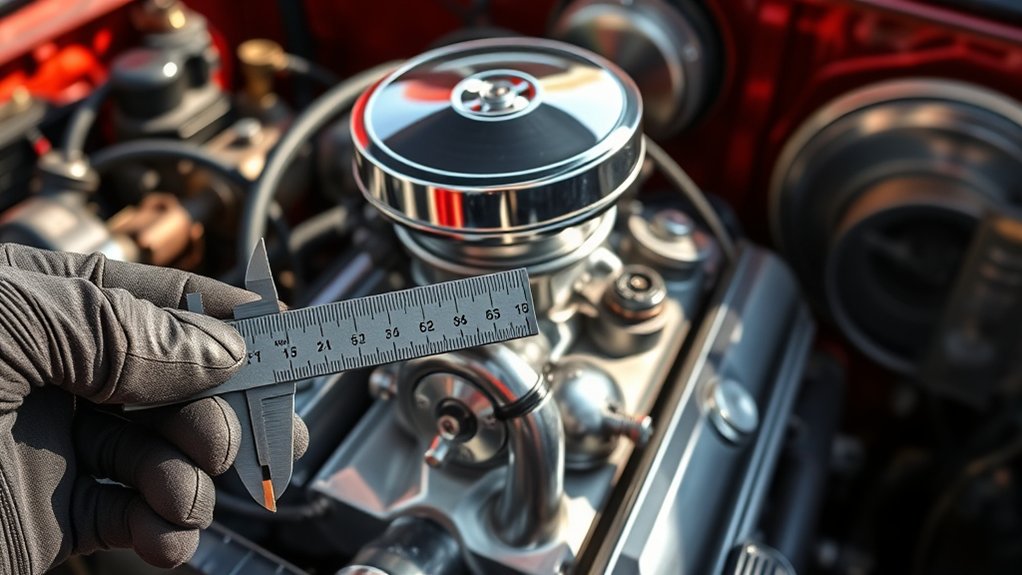
Before you buy a carburetor, you need to calculate the correct size for your engine to guarantee peak performance. To do this, focus on airflow, measured in cubic feet per minute (CFM). You can calculate CFM using the formula: CFM = (Engine RPM × Engine Displacement × Volumetric Efficiency) ÷ 3456.
Since you’re not covering engine displacement details here, just know you need accurate RPM and volumetric efficiency values. Most street engines run at about 80% volumetric efficiency. Once you find the CFM, choose a carburetor that matches or slightly exceeds that number.
Oversizing can hurt drivability, while undersizing limits power. Follow this method to pick a carburetor that balances airflow with your engine’s needs, ensuring smooth, efficient operation.
Why Engine Displacement Matters for Carburetor Size
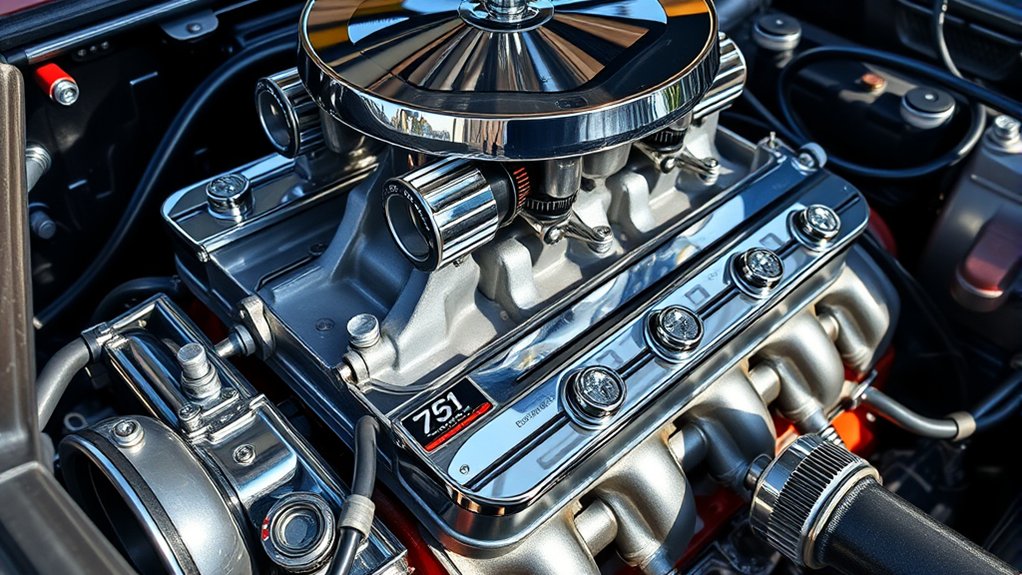
You need to match your carburetor size to your engine displacement because bigger engines demand more fuel and air to run efficiently. If the carburetor can’t supply enough fuel flow, your engine won’t perform at its best.
Getting the right air-fuel mixture ratio depends on this balance, so engine size directly influences your carburetor choice.
Engine Size Impact
Because engine displacement determines how much air and fuel your engine requires, it directly affects the size of the carburetor you’ll need. A larger engine demands more air, so you’ll need a carburetor with a bigger bore to provide sufficient airflow. If the carburetor is too small, your engine won’t get enough air, limiting performance and efficiency.
On the other hand, an oversized carburetor can cause poor throttle response and reduce low-end power because the airflow becomes too turbulent at low RPMs. Matching carburetor size to engine displacement ensures smooth operation and peak power delivery. So, when selecting a carburetor, consider your engine’s cubic inch or liter size carefully to balance airflow capacity with your engine’s needs.
Fuel Flow Requirements
Since engine displacement determines how much air your engine pulls in, it also dictates the amount of fuel the carburetor must deliver. Larger engines require more fuel to mix with the increased air volume for efficient combustion. If your carburetor can’t provide enough fuel flow, your engine will run lean, causing poor performance and potential damage.
Conversely, too much fuel can flood the engine, wasting fuel and reducing efficiency. You’ll want a carburetor sized to match your engine’s displacement to maintain proper fuel delivery across all operating conditions. This balance ensures your engine runs smoothly, delivers power, and stays reliable.
Understanding fuel flow requirements based on displacement helps you pick the right carburetor, avoiding costly mistakes and optimizing performance.
Air-Fuel Mixture Ratio
Although engine displacement primarily affects fuel flow, it also plays an essential role in determining the correct air-fuel mixture ratio. The air-fuel mixture needs to be just right for your engine to perform efficiently and avoid issues like poor combustion or excessive emissions. Larger engines require more air and fuel, so your carburetor must deliver a mixture that matches that demand.
If the mixture is too rich (too much fuel), you risk fouled spark plugs and wasted fuel. Too lean (too much air), and you could cause engine knocking or overheating. By considering your engine’s displacement, you guarantee the carburetor provides the proper balance of air and fuel.
This balance helps your engine run smoothly and maintain ideal power and efficiency.
How Horsepower Determines Carburetor Size
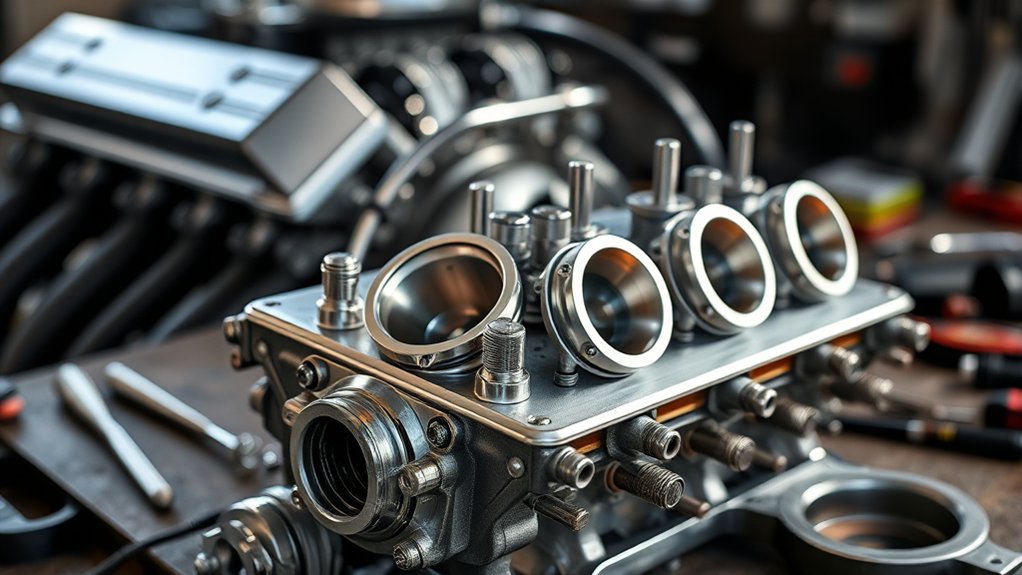
To pick the right carburetor size, you need to calculate the CFM based on your engine’s horsepower. Keep in mind that engine efficiency affects how much air your engine actually needs. Understanding these factors helps you match the carburetor to your engine’s performance.
Calculating CFM Requirements
How do you determine the right carburetor size for your engine? You start by calculating the required CFM (cubic feet per minute) to ensure your carburetor can supply enough air. Use this formula: CFM = (Engine Displacement in cubic inches × RPM × VE) / 3456.
VE stands for volumetric efficiency, which you can estimate around 85% (0.85) for most naturally aspirated engines. For example, with a 350 cubic inch engine running at 5,000 RPM, the calculation would be (350 × 5000 × 0.85) / 3456 ≈ 430 CFM. This tells you that a carburetor rated around 430 CFM would meet your engine’s airflow needs.
Picking a carburetor with too low CFM restricts power, while too high can cause poor throttle response.
Impact Of Engine Efficiency
When you consider engine efficiency, you’ll see that horsepower plays a crucial role in determining the right carburetor size. The more horsepower your engine produces, the more air and fuel it needs to perform effectively. A carburetor that’s too small will starve the engine of fuel, limiting power and risking lean conditions.
Conversely, one that’s too large can cause poor throttle response and fuel wastage. Engine efficiency affects how much air-fuel mixture your engine actually uses at peak power. By understanding your engine’s horsepower and efficiency, you can select a carburetor that matches its demand, ensuring smooth performance and fuel economy.
Always base your carburetor size on actual horsepower, not just displacement, for the best results.
What Is CFM and Why It Matters for Carburetor Size
Although you might be enthusiastic to pick a carburetor, understanding CFM—cubic feet per minute—is essential because it measures the amount of air the carburetor can flow. This measurement directly affects your engine’s performance, fuel efficiency, and power output. If the CFM rating is too low, your engine won’t get enough air, leading to poor combustion.
Understanding CFM is crucial for ensuring your carburetor delivers the right airflow for optimal engine performance.
Too high, and you risk wasting fuel and reducing engine responsiveness.
Here’s why CFM matters for your carburetor size:
- It determines the airflow compatible with your engine’s displacement and RPM.
- Proper CFM ensures ideal fuel-to-air ratio for efficient combustion.
- Choosing the right CFM prevents engine hesitation, stalling, or power loss.
Getting this balance right helps your engine run smoothly and efficiently.
How to Use Carburetor Size Charts for Quick Reference
Since selecting the right carburetor size can feel overwhelming, using carburetor size charts simplifies the process by matching your engine’s specifications with recommended CFM ratings. Start by identifying your engine’s cubic inch displacement (CID) and its maximum RPM. Locate these values on the chart, which usually lists engine sizes on one axis and RPM ranges on the other.
The chart then suggests an appropriate CFM range for your carburetor. This quick reference helps you narrow down your choices without guesswork. Keep in mind, charts provide general guidelines, so use them as a starting point.
Once you find the recommended CFM, you can confidently move forward knowing you’ve chosen a carburetor size that fits your engine’s airflow demands efficiently.
How to Match Carburetor Size to Your Driving Style and Use
Understanding your driving style and how you use your vehicle plays a crucial role in selecting the right carburetor size. If you drive aggressively or frequently tow heavy loads, you’ll need a larger carburetor to support higher air and fuel flow.
Conversely, if you mostly cruise at steady speeds, a smaller carburetor will provide better fuel efficiency and smoother performance.
Consider these points when matching your carburetor size to your use:
- Daily commuting: Opt for moderate size to balance power and economy.
- Performance driving: Choose a larger carburetor for maximum airflow and horsepower.
- Towing or hauling: Go for a carburetor that delivers strong low-end torque and consistent fuel supply.
This approach guarantees your carburetor complements your driving habits perfectly.
How Altitude and Climate Affect Carburetor Size Choices
You’ll notice that altitude changes how much air your engine gets, which directly affects carburetor size. Higher altitudes mean thinner air, so you’ll need to adjust your carburetor to keep the right fuel mixture.
Climate also plays a role by influencing fuel vaporization and engine performance, so it’s important to factor that in.
Altitude Impact On Airflow
Although carburetor size might seem straightforward, altitude plays a crucial role in determining the right fit for your engine. As you climb to higher elevations, the air becomes thinner, meaning less oxygen is available for combustion. This reduced air density impacts how your carburetor meters fuel and air, affecting performance.
To guarantee maximum airflow, you need to take into account altitude when choosing a carburetor size.
Here’s what to keep in mind:
- At higher altitudes, you may need a smaller carburetor to prevent an overly rich mixture.
- Thinner air reduces the volume of oxygen entering the engine, so your carburetor must adjust accordingly.
- Using a carburetor sized for sea level at high altitudes can cause poor throttle response and decreased efficiency.
Adjust your carburetor size to match altitude for better engine performance.
Climate Effects On Fuel Mixture
Since climate directly influences air temperature and humidity, it also affects how your carburetor mixes fuel and air. Warmer air holds more moisture, which reduces oxygen density, causing your carburetor to deliver a richer mixture.
Conversely, cooler, drier air increases oxygen density, leaning out the mixture. When you’re choosing a carburetor size, consider where you’ll be driving most often. High humidity or hot climates may require a slightly larger carburetor to compensate for reduced air density, ensuring proper fuel flow.
In contrast, colder or arid environments might need a smaller carburetor to avoid an overly lean mixture that can cause engine knocking or poor performance. Adjusting your carburetor for local climate conditions helps maintain ideal engine efficiency and longevity.
Why Carburetor Size Directly Impacts Performance
When you choose a carburetor size, you directly affect how efficiently your engine breathes and performs. A properly sized carburetor ensures the right air-fuel mixture reaches the engine, optimizing power and fuel economy. If it’s too small, your engine can starve for air, limiting performance.
Too large, and you risk poor fuel atomization, causing rough idling and wasted fuel.
Here’s why size matters:
- Airflow Control: The carburetor regulates airflow; size impacts how much air enters the engine.
- Fuel Delivery: Correct size balances fuel flow, preventing lean or rich mixtures.
- Throttle Response: Proper sizing improves acceleration and overall responsiveness.
Choosing the right carburetor size means your engine runs smoothly, efficiently, and with the power you expect.
How Different Engine Types Affect Carburetor Size Needs
Different engine types demand varying carburetor sizes because each design affects airflow and fuel requirements uniquely. When choosing a carburetor, you need to take into account your engine’s displacement, cylinder count, and intended use. For example, V8 engines usually require larger carburetors than inline-4s due to higher air demands.
Similarly, high-performance or racing engines often need bigger carburetors than stock engines.
| Engine Type | Typical Carburetor Size (CFM) |
|---|---|
| Inline-4 | 150-200 |
| V6 | 250-300 |
| V8 | 350-600 |
| High-Performance | 600+ |
Matching carburetor size to your engine type guarantees efficient fuel delivery and maximum power output. Choose wisely to avoid drivability issues.
How to Upgrade Your Carburetor Without Losing Driveability
Choosing the right carburetor size for your engine sets the foundation, but upgrading it requires careful attention to maintain smooth driveability. You want to avoid a carburetor that’s too large, as it can cause poor throttle response and hesitation.
Instead, focus on matching the carburetor’s airflow to your engine’s needs without sacrificing control.
To upgrade without losing driveability, consider these tips:
- Select a carburetor slightly larger than stock but within your engine’s airflow range.
- Retain or upgrade your vehicle’s fuel delivery system to support the new carburetor’s demands.
- Fine-tune the carburetor’s idle and transition circuits for smooth throttle response during low-speed driving.
How to Test and Tune Your Carburetor After Installation
After installing your new carburetor, you’ll need to carefully test and tune it to guarantee peak performance. Start by checking for vacuum leaks around the mounting base and fuel lines. Next, adjust the idle speed screw to reach the manufacturer’s recommended RPM.
Then, fine-tune the air-fuel mixture screws by turning them slowly until the engine runs smoothly without hesitation or stalling. Use a vacuum gauge or a wideband O2 sensor if available for precise adjustments. Once the idle and mixture are set, rev the engine and listen for any popping or bogging sounds, adjusting accordingly.
Finally, take your vehicle for a test drive to confirm smooth acceleration and consistent power delivery. Proper tuning maximizes efficiency, prevents engine damage, and guarantees your carburetor functions at its best.
Frequently Asked Questions
Can I Use the Same Carburetor Size for Multiple Engines?
You can use the same carburetor size for multiple engines if their airflow and fuel requirements match. Otherwise, it won’t perform well.
Always match the carburetor size to each engine’s specific needs for best results.
How Often Should I Clean or Rebuild My Carburetor?
You should clean or rebuild your carburetor every 12 months or 12,000 miles, but don’t wait for problems. Regular maintenance prevents performance issues, so sticking to this schedule keeps your engine running smoothly and efficiently.
What Are Common Signs of a Carburetor That’s Too Large or Small?
You’ll notice rough idling, poor fuel efficiency, or hesitation if the carburetor’s too large. If it’s too small, your engine might struggle for power or stall.
Listen to how your engine responds during acceleration.
Are There Specific Carburetor Brands Recommended for Certain Engines?
Think of carburetor brands like shoes—you want the perfect fit. You’ll find Holley suits muscle cars, Edelbrock’s great for street performance, and Mikuni’s excel on motorcycles.
Match your engine’s style to optimize power and efficiency.
Can a Carburetor Size Affect Fuel Economy Significantly?
Yes, a carburetor size can considerably affect your fuel economy. If it’s too large, you’ll waste fuel; if it’s too small, your engine won’t run efficiently.
Choosing the right size keeps your mileage and performance balanced.
Conclusion
Choosing the right carburetor size is essential for maximizing your engine’s performance. Did you know that a carburetor too large or small can reduce fuel efficiency by up to 30%? By understanding engine displacement, horsepower, and CFM, you’ll pick the perfect fit that keeps your ride smooth and powerful.
Remember, a well-sized carburetor isn’t just about power—it’s about balancing performance and drivability for the best results every time. Selecting the appropriate carburetor size enhances fuel economy, throttle response, and overall engine efficiency. Keep engine displacement, horsepower, and CFM in mind to ensure you get the optimal carburetor size for your vehicle.

