

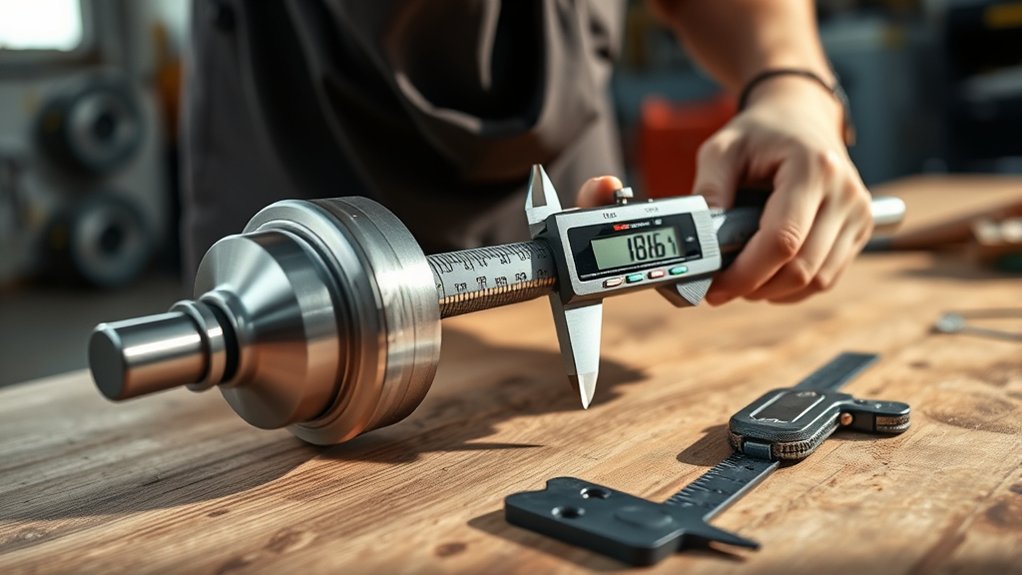
To measure axle length accurately, start by gathering essential tools like a tape measure, caliper, and notepad.
Knowing how to measure axle length properly is crucial for vehicle maintenance and ensuring compatibility with replacement parts.
Identify your axle type—whether solid, stub, or split—for the most effective measuring approach.
Next, measure the full length from end to end on a flat surface, making sure to include threaded sections and bearing seats.
Use precise tools to ensure accuracy in your measurements.
Record your results carefully and double-check them for consistency.
Finally, compare your measurements with your vehicle specifications to confirm compatibility.
Following these basics sets you up well, and exploring further will sharpen your skills.
Key Takeaways
- Remove the axle from the vehicle and place it on a flat, stable surface for accurate measurement.
- Use a reliable tape measure or caliper to measure straight from one outer end to the other, including protruding parts.
- Identify the axle type beforehand to apply the correct measuring approach and ensure precise results.
- Take multiple measurements at key points like overall length, spline length, and bearing seat diameter for accuracy.
- Record all measurements clearly, double-check for consistency, and compare with vehicle specifications for proper fitment.
Tools Needed to Measure Axle Length
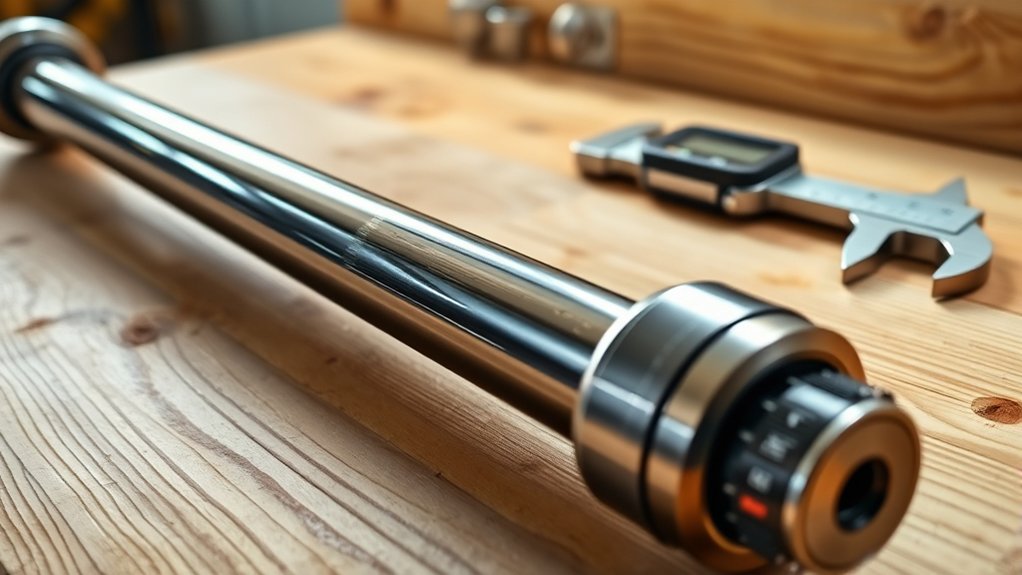
What tools do you need to measure axle length accurately? First, grab a reliable tape measure or a caliper. A tape measure is handy for longer axles, while calipers offer precision for shorter, detailed measurements.
You’ll also want a clean cloth to wipe off any grease or debris from the axle before measuring. This guarantees your measurements aren’t thrown off by grime. A notepad and pen can help you record your measurements clearly.
If you have access to a digital caliper, it can provide even more accurate readings and often displays measurements in both inches and millimeters. Having these tools ready will make your measurement process straightforward and accurate, setting you up for the next steps with confidence.
How to Identify Your Axle Type Before Measuring Length
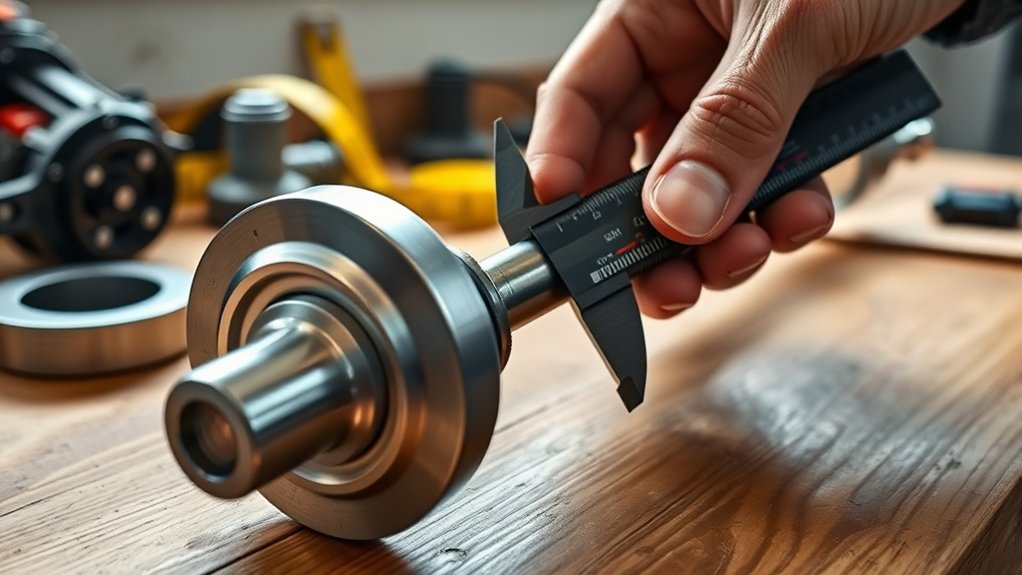
Before you measure your axle length, you need to identify the type of axle you have. Different axles have distinct features, so recognizing common types like solid, spindle, or stub axles will help.
Look for key visual cues, such as shape and mounting style, to make identification easier.
Common Axle Types
Although axle length measurement might seem straightforward, identifying your axle type first guarantees accuracy and saves you time. Common axle types include solid axles, which are a single, continuous shaft connecting both wheels, and split axles that have separate shafts for each wheel. You’ll also encounter live axles, which rotate with the wheels, and dead axles, which are stationary and only support weight.
Another type is the stub axle, typically found on front-wheel-drive vehicles, allowing wheels to pivot for steering. Knowing which type you have matters because each requires a different measuring approach. For example, measuring a solid axle differs from measuring a split axle, so recognizing your axle type helps you apply the correct method and avoid errors when determining axle length.
Visual Identification Tips
Since axle types vary widely in design, visually identifying your axle before measuring will save you time and prevent mistakes. To quickly recognize your axle type, focus on these key visual cues:
- Shape and Size: Notice if the axle is straight, tapered, or has flanges. For example, a straight axle often appears uniform, while a tapered one narrows at the ends.
- Number and Position of Bearings: Check how many bearings are present and where they sit. Some axles have bearings close to the hub, others near the ends.
- End Style: Look at the axle ends—are they threaded, splined, or plain? This detail often indicates the axle’s application and compatibility.
Use these tips to identify your axle type confidently before measuring its length.
Key Measurement Points on the Axle Explained
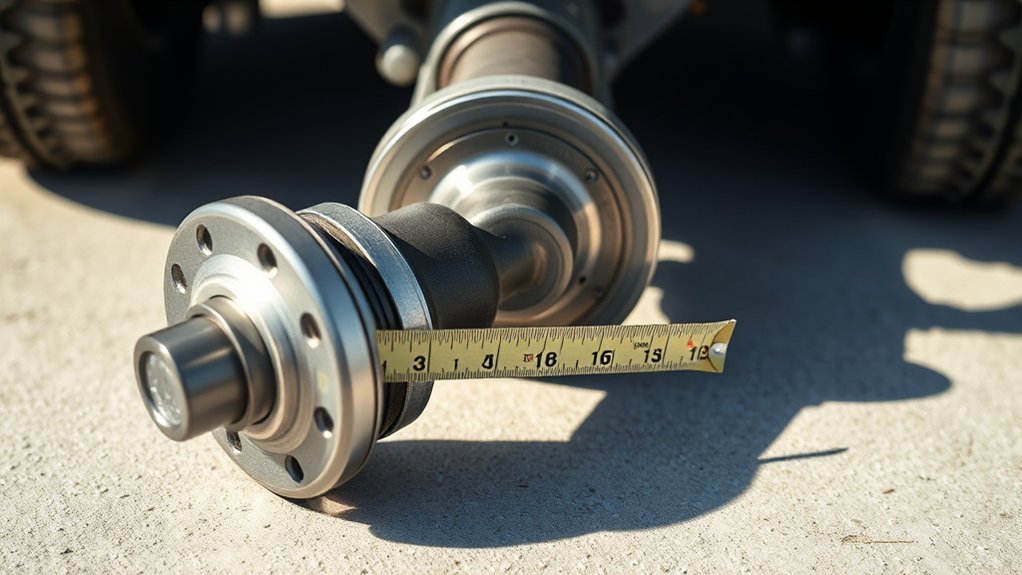
To measure your axle length accurately, you need to focus on the critical measurement areas. You’ll want to identify the key points where the axle ends and where components like bearings or flanges sit. Understanding these spots guarantees your measurements are precise and reliable.
Critical Axle Measurement Areas
When you measure an axle, focusing on specific key points *assures* accuracy and proper fit. You need to zero in on critical axle measurement areas that affect performance and compatibility.
Here are the three primary areas you should measure:
- Overall Length – Measure from one end of the axle shaft to the other for total length.
- Spline Length and Diameter – Check the splined section where the axle engages with the hub or differential.
- Bearing Seat Diameter – Measure the diameter where the axle bearing rests to ensure a snug fit.
Identifying Key Axle Points
Measuring the overall length, spline length and diameter, and bearing seat diameter gives you a solid starting point, but you also need to pinpoint specific spots on the axle to get accurate readings.
Identifying these key points ensures your measurements reflect the true dimensions, helping you avoid mistakes during replacement or repairs. Focus on locations like the flange face, bearing seat, spline start, and the shaft end.
| Key Point | Description | Measurement Tip |
|---|---|---|
| Flange Face | Where the wheel mounts | Measure flat against flange |
| Bearing Seat | Where bearing sits | Use calipers for precision |
| Spline Start | Beginning of splined area | Note spline length carefully |
| Shaft End | Extreme end of the axle | Measure to the exact tip |
These points guide your tools and give you reliable, consistent data.
How to Measure the Total Axle Length Accurately
Although it might seem straightforward, getting the total axle length right requires careful attention to detail. To measure accurately, you’ll need a reliable tape measure or caliper and a clear understanding of where the axle starts and ends.
Follow these steps to guarantee precision:
- Position the axle on a flat surface for stability.
- Measure from one outer end to the other, including any protruding parts.
- Double-check your measurement by repeating the process to avoid errors.
Make sure you measure in a straight line without bending the tape or tool, as this can distort the length.
How to Measure the Threaded Part of Your Axle
Now that you’ve accurately measured the total axle length, it’s time to focus on the threaded part. Start by locating where the threads begin and end on your axle. Use a caliper or a ruler to measure this section precisely, placing the tool at the first visible thread and extending it to the last thread.
Make sure to measure in a straight line along the axle’s axis to avoid errors. Record this length carefully, as the threaded part is essential for securing nuts and bearings. If you notice any damage or worn threads, note that, as it may affect fit and safety.
This measurement helps guarantee your replacement parts match perfectly. Keep your measurements handy for easy reference.
How to Measure Axle Diameter for Proper Fit
To measure your axle diameter accurately, you’ll need tools like a caliper or micrometer. Focus on measuring the axle’s thickest part to guarantee a proper fit.
Keep in mind that common axle diameters vary, so knowing the exact size helps you choose the right replacement or accessory.
Tools Needed
Before you start measuring your axle diameter, you’ll need the right tools to guarantee an accurate fit. Having precise equipment ensures your measurements are reliable, preventing costly mistakes or part mismatches.
Here are the essential tools you’ll need:
- Caliper – A digital or dial caliper lets you measure the axle diameter with great accuracy, usually within thousandths of an inch or millimeters.
- Micrometer – For even finer precision, a micrometer is perfect, especially on smaller axle diameters.
- Clean Cloth – Wipe down the axle before measuring to remove dirt or grease that could affect accuracy.
Gather these tools first, and you’ll be well-prepared to take precise, consistent axle diameter measurements.
Measuring Techniques
With your tools ready, you can start measuring the axle diameter accurately. First, clean the axle surface to remove dirt or rust that could affect the measurement. Use a caliper to measure the diameter at several points along the axle, making sure you capture any variations.
Always measure perpendicular to the axle’s length for the most precise reading. If you don’t have a caliper, a micrometer works well too. Avoid using a ruler since it lacks the precision needed.
Record each measurement and compare them to confirm consistency. Taking multiple readings helps you spot any irregularities or wear. This careful approach guarantees you get the right diameter, which is essential for a proper fit and smooth operation.
Common Diameter Sizes
Several common axle diameter sizes dominate the market, and knowing these helps you choose the right fit for your vehicle or project. Measuring the diameter accurately assures your axle fits properly, preventing mechanical issues and enhancing performance. Use a caliper for precise measurement and compare it against standard sizes.
Here are three common axle diameters you’ll encounter:
- 1 inch (25.4 mm) – Common for light-duty bikes and small trailers.
- 1.25 inches (31.75 mm) – Often used in mid-sized vehicles and larger trailers.
- 1.5 inches (38.1 mm) – Found in heavy-duty trucks and commercial equipment.
Recording and Comparing Axle Measurements for Accuracy
Once you’ve taken your axle measurements, you’ll want to record them carefully to guarantee accuracy throughout the process. Use a notebook or digital device to write down each measurement immediately, noting the exact points you measured from. This ensures you can reference them without confusion later.
Next, compare your measurements by double-checking the axle length from both ends to confirm consistency. If you notice any discrepancies, measure again to rule out errors. Taking multiple measurements and averaging them can also improve accuracy.
How to Check Axle Length Compatibility With Your Vehicle
Before ordering a new axle, you’ll need to *verify* its length matches your vehicle’s specifications exactly. Using the wrong length can cause poor fitment, handling issues, or damage.
Always verify axle length before ordering to avoid fitment problems and potential damage.
Here’s how to check compatibility:
- Consult Your Vehicle Manual: Find the exact axle length recommended by the manufacturer to ensure you’re working with accurate specs.
- Compare Your Measurements: Use the measurements you recorded earlier and compare them with the manual’s specs or OEM part numbers.
- Check Online Databases: Many parts websites offer compatibility tools where you enter your vehicle’s make, model, and year to confirm the axle length matches what you measured.
Common Axle Measurement Mistakes to Avoid
Verifying axle length compatibility is only part of the process—you also need to avoid common measurement mistakes that can throw off your results. First, don’t measure the axle while it’s installed; removal ensures accuracy. Avoid using flexible tapes that can bend or stretch, causing errors—use a rigid measuring tool instead.
Make sure you measure from the correct points: from the center of one bearing surface to the center of the opposite one. Also, take multiple measurements to confirm consistency. Don’t rush; a quick, careless measurement often leads to incorrect axle length.
Finally, avoid assuming the old axle’s length is correct if you don’t have the exact specs—always double-check. Staying precise here saves you time and prevents costly mismatches.
When to Consult a Professional for Axle Measurement
How do you know when measuring your axle is beyond a DIY task? Sometimes, it’s best to call in a pro to avoid costly mistakes. Consider consulting a professional if:
Knowing when to call a pro for axle measurements can prevent costly errors and ensure safety.
- You lack the right tools or experience to get accurate measurements.
- Your vehicle has unusual or custom axles that standard methods can’t handle.
- You notice damage or wear on the axle, which might affect measurement and safety.
Professionals have specialized equipment and expertise to ensure precise measurements. If you’re unsure about your skills or the axle’s condition, don’t risk it. Getting expert help can save you time, money, and prevent potential mechanical issues down the line.
When accuracy and safety matter, trusting a professional is the smartest move.
Frequently Asked Questions
How Often Should I Measure My Axle Length for Maintenance?
You should measure your axle length during regular maintenance checks or whenever you notice unusual noises, vibrations, or handling issues. Checking it every 6 months helps catch wear early and guarantees your vehicle stays safe and reliable.
Can Axle Length Affect Vehicle Performance or Safety?
Axle length is the backbone of your vehicle’s balance—if it’s off, your ride can wobble, risking safety and performance. You’ll feel misalignment, uneven tire wear, and compromised handling, so keep it precise and steady.
What Materials Are Axles Typically Made From?
Axles are typically made from strong materials like steel or alloy steel. You’ll find some using aluminum or carbon fiber for lighter vehicles, but steel’s durability and toughness make it the most common choice for handling stress effectively.
Are There Different Axle Length Standards by Vehicle Type?
Think of axles like tree branches—each vehicle type needs a different length to grow strong.
Yes, you’ll find varied axle length standards for cars, trucks, and bikes, matching their unique weight and balance needs perfectly.
How Do Axle Length Changes Impact Wheel Alignment?
Changing axle length affects wheel alignment by altering the wheelbase and track width, which can cause misalignment. You’ll need to adjust camber, toe, and caster to guarantee proper handling, tire wear, and vehicle stability.
Conclusion
Now that you’ve mastered measuring axle length, you’re like a mechanic with a sixth sense. Just as a tailor guarantees a perfect fit with precise measurements, your careful attention assures your axle will fit seamlessly.
Keep these steps handy, avoid common pitfalls, and you’ll save time and hassle down the road. When in doubt, don’t hesitate to call in a pro—after all, even the best need a helping hand sometimes.
Remember, accurate axle length measurement is crucial for vehicle performance and safety. Following these steps ensures a proper fit every time. With practice, measuring axle length becomes second nature.

