

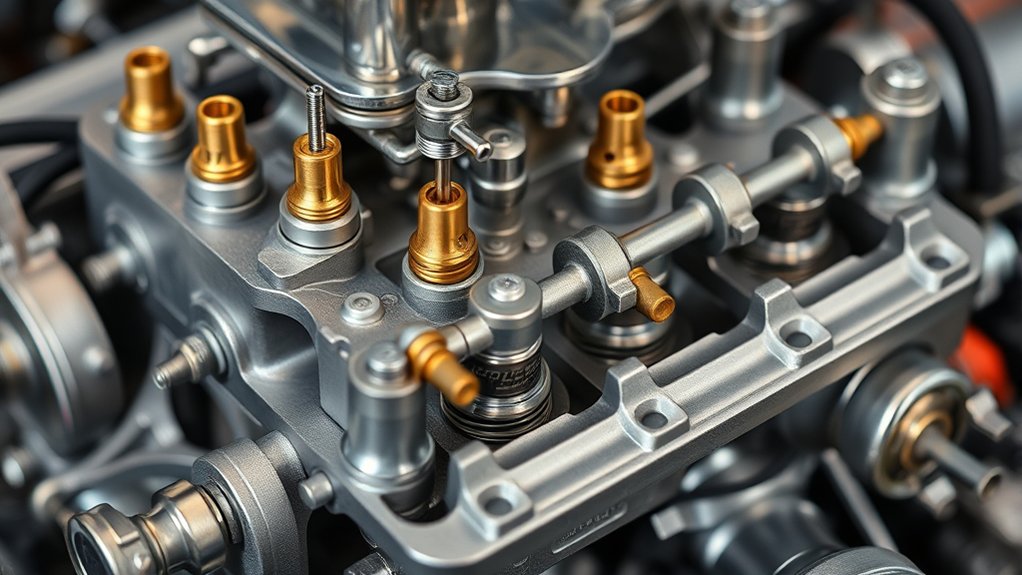
You’ll recognize a carburetor by its bulky, cast-metal body with visible linkages and mechanical parts controlling the air-fuel mixture. This essential engine component often features a throttle valve, float chamber, and venturi.
Its sturdy design is typically made from materials like aluminum, zinc, brass, or steel.
Compared to smaller, streamlined fuel injectors, carburetors look more complex and industrial. The intricate assembly of parts makes them easily distinguishable.
If you want to understand its parts, how it works, and how to keep it in good shape, keep exploring the details.
Key Takeaways
- A carburetor has a bulky, cast metal body with a complex structure and visible mechanical linkages.
- Its main parts include the float chamber, throttle valve, choke valve, and venturi, arranged compactly or in multiple barrels.
- Carburetors vary in size from small, compact single-barrel to larger, bulkier four-barrel designs with bigger air intakes.
- Common materials are aluminum, zinc, brass, and steel, giving a metallic, textured appearance with durable finishes.
- Unlike sleek fuel injectors, carburetors are more intricate, with multiple tubes and passages visible on the exterior.
Understanding Carburetors and Their Importance
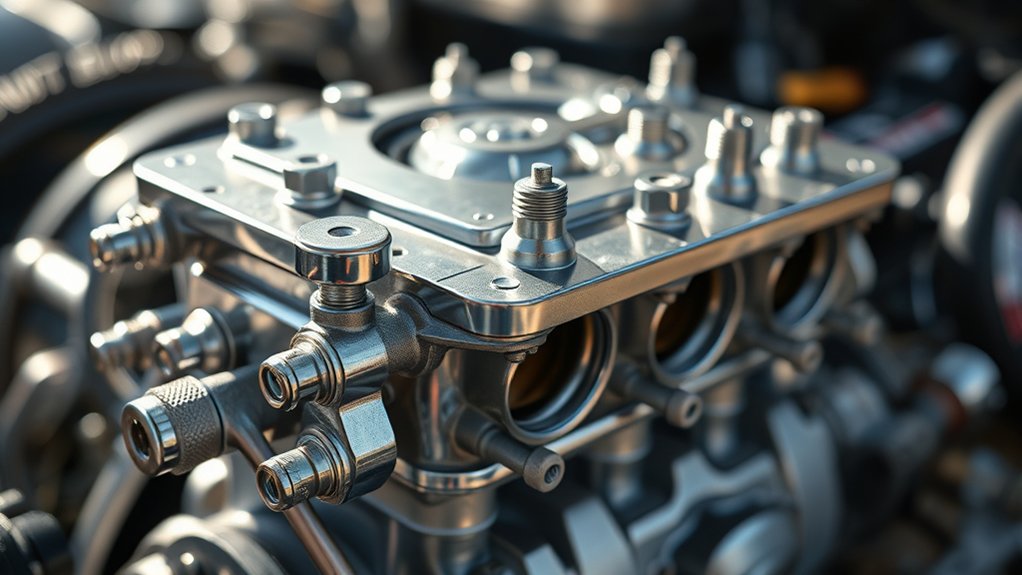
How exactly does a carburetor affect your engine’s performance? It controls the air-fuel mixture your engine needs to run smoothly. When the mixture is just right, your engine gets the power and efficiency it deserves.
If it’s off, you’ll notice rough idling, poor acceleration, or increased fuel consumption. You rely on the carburetor to balance air and fuel precisely so combustion happens efficiently. Without it, your engine wouldn’t start or run properly.
Understanding this part helps you appreciate why maintaining or adjusting it matters. It’s a key player in keeping your engine responsive and reliable. So, knowing what a carburetor does lets you better diagnose engine issues and keep your vehicle in top shape.
How a Carburetor Works: Basic Overview
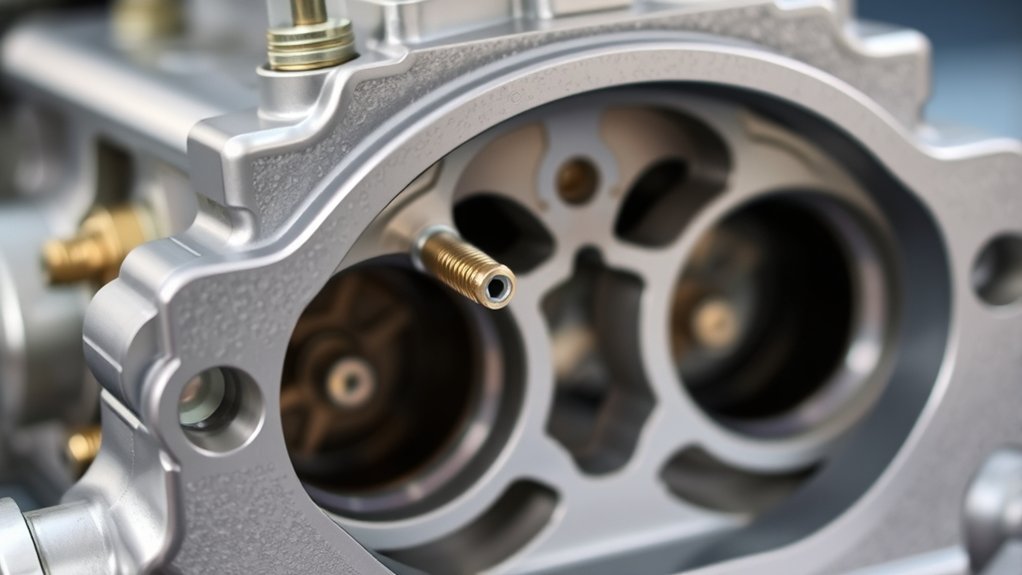
Although it might seem complex, a carburetor works by mixing the right amount of air with fuel before it enters your engine. This precise blend guarantees your engine runs smoothly and efficiently.
A carburetor ensures your engine runs smoothly by blending the perfect mix of air and fuel.
Here’s a basic overview of how it works:
- Air flows through the carburetor’s throat, creating a vacuum.
- This vacuum pulls fuel from the float chamber into the airflow.
- The fuel mixes with the air to form a combustible mixture.
- This mixture then travels into the engine’s combustion chamber, where it ignites to power your vehicle.
How Air and Fuel Enter a Carburetor
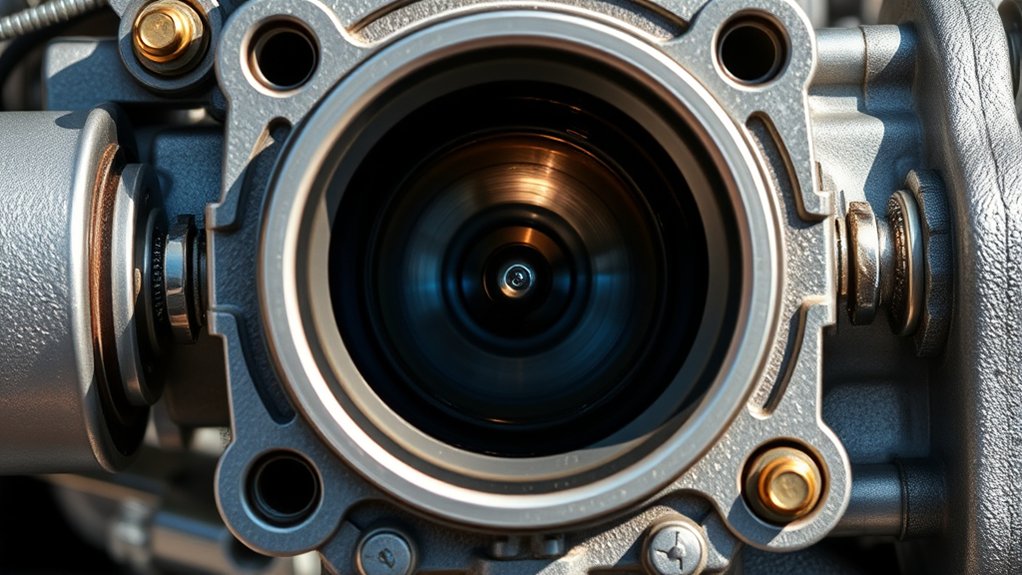
When air rushes into the carburetor, it passes through a narrow section called the venturi, which speeds up the airflow and lowers the pressure. This pressure drop creates a suction effect that draws fuel into the incoming air stream. The fuel enters the carburetor from the float chamber, where it’s stored at a constant level.
As you operate the engine, this precise interaction between air and fuel allows the mixture to form just right for combustion. The air and fuel blend together right at the carburetor’s entrance, preparing to move into the engine’s cylinders. Understanding this initial step helps you see how critical airflow and fuel delivery are to your carburetor’s function, setting the stage for efficient engine performance.
Tubes and Passages Inside a Carburetor
Since air and fuel must travel through the carburetor smoothly, a network of tubes and passages directs their flow precisely where it’s needed. You’ll find these channels carefully designed to mix the right amount of fuel with the incoming air before it reaches the engine.
Here are the key tubes and passages you should know:
- Main fuel passage – carries fuel from the bowl to the venturi area.
- Air passage – guides air into the venturi for mixing.
- Idle passage – controls fuel flow at low engine speeds.
- Choke passage – restricts air for easier starts in cold conditions.
Understanding these pathways helps you appreciate how the carburetor balances fuel and air for efficient combustion.
Identifying the Main Parts of a Carburetor
How do you recognize the main parts of a carburetor and understand their roles? First, look for the float chamber, which holds fuel before it mixes with air. Connected to this is the float, a small device that regulates fuel flow.
Next, spot the throttle valve; it controls how much air-fuel mix enters the engine. You’ll also find the choke valve, which restricts airflow to enrich the mixture during cold starts. The venturi, a narrow passage inside the carburetor, speeds up air and helps draw fuel in.
Finally, notice the jets—small openings that deliver fuel into the airflow. By identifying these parts, you get a clear picture of how the carburetor manages fuel and air to power your engine effectively.
How Carburetor Shape Affects Engine Performance
Understanding the main parts of a carburetor helps you see how its shape influences engine performance. The design directly affects how air and fuel mix, which impacts power, efficiency, and responsiveness.
Knowing carburetor parts reveals how their design shapes engine power, efficiency, and responsiveness.
Here’s how carburetor shape plays a role:
- Venturi Size – A narrower venturi speeds up airflow, improving fuel atomization for better combustion.
- Throttle Bore Diameter – Larger diameters allow more air, increasing power but may reduce low-speed control.
- Fuel Bowl Shape – Compact shapes maintain steady fuel levels, preventing lean or rich mixtures.
- Airflow Path Design – Smooth, streamlined paths reduce turbulence, enhancing fuel delivery consistency.
Throttle and Choke: Appearance and Function in a Carburetor
Take a close look at the throttle valve design and how it controls airflow in the carburetor. You’ll also notice the choke mechanism, which plays a critical role during engine startup by restricting air to enrich the fuel mixture.
Understanding these parts helps you see how your engine gets the right balance for smooth operation.
Throttle Valve Design
Although the throttle valve might seem like a simple component, it plays an essential role in controlling the engine’s power by regulating airflow into the carburetor. When you press the accelerator, the throttle valve opens wider, allowing more air to mix with fuel, increasing engine speed.
Here are four key aspects of throttle valve design:
- Butterfly Valve: A circular plate that pivots on a shaft to open or close airflow.
- Material: Usually made of metal or durable plastic for strength and heat resistance.
- Positioning: Located inside the carburetor’s venturi to influence air velocity.
- Linkage Connection: Attached to the throttle cable or pedal for direct control.
This precise design guarantees smooth acceleration and efficient engine response.
Choke Mechanism Overview
How does the choke mechanism help your engine start smoothly in cold conditions? The choke is a small valve located near the carburetor’s air intake. When activated, it partially blocks the airflow, creating a richer fuel mixture by increasing fuel relative to air.
This richer mixture is easier for your engine to ignite when it’s cold. You’ll notice the choke usually looks like a round plate or butterfly valve that pivots to open or close. Some chokes are manual, operated by a lever or knob you control, while others are automatic, using sensors or engine temperature to adjust themselves.
Function During Startup
Once the choke adjusts the air intake for a richer fuel mixture, the throttle controls how much of that mixture enters the engine during startup. You’ll notice the throttle is a butterfly valve inside the carburetor that opens and closes to regulate airflow and fuel flow.
As you start the engine, the throttle opens slightly to let just enough fuel mixture in for ignition.
Here’s how it works during startup:
- The choke closes partially, restricting air and enriching the mixture.
- The throttle opens slightly to allow the mixture into the engine.
- As the engine warms, the choke gradually opens to allow more air.
- The throttle then adjusts to your acceleration needs once the engine runs smoothly.
This coordinated action ensures a smooth, efficient startup.
How Carburetor Screws Adjust Engine Performance
You’ll find that adjusting the idle screw controls how smoothly your engine runs at low speeds. The mixture screw lets you fine-tune the air-fuel balance for better performance.
Meanwhile, the throttle screw impacts how quickly your engine responds when you press the gas.
Idle Screw Function
Although it might seem small, the idle screw plays a crucial role in tuning your carburetor for smooth engine performance at low speeds. This screw controls the amount of air entering the carburetor when the throttle is closed, ensuring your engine doesn’t stall or run rough. When you adjust the idle screw, you’re directly affecting how your engine behaves at idle.
Here’s what it does:
- Regulates airflow to maintain steady idle RPM.
- Prevents engine stalling when you’re stopped.
- Helps achieve smooth acceleration from a stop.
- Balances fuel and air mix at low throttle settings.
Mixture Screw Adjustment
Because the mixture screw directly controls the ratio of fuel to air entering your engine, adjusting it properly can considerably improve performance and efficiency. When you turn the mixture screw, you either enrich or lean out the fuel mixture. Turning it clockwise generally leans the mixture, reducing fuel flow, while turning it counterclockwise enriches it by allowing more fuel in.
You want to find the sweet spot where the engine runs smoothly without sputtering or stalling. If the mixture is too lean, your engine may hesitate or overheat; too rich, and you’ll waste fuel and increase emissions. To adjust, start with small turns and listen for changes in engine idle quality.
Proper mixture screw adjustment guarantees your carburetor delivers the right fuel-to-air balance for ideal engine performance.
Throttle Screw Impact
How does the throttle screw affect your engine’s performance? The throttle screw controls the idle speed by adjusting how much the throttle plate opens when the engine is at rest. Turning this screw changes airflow, directly impacting how your engine runs at low RPMs.
Here’s what happens when you adjust it:
- Increasing throttle screw opening raises idle speed, preventing stalling.
- Decreasing it lowers idle speed, saving fuel but risking rough idling.
- Fine-tuning helps maintain smooth progression from idle to acceleration.
- Incorrect settings can cause hesitation, poor fuel efficiency, or engine flooding.
Different Carburetor Designs and How They Look
When you examine carburetors, you’ll notice they come in several distinct designs, each tailored to specific engine needs and performance goals. You’ll find simple single-barrel models ideal for small engines, while two-barrel carburetors balance efficiency and power for moderate performance.
Four-barrel carburetors, often used in high-performance vehicles, feature a more complex look with multiple throttle plates and fuel channels.
Here’s a quick visual guide:
| Design Type | Appearance Features |
|---|---|
| Single-Barrel | Compact, one large opening |
| Two-Barrel | Two side-by-side barrels, medium size |
| Four-Barrel | Larger, complex with four openings |
Recognizing these designs helps you understand how carburetors cater to different engine requirements.
How Size and Material Affect Carburetor Appearance
You’ll notice that the size of a carburetor changes its overall design and presence on the engine. Different materials like aluminum, steel, or brass not only affect durability but also give the carburetor a unique texture and finish.
Let’s explore how these factors shape the carburetor’s appearance.
Size Variations Impact Design
Although carburetors serve the same basic function, their size and material choices can dramatically change their appearance. When you look closely, size variations impact not just how a carburetor looks but also how it fits and performs within an engine system. Here’s what you should know:
- Larger carburetors often have bulkier bodies, making them visually more complex with bigger air intakes.
- Smaller carburetors appear compact and sleek, fitting into tight engine spaces with ease.
- Size affects the number and arrangement of components, like jets and throttle plates, altering the overall shape.
- Proportions shift with size changes, so even similar designs can look quite different when scaled up or down.
Understanding these size impacts helps you identify and appreciate carburetor designs better.
Common Carburetor Materials
Because carburetor materials influence both durability and weight, they also shape how these components look and feel. You’ll notice that materials like aluminum and zinc give carburetors a metallic shine, while brass adds a golden hue. The choice of material affects the size too—lighter materials allow for more compact designs without sacrificing strength.
Here’s a quick look at common materials and their visual traits:
| Material | Visual Characteristics |
|---|---|
| Aluminum | Silvery, lightweight, smooth |
| Zinc | Dull gray, solid, robust |
| Brass | Golden, polished, classic |
| Steel | Darker, heavy, rugged |
Knowing these differences helps you identify carburetors by sight and understand how their construction impacts their appearance.
Material Influence On Texture
When you examine a carburetor’s texture, the material and size play key roles in shaping its overall appearance. You’ll notice how different materials bring unique textures and finishes, influencing what you see at first glance.
Here’s how size and material affect the look:
- Aluminum: Smooth and lightweight, it often has a matte or polished finish, giving a sleek appearance.
- Zinc or Brass: These metals show a more textured, sometimes grainy surface that can develop a patina over time.
- Plastic Components: Typically glossy or matte, they contrast with metal parts, adding variety to the texture.
- Size Impact: Larger carburetors reveal more detailed textures and machining marks, while smaller ones appear smoother and more compact.
Understanding these factors helps you appreciate the carburetor’s design better.
Carburetors vs. Fuel Injectors: Key Visual Differences
If you’ve ever tried to identify a carburetor or a fuel injector just by looking, you’ll notice some clear visual differences. A carburetor is bulkier, made mostly from cast metal, with a complex body featuring visible throttle plates, fuel bowls, and linkages. It has a classic, mechanical appearance with several screws and adjustment points.
In contrast, fuel injectors are smaller, more streamlined, and often housed in plastic or metal casings. You’ll spot fuel injectors mounted directly on the intake manifold or fuel rail, with electrical connectors instead of mechanical linkages. Where a carburetor mixes air and fuel in one unit, fuel injectors spray fuel precisely into each cylinder.
Common Signs of Wear on a Carburetor
Although carburetors are built to last, you’ll notice signs of wear showing up over time that can affect performance. Recognizing these issues early helps you address them before they cause bigger problems. Here are common signs to watch for:
Carburetors show wear over time; spotting early signs prevents bigger performance issues.
- Rough idling or stalling – This often indicates clogged jets or worn-out components inside the carburetor.
- Poor fuel economy – If your engine consumes more fuel, the carburetor might be leaking or improperly adjusted.
- Black smoke from the exhaust – This suggests a rich fuel mixture, possibly caused by a stuck float or needle valve.
- Hesitation or backfiring during acceleration – Wear in the throttle linkage or a dirty carburetor can cause this issue.
Noticing these signs early can save you time and money on repairs.
How to Inspect and Maintain a Carburetor Safely
Before you start inspecting or maintaining your carburetor, make sure the engine is off and cool to prevent burns or accidents. Wear gloves and safety glasses for extra protection. Begin by checking for dirt, debris, or leaks around the carburetor.
Use a clean cloth to wipe off grime and a screwdriver to tighten loose screws. If you notice buildup inside, consider using a carburetor cleaner spray, but work in a well-ventilated area.
| Step | Safety Tip |
|---|---|
| Turn off the engine | Prevent burns and accidental starts |
| Wear protective gear | Protect eyes and hands |
| Use proper tools | Avoid damaging carburetor parts |
Regular upkeep helps keep your carburetor functioning efficiently and extends its lifespan.
Frequently Asked Questions
How Do I Clean My Carburetor at Home?
You start by removing the carburetor, then spray carb cleaner on all parts. Use a soft brush to scrub away grime. Rinse thoroughly, dry completely, and reassemble.
Make sure to check gaskets and jets for damage.
Can a Carburetor Be Repaired or Does It Need Replacement?
You can usually repair a carburetor by cleaning or replacing worn parts, but if it’s severely damaged or corroded, replacing it might be your best bet.
Always inspect it thoroughly before deciding.
What Tools Are Required for Carburetor Maintenance?
You’ll need screwdrivers, wrenches, a carburetor cleaner spray, a small brush, and possibly a socket set.
Don’t forget safety gloves and goggles to protect yourself while you clean and adjust the carburetor properly.
How Often Should a Carburetor Be Serviced?
Like clockwork, you should service your carburetor every 12,000 to 15,000 miles or once a year. Regular maintenance keeps your engine running smoothly and prevents costly repairs down the road, so don’t skip it.
Are There Common Brands Known for Reliable Carburetors?
Yes, you’ll find reliable carburetors from brands like Holley, Edelbrock, and Weber. They’re known for durability and performance, so choosing one of these will help you keep your engine running smoothly and efficiently.
Conclusion
Now that you know what a carburetor looks like and how it works, aren’t you curious about what’s going on under your vehicle’s hood? Understanding its parts and functions helps you spot wear and keep it running smoothly.
With regular inspection and maintenance, you’ll guarantee your engine gets the right mix of air and fuel every time. So, why not take a closer look and keep your carburetor in top shape? Proper care of your carburetor ensures optimal engine performance and fuel efficiency.

