

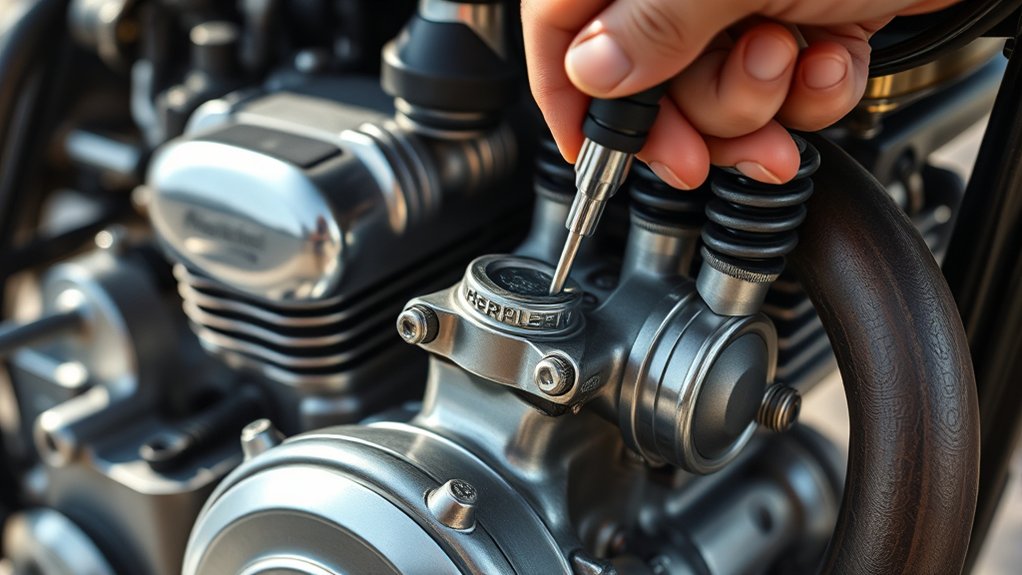
To adjust your carburetor mixture screws, start by locating the “L” (low speed) and “H” (high speed) screws and gathering the necessary tools. Proper adjustment of these carburetor mixture screws is essential for optimal engine performance and fuel efficiency. Warm up your engine to operating temperature before making any changes.
Next, set the screws to the factory default positions by gently seating them and then backing out 1.5 to 2.5 turns. This baseline ensures a stable starting point for fine-tuning.
Adjust the idle screw slowly to achieve a smooth idle. Then, fine-tune the main mixture screw for peak RPM and best engine response. Test the engine’s performance under different conditions and make small adjustments as needed.
Keep your mixture screws clean and inspect them regularly for wear or damage to maintain consistent performance.
With practice and attention to detail, you’ll find more tips to perfect your carburetor and keep your engine running smoothly.
Key Takeaways
- Warm the engine to normal operating temperature before adjusting mixture screws.
- Turn mixture screws clockwise gently until lightly seated, then back out 1.5 to 2.5 turns for baseline settings.
- Adjust idle mixture screw to find the smoothest idle by turning until RPM peaks without faltering.
- Fine-tune main mixture screw by balancing between lean and rich RPM peaks for optimal performance.
- Test engine response under load and make small adjustments to correct hesitation, stalling, or smoke.
Identify Your Carburetor Mixture Screws

Before you can adjust the mixture screws, you need to locate them on your carburetor. Typically, mixture screws are small, slotted screws found on the carburetor’s body, often near the base or side. Depending on your carburetor model, you might find one or two screws—usually labeled as “L” for low-speed and “H” for high-speed mixture adjustments.
They control the air-fuel ratio by regulating fuel flow. Take a close look and identify these screws carefully; they often have springs around them to maintain tension. Avoid confusing them with idle speed screws, which adjust throttle position.
Knowing their exact position helps you make precise adjustments later, so take your time to familiarize yourself with your carburetor’s layout before moving forward.
Gather the Tools for Adjusting Mixture Screws
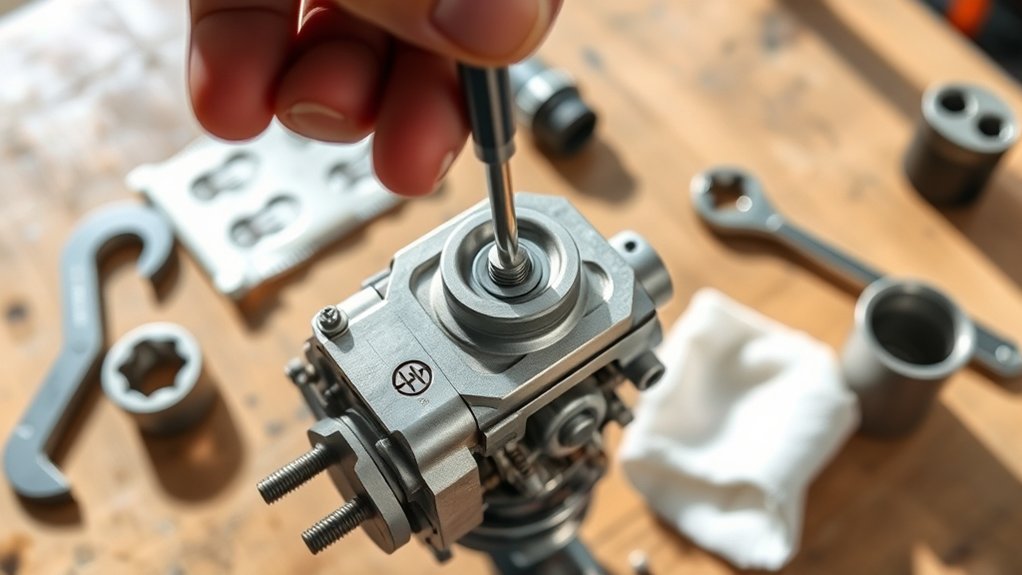
Before you start adjusting, make sure you have the right tools on hand, including precise measuring devices like a tachometer or vacuum gauge. Choosing accurate tools helps you make exact adjustments for better performance.
Also, prepare your workspace by keeping it clean and well-lit to avoid mistakes.
Essential Tools Overview
Although adjusting carburetor mixture screws may seem straightforward, having the right tools on hand makes the process much smoother and more accurate. Before you start, gather these essentials to guarantee you work efficiently and safely:
- Screwdriver or Carburetor Adjustment Tool – Choose the correct size and type to avoid stripping screws.
- Socket Wrench Set – Useful for removing components that block access to the screws.
- Cleaning Supplies – Use carb cleaner and a rag to keep parts free from dirt and grime during adjustment.
- Gloves and Safety Glasses – Protect your hands and eyes from fuel and debris.
With these tools ready, you’ll be set for a precise and hassle-free adjustment session.
Selecting Accurate Measuring Devices
When you adjust carburetor mixture screws, having accurate measuring devices guarantees you get the right air-fuel balance every time. Start by choosing a reliable vacuum gauge or a digital multimeter with a tachometer function to measure engine RPM precisely. A quality screwdriver with the correct tip size is essential to avoid damaging the screws.
You’ll also want a fuel pressure gauge if your adjustment involves fuel delivery checks. Don’t forget a dial or digital tachometer for fine-tuning idle speed in sync with mixture settings. Avoid cheap or worn-out tools, as inaccurate readings can lead to poor engine performance or damage.
Investing in precise instruments guarantees your adjustments are spot-on, saving you time and preventing costly mistakes during the tuning process.
Preparing Workspace Properly
Since precise adjustments require focus and organization, you should prepare your workspace carefully before starting. A clutter-free, well-lit area helps you avoid mistakes and keeps tools within reach.
Begin by gathering the essential items so you won’t interrupt your workflow. Here’s what you need:
- A reliable screwdriver or specialized tool for your carburetor’s mixture screws.
- A tachometer or vacuum gauge to monitor engine response during adjustments.
- Clean rags and a small container to catch fuel drips or debris.
- Safety gear, including gloves and eye protection, to prevent injury.
Setting up in this way guarantees you’re ready for smooth, efficient tuning without unnecessary distractions or hazards.
Warm Up Your Engine Before Adjusting
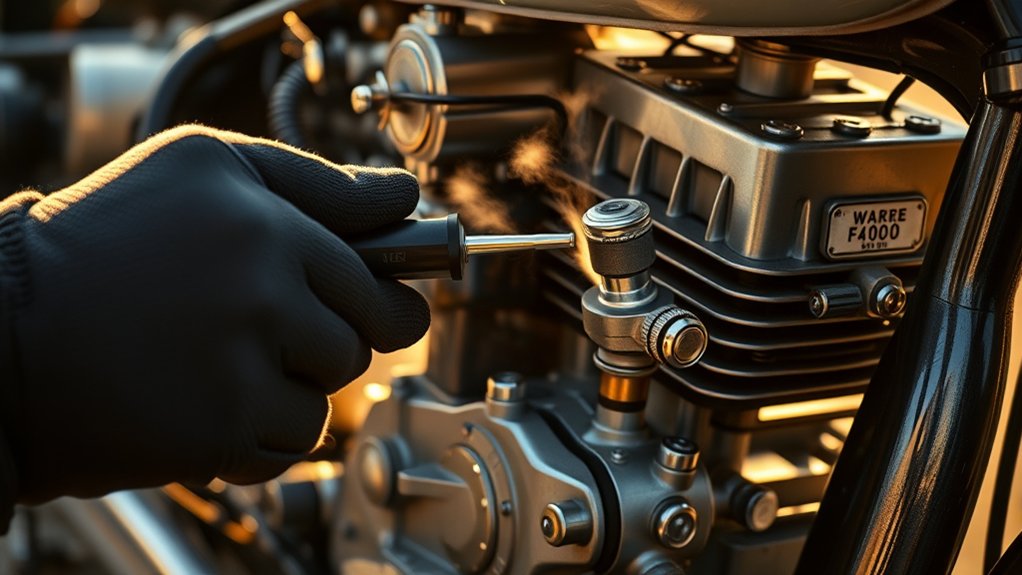
Before you start adjusting the carburetor mixture screws, make sure you warm up your engine properly. A cold engine doesn’t run smoothly, which can lead to inaccurate adjustments. Start your engine and let it idle for about 5 to 10 minutes, allowing it to reach its normal operating temperature.
This guarantees fuel and air flow stabilize, giving you a consistent baseline for your adjustments. Avoid revving the engine during this time, as it can cause fluctuations. If your engine has a temperature gauge, wait until it’s in the normal range.
Warming up also helps the carburetor components expand and function as they will under regular driving conditions, so your mixture screw settings will be more precise and effective.
Set Mixture Screws to Factory Default Positions
Although it might be tempting to start tweaking immediately, you should first set the mixture screws to their factory default positions. This guarantees a consistent baseline before making adjustments.
Before adjusting, always reset mixture screws to factory defaults for a reliable starting point.
Here’s how you do it:
- Locate the mixture screws on your carburetor—usually near the base or side.
- Gently turn each screw clockwise until it lightly seats; don’t force it to avoid damage.
- From the seated position, turn each screw counterclockwise the number of turns specified in your service manual, commonly between 1.5 to 2.5 turns.
- Double-check that both screws are set evenly to maintain balance in the fuel-air mixture.
Starting from these defaults helps you make precise adjustments later without guesswork or risking engine damage.
Adjust the Idle Mixture Screw for a Smooth Idle
When you adjust the idle mixture screw, you control the air-fuel ratio at idle, which directly affects how smoothly your engine runs. Start by warming up your engine so it’s at normal operating temperature.
Then, slowly turn the idle mixture screw clockwise until the engine begins to falter, indicating a lean mixture. Next, turn it counterclockwise until the engine stumbles again, signaling a rich mixture.
Now, find the sweet spot by adjusting the screw to the position where the engine idles fastest and smoothest. Keep the throttle steady during this process and avoid making large adjustments at once.
This fine-tuning helps eliminate rough idling, stalling, and hesitation when your engine is at rest, ensuring better fuel efficiency and engine longevity.
Fine-Tune the Main Mixture Screw to Boost Performance
After you’ve achieved a smooth idle by adjusting the idle mixture screw, you can focus on fine-tuning the main mixture screw to enhance overall engine performance. This screw controls the fuel-air ratio at higher speeds, so precise adjustments are essential. To fine-tune it:
- Warm up the engine fully to guarantee accurate settings.
- Slowly turn the main mixture screw clockwise until the engine RPM begins to drop.
- Then, turn it counterclockwise until you reach the highest stable RPM.
- Set the screw halfway between these two points for the ideal mixture.
This process optimizes fuel efficiency and power output without risking engine damage from running too lean or too rich.
Listen to Engine Sounds to Guide Your Adjustments
Since carburetor adjustments directly affect engine performance, listening carefully to engine sounds can help you identify whether the mixture is too rich or too lean. When you turn the mixture screw, pay attention to changes in the engine’s tone, idle smoothness, and response.
A rich mixture often causes sputtering or bogging, while a lean mixture may produce a high-pitched or popping sound. Use these audio cues to guide your fine-tuning.
| Engine Sound | Likely Mixture Issue | Adjustment Tip |
|---|---|---|
| Sputtering or bogging | Mixture too rich | Turn screw clockwise (leaner) |
| High-pitched or popping | Mixture too lean | Turn screw counterclockwise (richer) |
| Smooth, steady idle | Mixture balanced | Maintain current setting |
Test Your Engine Under Load to Confirm Settings
Although adjusting the carburetor mixture screws at idle gives you a good starting point, you need to test your engine under load to guarantee peak performance. Running your engine while it’s working hard reveals how well the mixture settings hold up in real conditions.
Here’s what you should do:
- Gradually increase throttle and observe engine response to acceleration.
- Listen for hesitation, bogging, or loss of power which signals adjustment needs.
- Monitor exhaust color; a healthy mixture produces a light gray or blueish tint.
- Make small screw adjustments and retest to fine-tune mixture under load.
Troubleshoot Common Issues Like Stalling and Rough Idle
If your engine stalls or idles roughly, you’ll want to pinpoint the exact cause before making adjustments. Start by identifying if the issue stems from an incorrect fuel mixture or another factor.
Then, fine-tune the mixture screws carefully to restore smooth performance.
Identifying Stalling Causes
When your engine stalls or idles roughly, it usually points to an issue with the carburetor’s mixture settings. To identify stalling causes, check these key areas:
- Fuel Mixture Too Lean: If there’s not enough fuel, the engine starves and stalls.
- Fuel Mixture Too Rich: Excess fuel floods the engine, causing it to stall or hesitate.
- Idle Speed Too Low: A low idle speed can make the engine stall when coming to a stop.
- Dirty or Clogged Jets: Blocked jets restrict fuel flow, disrupting the mixture balance.
Diagnosing Rough Idle
Since rough idling often signals carburetor issues, you’ll want to carefully examine the mixture settings and related components. Start by inspecting the mixture screws for dirt or damage, as debris can cause irregular fuel flow. Check the idle speed screw to ensure it’s not set too low, which might cause the engine to stumble.
Also, look for vacuum leaks around the carburetor base or intake manifold, as these can lean out the mixture and lead to rough idle. Inspect the throttle linkage for smooth operation and proper return. Finally, make sure the choke is fully disengaged at warm idle; a partially closed choke can cause hesitation.
Fine-Tuning Mixture Screws
Now that you’ve identified potential causes of a rough idle, it’s time to fine-tune the mixture screws to get your engine running smoothly. Start by turning the screws slowly in small increments.
Here’s how to troubleshoot common issues:
- Stalling: If the engine stalls when you adjust the screws, try leaning the mixture slightly by turning the screws clockwise.
- Rough Idle: Turn the screws counterclockwise slowly until the idle smooths out.
- Hesitation or bogging: Lean the mixture out by turning the screws clockwise to improve throttle response.
- Excessive smoke or fouled plugs: Richen the mixture by turning screws counterclockwise cautiously.
Adjust in small steps, listening carefully, and you’ll achieve a balanced idle without stalling or roughness.
Maintain Your Mixture Screws for Long-Term Performance
To keep your carburetor mixture screws functioning properly over time, you’ll need to perform regular maintenance that prevents buildup and wear. Begin by cleaning the screws and surrounding areas with a carburetor cleaner to remove dirt, varnish, and fuel residue.
Periodically remove the screws to inspect them for damage or corrosion, replacing them if necessary. Apply a light coating of anti-seize lubricant to the screws before reinstalling to guarantee smooth adjustments and prevent seizing.
Additionally, check the screw springs and seats for wear, as these affect the seal and mixture accuracy. Regularly maintaining your mixture screws not only extends their lifespan but also keeps your engine running efficiently and smoothly, reducing the need for costly repairs down the line.
Frequently Asked Questions
Can Adjusting Mixture Screws Improve Fuel Efficiency?
Yes, adjusting mixture screws can improve fuel efficiency by optimizing the air-fuel ratio. You’ll get cleaner combustion, better throttle response, and reduced fuel consumption when you fine-tune the mixture properly for your engine’s needs.
How Often Should Carburetor Mixture Screws Be Adjusted?
You’ll want to refresh your carburetor mixture screws about once a year or whenever your engine feels a bit out of tune. Regular check-ups keep your ride smooth and happy, avoiding surprises on the road.
Are There Risks to Adjusting Mixture Screws Incorrectly?
Yes, you risk damaging your engine or causing poor performance if you adjust the mixture screws incorrectly. You could make the engine run too rich or too lean, leading to overheating, fouled spark plugs, or increased emissions.
Can Mixture Screw Adjustments Affect Emissions?
If you lean the mixture too much, your car’s emissions spike with harmful pollutants.
You’ll increase carbon monoxide output, which harms the environment and can cause your vehicle to fail emission tests.
Do All Carburetors Have the Same Type of Mixture Screws?
No, not all carburetors have the same type of mixture screws. You’ll find different designs and placements depending on the carburetor model, so it’s important to check your specific carburetor’s manual before adjusting anything.
Conclusion
Adjusting your carburetor mixture screws is like tuning a musical instrument—the right harmony makes your engine sing smoothly. By carefully listening, tweaking, and testing, you guarantee every note runs just right. Remember, patience and attention keep your engine’s performance in perfect rhythm.
Treat your carburetor like a trusted bandmate, and together you’ll enjoy a ride that’s both powerful and reliable, mile after mile. Keep tuning, and keep riding strong! Proper adjustment of carburetor mixture screws ensures optimal engine efficiency, better fuel economy, and a smoother ride every time.

