

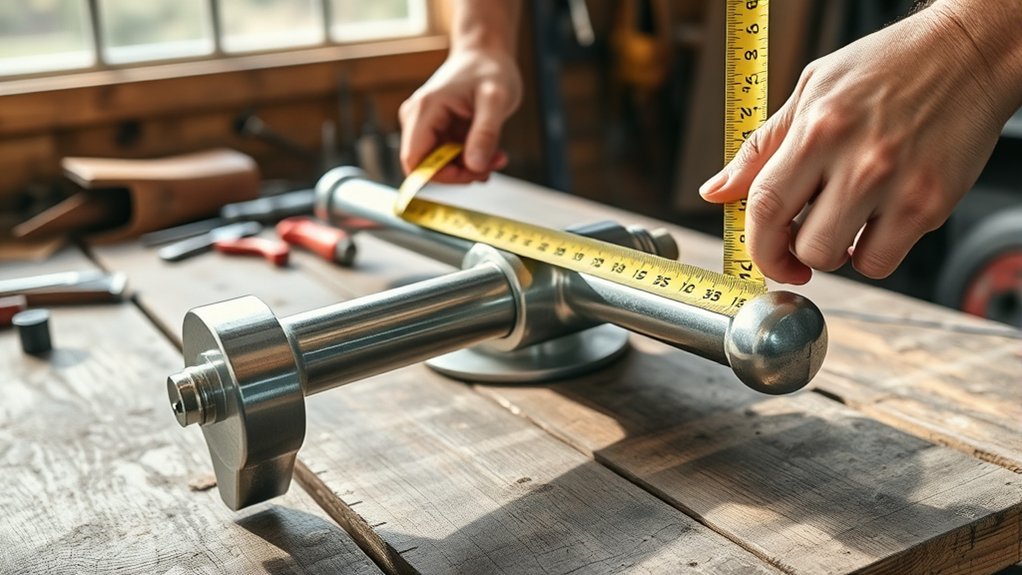
To measure your trailer axle in 7 easy steps, start by gathering essential tools like a tape measure, caliper, and safety gear.
Accurately measuring your trailer axle is crucial for ensuring proper fit, compatibility, and safety during use. Understanding the key measurements helps in selecting the right replacement parts or upgrades for your trailer.
Identify your axle type first, as it influences the measurements you need to take and the compatibility with your trailer.
Measure the axle length between hubs carefully, then proceed to measure the spring center distance.
Next, check the hub face width and use a caliper to find the axle diameter, which is important for determining load rating.
Finally, count the lug nuts and measure the bolt circle diameter to confirm the bolt pattern.
Keep going to verify your axle fits perfectly and stays safe during operation.
Key Takeaways
- Measure the axle length between the centers of the hub mounting surfaces, keeping the tape measure taut and level for accuracy.
- Use a caliper to measure the axle diameter near the center, avoiding thinner ends for correct load capacity assessment.
- Measure the spring center-to-center distance by locating and aligning the spring bolts or pins.
- Count lug nuts and measure the bolt circle diameter (BCD) between opposite lug centers to confirm the bolt pattern.
- Verify all measurements against manufacturer specifications to ensure axle, hub, and load rating compatibility before installation.
Gather Tools for Accurate Trailer Axle Measurement
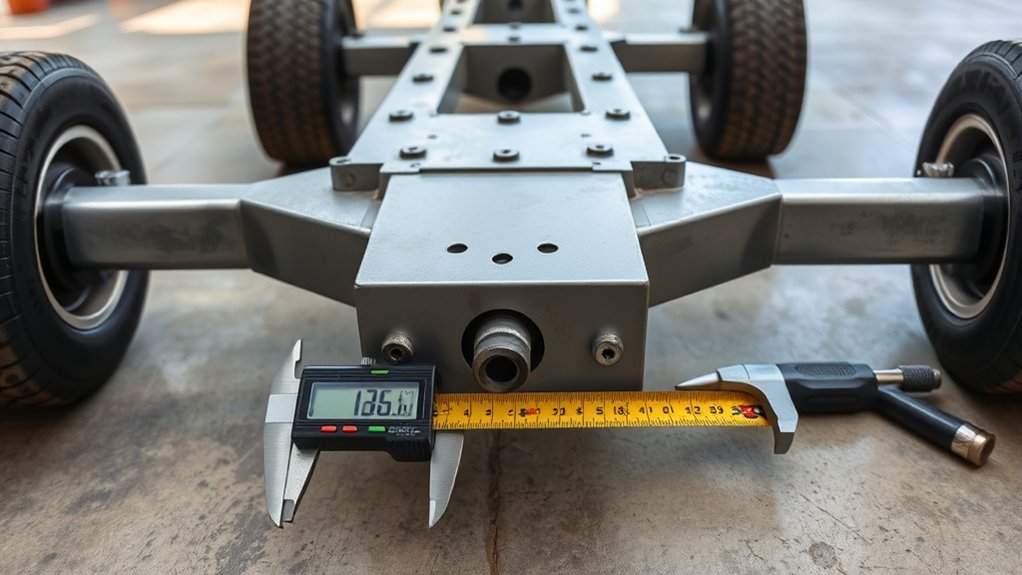
Before you begin measuring your trailer axle, make sure you have the right tools on hand. You’ll need a tape measure for precise length measurements and a caliper to check the diameter of the axle shaft. A marker or chalk can help you mark key points on the axle for reference.
Carry a notepad or use your phone to jot down measurements as you go, avoiding any confusion later. Don’t forget safety gear like gloves and eye protection; working under a trailer can expose you to dirt and rust. Having these tools ready guarantees your measurements are accurate and the process goes smoothly, saving you time and preventing costly mistakes when ordering or replacing your trailer axle.
Identify Your Trailer Axle Type and Why It Matters
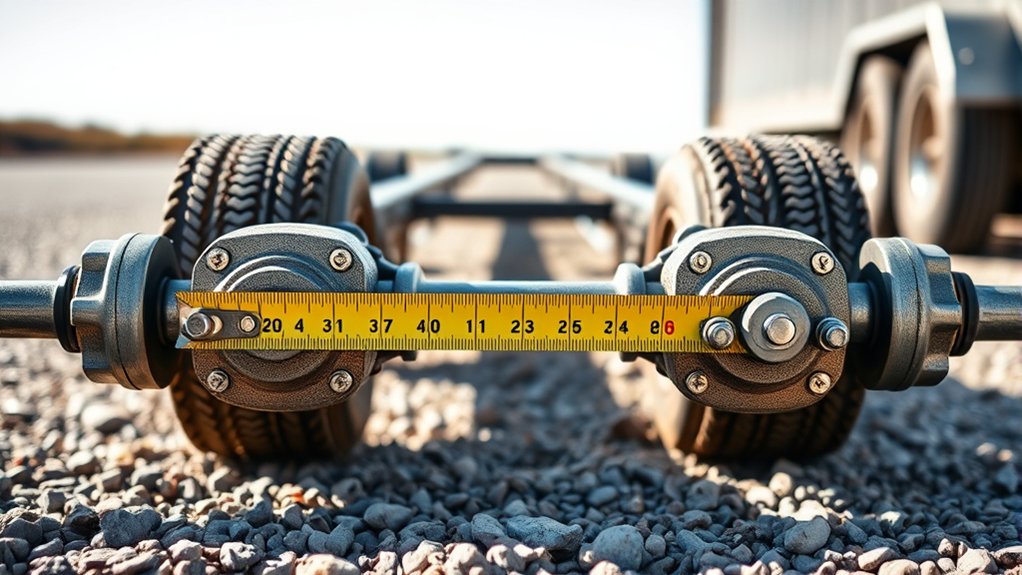
Once you have your tools ready and measurements noted, the next step is figuring out what type of axle your trailer uses. Knowing the axle type matters because it affects load capacity, maintenance, and compatibility with replacement parts.
Identifying your trailer’s axle type is key for proper maintenance, load handling, and choosing compatible parts.
Here are four common trailer axle types you might encounter:
- Spring Axle – Uses leaf springs for suspension; standard on many trailers.
- Torsion Axle – Features rubber cords inside for a smooth ride and less maintenance.
- Straight Axle – A solid beam connecting both wheels, offering durability and stability.
- Independent Suspension Axle – Allows each wheel to move independently, providing better handling on rough terrain.
Identifying your axle type helps you choose the right maintenance approach and guarantees accurate measurements later.
Measure Trailer Axle Length Between Hubs
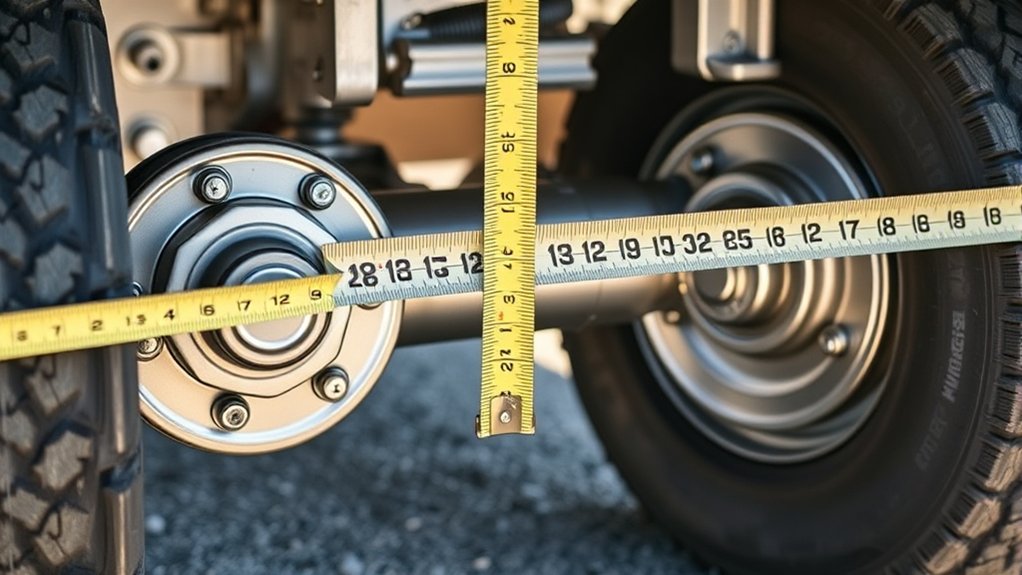
Although measuring the trailer axle length might seem straightforward, getting it right guarantees proper fit and function. To measure the axle length between hubs, start by positioning your tape measure at the center of one hub’s mounting surface. Stretch the tape straight across to the center of the opposite hub’s mounting surface.
This measurement is critical because it reflects the true axle length your trailer requires. Avoid measuring the entire axle tube or including the hub widths, as that will give you an inaccurate length. Make sure the tape is taut and level for an exact reading.
Recording this length helps verify you order or replace the correct axle, preventing alignment issues and uneven tire wear down the line.
Measure Spring Center Distance on Your Trailer Axle
First, find the trailer springs attached to your axle. Then, measure the distance from the center of one spring to the center of the other.
Make sure you use a reliable measuring tool to get an accurate reading.
Locate Trailer Springs
To accurately measure your trailer axle, start by locating the trailer springs and identifying the spring center distance. Trailer springs are usually mounted on the axle, and their placement is key to finding the right points for measurement.
Here’s how to locate them effectively:
- Look under your trailer to spot the leaf springs attached to the axle.
- Identify the spring hangers, which secure the springs to the trailer frame.
- Find the center bolts or pins on each spring, as these mark the spring centers.
- Confirm the springs are properly aligned and not damaged before measuring.
Measure Center To Center
Measuring the spring center distance involves finding the exact space between the center bolts of the trailer springs on your axle. To do this, locate the bolts that secure the springs to the axle and measure straight from the center of one bolt to the center of the other.
This measurement is crucial for ensuring proper fit and alignment when replacing or servicing your trailer axle.
| Step | Detail |
|---|---|
| 1. Locate Bolts | Identify center bolts on springs |
| 2. Position Tape | Place tape measure at bolt center |
| 3. Measure Distance | Stretch tape to opposite bolt |
| 4. Record Measurement | Note exact center-to-center length |
| 5. Double Check | Confirm accuracy before proceeding |
Use Accurate Measuring Tools
Since accurate measurements are key to a proper fit, you’ll want to use reliable tools when measuring the spring center distance on your trailer axle. Using the right equipment guarantees your measurements are precise, avoiding costly mistakes when replacing or repairing parts.
Here’s what you’ll need:
- A high-quality tape measure or ruler marked in inches or millimeters
- A caliper for measuring smaller components accurately
- A level surface to place your trailer axle for consistent readings
- A marker to note measurement points clearly
Start by positioning your tools correctly and double-check your measurements. Taking your time with these tools helps you get an exact spring center distance, ensuring your trailer performs safely and smoothly.
Measure Hub Face Width for a Proper Fit
To get the right fit, you need to measure the hub face width accurately. This measurement is the distance between the outer edge of the hub and the mounting surface, and it guarantees your wheels align properly.
Grab a caliper or tape measure to take this critical measurement.
What Is Hub Face Width
When you’re fitting a new axle, knowing the hub face width guarantees everything aligns correctly between the hub and the wheel. Hub face width is the distance from the mounting surface on one side of the hub to the mounting surface on the other side. It guarantees the wheel sits properly without wobbling or rubbing.
To measure hub face width, follow these steps:
- Remove the wheel and brake components if necessary.
- Use a caliper or tape measure to find the distance between the hub’s outer mounting surfaces.
- Double-check for any debris or damage that might affect accuracy.
- Compare your measurement to the wheel specifications to verify compatibility.
This measurement is essential for a safe, smooth ride.
Why Measure Hub Face
Why does measuring the hub face width matter so much? Because it guarantees your trailer’s wheels fit perfectly on the axle, preventing issues like misalignment or uneven wear. If the hub face width is off, you risk damaging the bearings or even compromising safety on the road.
By measuring this width accurately, you guarantee the hub centers properly, which keeps the trailer stable and extends component life.
Here’s why the hub face width is critical:
| Aspect | Correct Measurement | Consequence of Error |
|---|---|---|
| Wheel Fit | Proper hub face match | Wheel wobble or looseness |
| Bearing Load | Even distribution | Premature bearing failure |
| Alignment | Accurate positioning | Tire wear and steering issues |
| Safety | Secure attachment | Risk of accidents or breakdown |
Tools For Measuring Hub
How do you guarantee your measurements are spot on? Using the right tools is key when measuring the hub face width for a proper fit. Without accurate tools, you risk buying an axle that doesn’t match your trailer’s requirements.
To measure the hub face width precisely, you’ll need:
- Tape Measure – For quick overall length checks.
- Caliper – Offers precise width measurements down to the millimeter.
- Straight Edge – Helps ensure your measurements are level and true.
- Feeler Gauge – Useful for checking any gaps between components.
Measure Axle Diameter and Determine Load Rating
Measuring your trailer axle diameter accurately is essential for determining its load rating and ensuring safety. First, locate the thickest part of the axle shaft, usually near the center. Use a caliper or a micrometer to measure the diameter precisely in inches or millimeters.
Avoid measuring at the ends, as they’re often thinner. Once you have the diameter, refer to manufacturer charts or online resources that correlate axle diameter with load capacity. This info helps you confirm your axle can handle the weight you intend to carry.
Knowing the load rating prevents overloading, reducing the risk of axle failure. Accurate measurement and load rating checks keep your trailer safe and roadworthy.
Check Trailer Axle Bolt Pattern and Hub Specifications
Once you’ve determined your axle’s diameter and load rating, the next step is to verify the bolt pattern and hub specifications. This ensures your new axle matches your trailer’s current setup for safe and smooth operation. Here’s how to proceed:
Confirming your axle’s bolt pattern and hub specs ensures compatibility and safe trailer performance.
- Count the number of lug nuts on the hub; common patterns include 4, 5, or 6 bolts.
- Measure the bolt circle diameter (BCD) by determining the distance between the centers of two opposite bolts.
- Note the hub’s type—whether it’s drum or disc brake compatible.
- Check the hub face and center-to-face dimensions to confirm proper fitment.
Frequently Asked Questions
How Often Should Trailer Axles Be Inspected for Safety?
You should inspect your trailer axles at least once a year and before long trips. Regular checks help catch wear or damage early, ensuring your safety and preventing costly repairs down the road.
Don’t skip it!
What Maintenance Is Required to Extend Trailer Axle Life?
You should regularly grease the bearings, check for worn or damaged parts, inspect seals, and guarantee proper alignment.
Also, avoid overloading and keep the axle clean to extend your trailer axle’s life effectively.
Can Trailer Axle Measurements Affect Towing Stability?
Absolutely—if your trailer axle measurements are off, your towing stability could feel like a rollercoaster ride! You’ll want precise measurements to keep your trailer steady, safe, and smooth on every trip.
Don’t risk it!
What Signs Indicate a Trailer Axle Needs Replacement?
You’ll know your trailer axle needs replacing if you notice excessive wobbling, unusual noises, uneven tire wear, or visible cracks and rust.
Also, if your trailer drifts while towing, don’t ignore these warning signs.
Are There Weight Limits for Different Trailer Axle Types?
Think of trailer axles like strong branches—each supports a certain weight.
Yes, you’ll find weight limits vary by axle type, so you’ve got to match your load to avoid overburdening and guarantee safe, smooth travels.
Conclusion
Now that you know how to measure your trailer axle in 7 easy steps, you’re ready to guarantee a perfect fit and safe towing.
Did you know that nearly 60% of trailer failures happen due to improper axle maintenance or fit? Taking the time to measure accurately not only saves you money but also keeps your trailer safe on the road.
So grab your tools, follow these steps, and tow with confidence every time! Accurate trailer axle measurement is key to ensuring durability and safety for your towing needs.

