

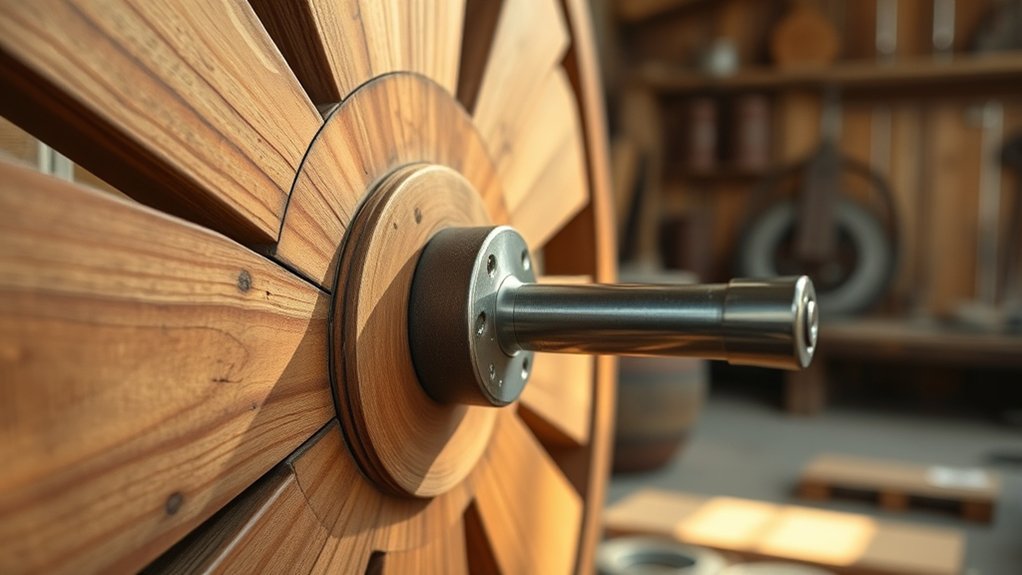
You increase force with a wheel and axle by turning the larger wheel, which multiplies your input effort through mechanical advantage. This simple machine uses the relationship between the wheel and axle sizes to generate greater leverage.
The bigger the wheel compared to the axle, the more torque you create, making it easier to move or lift loads.
This setup reduces friction and spreads out your force over a longer distance, so you exert less effort overall.
Understanding how sizes and torque work together reveals even more ways to use this simple machine efficiently.
By mastering these principles, you can apply the wheel and axle to a variety of tasks requiring increased force.
Key Takeaways
- A larger wheel radius compared to the axle increases mechanical advantage, allowing more force output with less effort.
- Turning the wheel applies force over a longer distance, amplifying the input force on the smaller axle.
- The wheel acts like a lever, multiplying torque that transfers effort efficiently to the load.
- Mechanical advantage is calculated by dividing the wheel’s radius by the axle’s radius, showing force multiplication.
- Reducing friction and maintaining smooth rotation helps maximize the force increase provided by the wheel and axle.
What Is a Wheel and Axle and How Does It Work
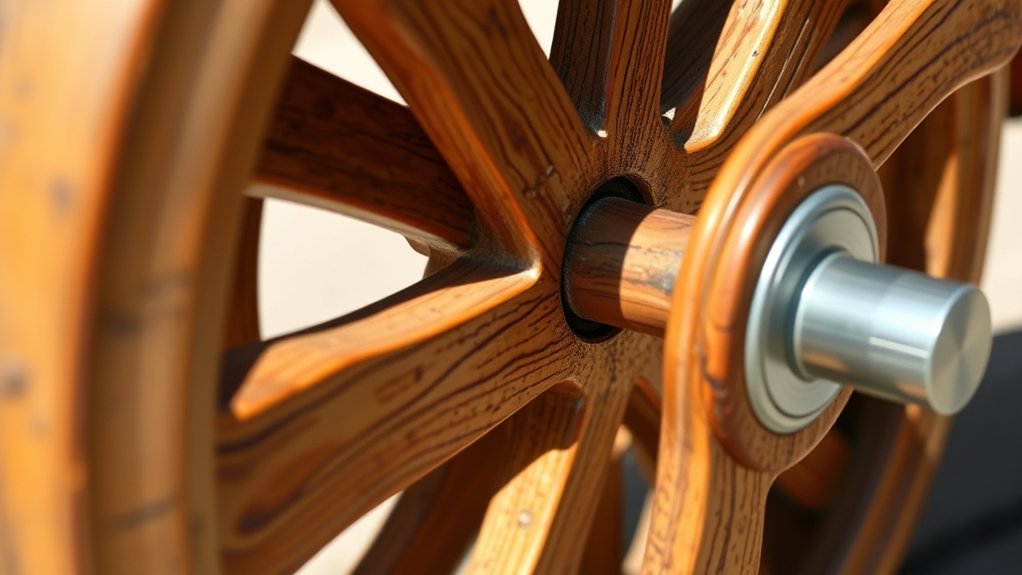
How exactly does a wheel and axle work to make tasks easier? You’ll find it’s a simple machine consisting of a larger wheel attached to a smaller axle. When you turn the wheel, it causes the axle to rotate as well.
This connection allows you to move or lift objects with less effort than if you tried to push or pull them directly. The wheel provides a larger surface to grip and apply force, while the axle transmits that force to the load. When you rotate the wheel, the axle spins, transferring your input force efficiently.
This mechanism reduces friction and makes it easier for you to move heavy or resistant objects, simplifying everyday tasks like opening doors or rolling carts.
How the Wheel and Axle Create Mechanical Advantage
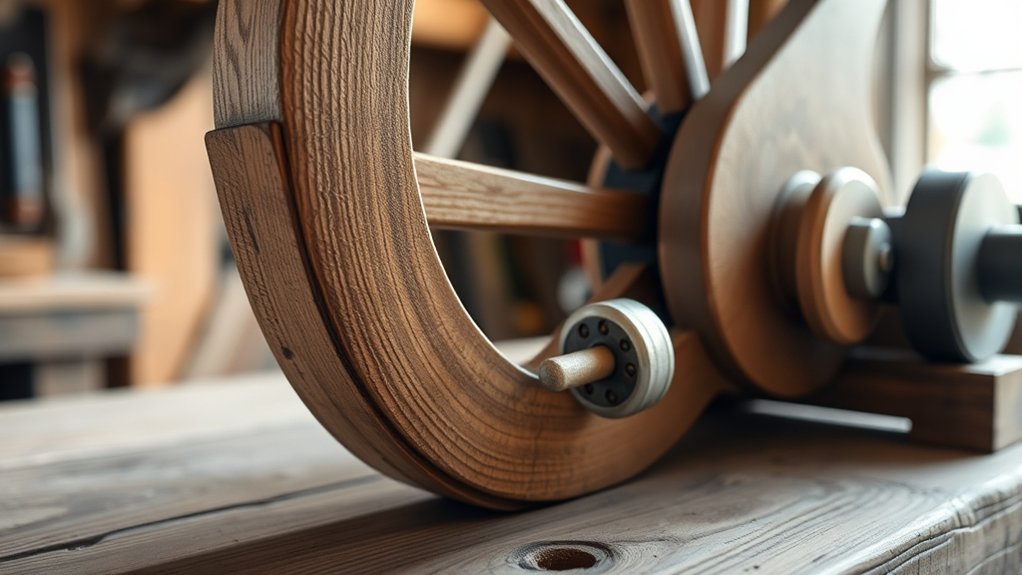
Why does turning a large wheel make lifting heavy objects feel easier? When you turn the wheel, you apply force over a greater distance compared to the axle. This difference means you don’t need to push as hard to move the load attached to the axle.
The wheel and axle system creates mechanical advantage by allowing you to trade distance for force. Basically, the larger the wheel you turn, the more force you multiply on the axle, making heavy lifting manageable. This advantage happens because the wheel’s circumference lets you apply input force over a longer path, while the axle moves a shorter distance but with increased force.
That’s how the wheel and axle help you lift or move heavy objects more efficiently.
Why Wheel and Axle Size Difference Affects Force Output
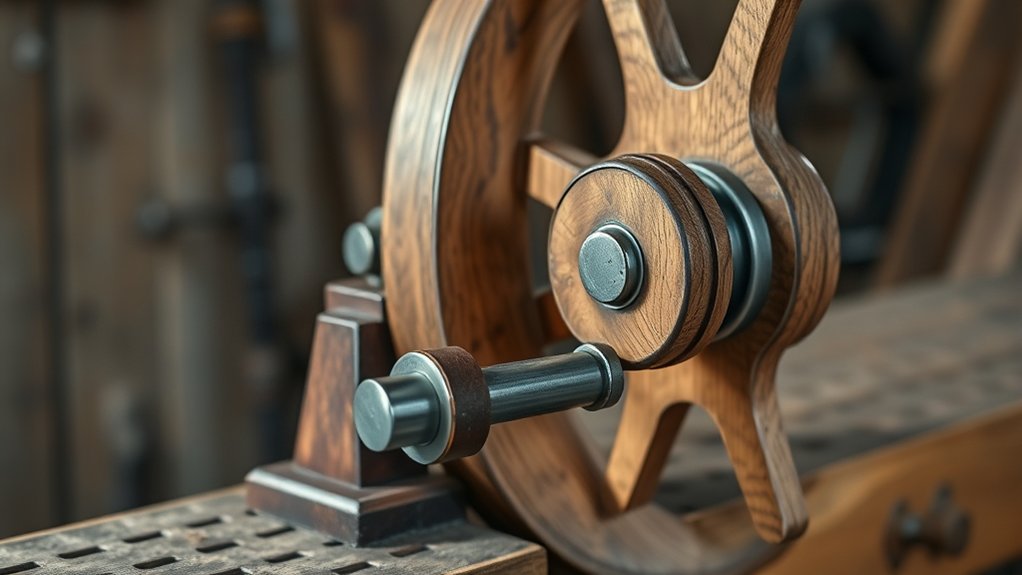
When you increase the size difference between the wheel and axle, you boost the force output considerably. The larger the wheel compared to the axle, the more leverage you gain. This means you can apply less effort to move a heavier load.
Think of it like using a longer lever arm; the bigger the wheel, the greater the distance your force travels, which translates to a stronger push or pull at the axle. Conversely, if the wheel and axle sizes are similar, the force advantage lessens, requiring more effort.
How Force Is Multiplied by the Wheel and Axle
You’ll see that the wheel and axle multiply force through mechanical advantage, letting you apply less effort to move heavier loads. This happens because the larger wheel creates more torque compared to the smaller axle.
Understanding how torque and force work together helps you grasp why the wheel and axle system is so effective.
Mechanical Advantage Explained
Although the wheel and axle may seem simple, they considerably multiply the force you apply. When you turn the larger wheel, it rotates the smaller axle connected to it. This setup allows you to use less effort to move or lift heavy objects.
The key concept here is mechanical advantage—the ratio of the wheel’s radius to the axle’s radius. If the wheel is bigger, you gain more mechanical advantage, meaning your input force gets amplified. So, a small push on the wheel translates into a stronger force on the axle, making tasks easier.
Understanding this helps you see why wheels and axles have been essential in tools and machines, saving energy and increasing efficiency in everyday work.
Torque and Force Relationship
How exactly does the wheel and axle multiply force? It’s all about torque, which you get by multiplying force by the distance from the pivot point. When you apply force to the wheel’s edge, you create more torque because the wheel’s radius is larger than the axle’s.
This difference means the wheel turns the axle with greater force but less distance moved. Essentially, the wheel’s larger radius amplifies your input force, making it easier to move or lift loads attached to the axle. So, by turning the wheel, you exert less effort while generating more torque at the axle, effectively multiplying your force.
This torque relationship is why wheel and axle systems are so useful in tools and machines.
What Role Does Torque Play in Wheel and Axle Force?
Since torque measures the twisting force applied to the wheel and axle, it directly affects how much force you can generate. When you turn the wheel, you apply torque, which then transfers to the axle. The larger the wheel’s radius compared to the axle’s, the greater the torque advantage you gain.
This means you can exert a smaller force on the wheel to produce a larger force on the axle. Fundamentally, torque acts as the bridge that converts your input force into a stronger output force, making tasks like lifting or moving heavy objects easier. Understanding torque helps you see why the wheel and axle work as a simple machine that amplifies your effort efficiently.
How Friction Affects Wheel and Axle Efficiency
When you use a wheel and axle, friction plays a crucial role in determining how efficiently the system works. Friction occurs between the surfaces in contact, such as the axle and its bearings, and it resists motion. While some friction is necessary to prevent slipping, too much friction wastes energy and reduces the force output.
You can improve efficiency by lubricating the axle or using smoother materials to minimize friction. Also, proper alignment and maintenance help keep friction low. If friction is too high, you’ll need to apply more input force to achieve the same output, defeating the purpose of the wheel and axle.
Understanding and managing friction ensures you get the most mechanical advantage and smooth operation from your wheel and axle system.
Real-Life Examples of Wheel and Axle Increasing Force
Minimizing friction in a wheel and axle system helps you get the most force with less effort. Think about a car’s steering wheel—you turn it easily, but the axle translates that small force into a larger one that moves the wheels. When you use a doorknob, the wheel and axle let you open heavy doors smoothly, increasing your force without extra strain.
Bicycles also rely on this principle; the pedals turn the axle connected to the wheels, amplifying your pedaling force to propel the bike forward. Even windmills use large wheels attached to axles to capture wind energy and increase force for grinding grain or generating electricity. These examples show how wheel and axle systems boost your force daily.
How Materials Affect Wheel and Axle Efficiency and Durability
The materials you choose for a wheel and axle directly impact how efficiently it transfers force and how long it lasts. You want materials that reduce friction and resist wear while maintaining strength. Here’s what to contemplate:
- Metal alloys – Offer high strength and durability but can add weight.
- Plastics – Lightweight and corrosion-resistant but may wear faster under heavy loads.
- Rubber coatings – Improve grip and reduce slipping, enhancing efficiency.
- Composites – Combine strength and lightness, often increasing lifespan and performance.
Choosing the right material balances efficiency and durability, ensuring your wheel and axle perform at its best for the task at hand without frequent replacements or energy loss.
How to Optimize Wheel and Axle Designs for More Force
Although optimizing a wheel and axle design requires careful consideration, you can substantially increase the force it generates by adjusting key factors like the wheel’s diameter, axle size, and the connection between them. Start by increasing the wheel’s diameter relative to the axle; a larger wheel gives you more leverage, boosting the force output.
Next, choose an axle diameter that balances strength and ease of rotation—too thick, and it adds friction; too thin, and it might deform. Also, assure the wheel and axle are securely connected to prevent slipping, which wastes force.
Finally, minimize friction by using proper bearings or lubrication. By focusing on these elements, you’ll make your wheel and axle system more efficient and capable of producing greater force.
Common Misconceptions About Wheel and Axle Force
When you think about how a wheel and axle work, you might assume they always multiply force in the same way, but that’s not quite true. There are common misconceptions that can cloud your understanding:
- Bigger wheels always mean more force — not necessarily; it depends on the axle size too.
- The wheel and axle only reduce effort — sometimes they just change the direction of the force.
- Force multiplication is constant — it varies based on wheel and axle radii.
- Friction is negligible — in reality, it affects how much force you actually get.
Knowing these helps you use wheel and axle systems more effectively and avoid expecting unrealistic outcomes.
How the Wheel and Axle Compare to Other Simple Machines
You’ll notice the wheel and axle offer a unique mechanical advantage compared to other simple machines like levers or pulleys. It’s important to understand how their efficiency stacks up in different tasks.
Let’s explore how this simple machine holds its own in both force and energy use.
Mechanical Advantage Comparison
How does the wheel and axle compare to other simple machines in regard to mechanical advantage? When you look closely, the wheel and axle can amplify force efficiently, but it’s important to see how it stacks up against others.
- Lever: Offers variable mechanical advantage depending on arm length, often higher than a wheel and axle.
- Pulley: Can multiply force considerably by combining multiple pulleys, surpassing the wheel and axle’s simpler design.
- Inclined Plane: Reduces effort by increasing distance, but doesn’t multiply force as directly as the wheel and axle.
- Wheel and Axle: Provides consistent mechanical advantage by converting rotational force, ideal for reducing friction and moving loads smoothly.
You’ll find the wheel and axle excels in applications needing smooth, continuous force with moderate advantage.
Efficiency Versus Other Machines
Although many simple machines offer mechanical advantages, the wheel and axle often deliver superior efficiency by minimizing friction and maintaining smooth motion. When you compare it to levers or pulleys, the wheel and axle reduces energy loss, letting you apply force more effectively. Unlike inclined planes, which require constant effort over distance, the wheel and axle converts force with less resistance.
You’ll notice that gears, which are variations of the wheel and axle, maintain this efficiency even under heavier loads. While some machines might multiply force more, they often sacrifice efficiency due to added friction or complexity. By choosing a wheel and axle, you get a reliable balance between force increase and energy conservation, making your tasks easier without wasting effort.
Calculating Mechanical Advantage of a Wheel and Axle
When you want to understand the mechanical advantage of a wheel and axle, you need to focus on the relationship between the sizes of the two parts. The mechanical advantage (MA) tells you how much the wheel and axle multiply your input force.
To calculate it, follow these steps:
To find mechanical advantage, simply measure the wheel and axle radii, then divide the wheel radius by the axle radius.
- Measure the radius of the wheel (R_wheel).
- Measure the radius of the axle (R_axle).
- Use the formula: MA = R_wheel ÷ R_axle.
- Interpret the result: a larger MA means less effort is needed to move a load.
How Knowing About Wheel and Axle Makes Daily Tasks Easier
Understanding the wheel and axle helps you tackle everyday tasks more efficiently by reducing the effort needed to move objects. When you use tools like doorknobs, rolling carts, or screwdrivers, you’re applying the wheel and axle principle to make work easier. Knowing how it works lets you choose the right tool for the job and use it correctly, saving time and energy.
For example, when you push a shopping cart, the wheels reduce friction, making it easier to move heavy items. Even riding a bike relies on this concept to amplify your pedaling force. By understanding this simple machine, you can approach tasks smarter, avoid strain, and complete chores faster without unnecessary effort.
Frequently Asked Questions
Who Invented the Wheel and Axle Mechanism?
You can’t credit a single person with inventing the wheel and axle; it was developed by ancient civilizations thousands of years ago. Early Mesopotamians likely created it to make transportation and work easier for everyone.
How Has the Wheel and Axle Evolved Historically?
You’ve come a long way since the wheel’s early days, evolving from simple wooden discs to sophisticated, lightweight alloys. It’s like turning over a new leaf, constantly improving efficiency and durability for modern machines.
The transformation highlights human ingenuity in adapting basic tools to meet complex needs. Each advancement reflects a step forward in technology and design. This evolution continues to drive progress in transportation and industry.
What Are the Environmental Impacts of Wheel Production?
You’ll find wheel production impacts the environment through resource extraction, energy use, and waste generation. Manufacturing and transporting wheels release emissions, and improper disposal can pollute.
Choosing sustainable materials and recycling helps reduce these effects.
Can Wheel and Axle Systems Be Automated?
You can absolutely automate wheel and axle systems today; think of adding a steam-powered motor to a vintage carriage. Modern sensors and robotics let you control speed and torque precisely, boosting efficiency in all your machinery tasks.
What Safety Precautions Are Needed When Using Wheels and Axles?
You should always wear gloves and goggles to protect yourself from debris. Keep the wheel and axle clean and well-lubricated, check for damage regularly, and never overload the system beyond its weight limit to stay safe.
Conclusion
So, next time you’re struggling to open a stubborn jar or move heavy furniture, just remember: the wheel and axle are secretly flexing their mechanical muscles behind the scenes. They’re not just ancient relics; they’re your silent force multipliers. Who knew that spinning a circle could make you feel like a superhero?
Embrace the genius of this simple machine—it’s the original life hack that turns your lazy effort into pure power! The wheel and axle increase force by allowing you to apply less effort over a greater distance, making tough tasks easier. This clever use of mechanical advantage shows how simple machines can amplify your strength in everyday life.

