

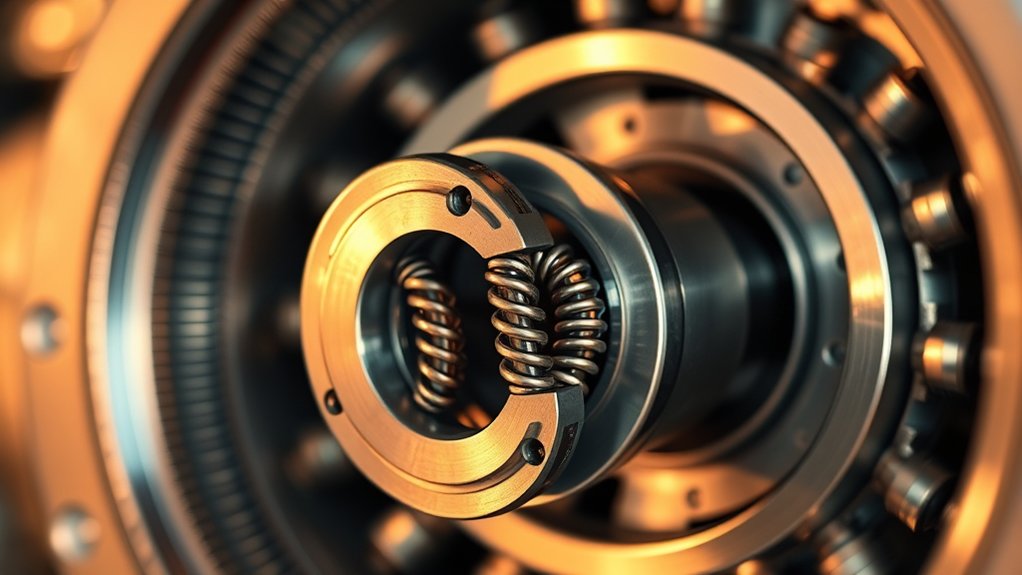
A centrifugal clutch is a key component in many engines, designed to automatically engage and disengage power based on your engine’s speed. It uses the principles of centrifugal force to control the connection between the engine and the drivetrain, ensuring smooth operation. This type of clutch helps prevent stalling and reduces wear by transmitting torque only when needed.
When your engine revs low, springs keep the clutch shoes from touching the drum, so no power transfers. As speed increases, centrifugal force pushes the shoes outward, pressing them against the drum to smoothly transmit torque.
This mechanism protects your drivetrain from shocks and ensures efficient power delivery.
If you’re curious about its parts, benefits, or maintenance, there’s more to discover. Understanding how a centrifugal clutch works can help you optimize your engine’s performance and longevity.
Key Takeaways
- A centrifugal clutch engages automatically as engine speed increases, using centrifugal force to connect power transmission smoothly. Clutch shoes move outward at higher RPMs, pressing against the drum to transfer torque through friction. Springs retract the shoes at low speeds, disengaging the clutch to prevent unintended movement and engine load.
- Engagement begins gradually between 1000-3000 RPM, ensuring seamless power transfer without shock or mechanical stress. Disengagement occurs below 1000 RPM, allowing the engine to idle without load and preventing stalling or drivetrain damage.
What Is a Centrifugal Clutch and Why It’s Used
Although you might not notice it, a centrifugal clutch plays a crucial role in many machines by automatically engaging and disengaging power based on engine speed. You’ll find these clutches in go-karts, chainsaws, and small motorcycles, where they simplify operation. When you start the engine and it’s idling, the clutch stays disengaged, so the machine doesn’t move.
As you increase engine speed, the clutch engages, transferring power smoothly. This design protects the engine and drivetrain from sudden shocks and wear. You don’t need to manually operate the clutch, making it easier to control the machine.
In short, a centrifugal clutch helps you manage power delivery efficiently, improving both safety and convenience.
How Centrifugal Force Controls Clutch Engagement
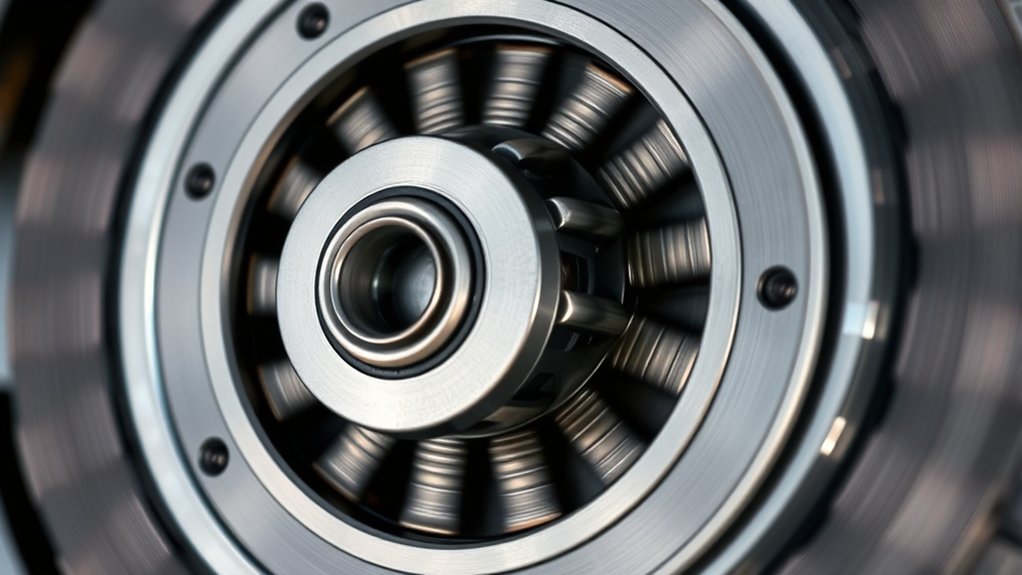
When the engine speed increases, centrifugal force pushes the clutch shoes outward against the drum, causing them to engage. You’ll notice that as the rotational speed grows, this outward force intensifies, pressing the shoes firmly. This contact transfers torque from the engine to the drivetrain, allowing motion.
Conversely, at low speeds, the force is too weak to engage the shoes, so the clutch stays disengaged, preventing power transfer.
| Engine Speed (RPM) | Clutch Action |
|---|---|
| Low (<1000) | Shoes retract, no engagement |
| Medium (1000-3000) | Shoes begin to engage gradually |
| High (>3000) | Shoes fully engage, maximum torque transfer |
Understanding this force-controlled engagement helps you see how the clutch automatically modulates power without manual input.
Key Components Inside a Centrifugal Clutch
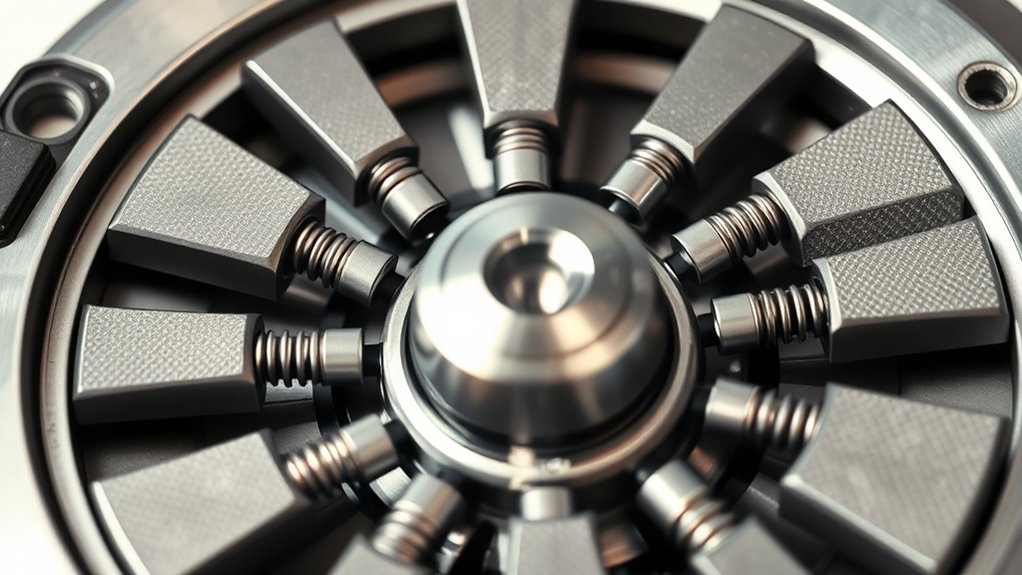
Because the clutch’s operation depends on precise movement, understanding its key components is vital for grasping how it functions. Inside the centrifugal clutch, you’ll find the clutch shoes, springs, and the drum. The clutch shoes are curved friction pads that move outward under centrifugal force.
Springs hold these shoes inward when the engine runs at low speed, preventing contact with the drum. The drum surrounds the shoes and connects to the output shaft, transferring power when the shoes engage. Additionally, the clutch hub anchors the shoes and springs to the engine shaft, allowing rotation.
Each part plays an essential role, working together to guarantee smooth power transfer without slipping or sudden engagement. Knowing these components helps you appreciate the clutch’s mechanical simplicity and effectiveness.
How a Centrifugal Clutch Engages and Disengages
The key components inside a centrifugal clutch work together to control how it engages and disengages. When the clutch’s drum spins slowly, the clutch shoes stay retracted, preventing contact with the drum, so the engine remains disconnected from the load.
As speed increases, centrifugal force pushes the clutch shoes outward, making them contact the inner surface of the drum. This contact creates friction, which transmits power from the engine to the driven shaft. When the speed drops, the springs pull the shoes back, breaking the contact and disengaging the clutch.
This automatic process lets you smoothly transfer power without manually operating a clutch lever, making it ideal for applications needing simple, reliable engagement and disengagement based on rotational speed.
How Engine Speed Controls Centrifugal Clutch Engagement
As engine speed rises, it directly influences how the centrifugal clutch engages by increasing the centrifugal force acting on the clutch shoes. When the engine runs slow, the shoes stay retracted, preventing contact with the drum. But as speed builds, the force pushes the shoes outward until they touch the drum’s inner surface.
This contact causes the clutch to engage, transferring power from the engine to the drivetrain. You’ll notice that the clutch engagement happens smoothly because the force gradually grows with speed, allowing controlled power delivery. If the engine slows down, the force drops, and the shoes retract, disengaging the clutch.
Different Types of Centrifugal Clutches Explained
You’ll find several types of centrifugal clutches designed for different uses and performance needs. Drum-type, shoe-type, and multi-plate clutches each operate uniquely to transfer power smoothly.
Let’s explore how these variations work and what makes them stand out.
Drum-Type Centrifugal Clutches
When you engage a drum-type centrifugal clutch, centrifugal force pushes the clutch shoes outward to grip the drum, transferring power smoothly without manual input. This type is common in small engines and go-karts because it provides reliable engagement and protects the engine from sudden load changes. You’ll find the drum encases the shoes, which expand as the engine speed increases, creating friction and transmitting torque.
Its design guarantees gradual engagement, preventing jerks during acceleration. Here’s a quick comparison to help you understand its features:
| Feature | Description | Benefit |
|---|---|---|
| Engagement Speed | Moderate RPM | Smooth power transfer |
| Components | Drum, shoes, springs | Durable and low maintenance |
| Application | Small engines, go-karts | Reliable and simple design |
| Maintenance | Periodic shoe replacement | Ensures consistent performance |
| Load Handling | Moderate | Protects engine from overload |
Shoe-Type Centrifugal Clutches
Although shoe-type centrifugal clutches share similarities with drum-type clutches, they use a different mechanism to engage power transmission. Instead of relying on a full drum, shoe-type clutches have individual curved shoes attached to a central hub. As the engine speed increases, centrifugal force pushes these shoes outward.
When they contact the clutch housing or an outer drum, friction generates enough grip to transfer rotational power. This design lets the clutch engage smoothly and adjust automatically based on speed. You’ll find shoe-type clutches commonly in small engines, go-karts, and some power tools because they’re simple, lightweight, and reliable.
Multi-Plate Centrifugal Clutches
Shoe-type clutches rely on individual shoes expanding outward to engage power, but multi-plate centrifugal clutches take a different approach by using multiple friction plates stacked together. This design allows for smoother engagement and higher torque capacity in a compact size.
When the clutch spins faster, centrifugal force presses the plates together, transmitting power efficiently to the drivetrain.
Here’s a quick comparison to help you understand multi-plate clutches better:
| Feature | Multi-Plate Clutch | Shoe-Type Clutch |
|---|---|---|
| Engagement Style | Friction plates compress | Shoes expand outward |
| Torque Capacity | Higher | Moderate |
| Size | Compact | Larger |
| Smoothness | Very smooth | Can be abrupt |
| Typical Use | Motorcycles, go-karts | Small engines, lawn equipment |
Benefits of Using a Centrifugal Clutch in Small Engines
You’ll find that a centrifugal clutch offers improved engine protection by reducing wear during startup. It also makes your experience more convenient by engaging and disengaging automatically.
Plus, it keeps maintenance costs low, saving you time and money in the long run.
Improved Engine Protection
When your engine runs at low speeds, a centrifugal clutch prevents unnecessary wear by disengaging the drive automatically. This means you won’t damage the engine or related components by forcing them to operate under stressful conditions. The clutch only engages when the engine reaches a specific RPM, allowing smooth power transfer and minimizing shock loads.
This controlled engagement reduces the risk of overheating and mechanical failure, extending your engine’s lifespan. Additionally, by absorbing sudden torque spikes, the centrifugal clutch protects the drivetrain from excessive strain. You’ll find that this system helps maintain consistent engine performance and reliability, especially during frequent starts and stops.
This makes sure your small engine stays in good shape longer without requiring constant maintenance or repairs.
Enhanced User Convenience
Beyond protecting your engine, a centrifugal clutch makes operating small engines much easier. You don’t have to manually engage or disengage the clutch, which means starting and stopping your equipment feels smooth and intuitive. When the engine idles, the clutch stays disengaged, so you can safely handle your machine without sudden movements or jerks.
As you increase speed, the clutch automatically engages, delivering power seamlessly without extra effort from you. This hands-free operation reduces fatigue, especially during extended use, letting you focus on your task. Plus, it simplifies control for beginners and pros alike, making it less likely you’ll stall or damage the engine.
Cost-Effective Maintenance
How does a centrifugal clutch help keep your maintenance costs down? It reduces wear on your engine by engaging and disengaging automatically based on speed, preventing unnecessary strain. You won’t need frequent adjustments or complex repairs since the clutch self-regulates, saving you time and money.
Plus, it minimizes damage caused by sudden starts and stops, which means fewer parts to replace. Because it operates smoothly, you avoid costly breakdowns and extend your engine’s lifespan. Its simple design means fewer components that can fail, so you spend less on replacements.
Signs Your Centrifugal Clutch Needs Repair or Replacement
If you notice your machine struggling to engage smoothly or experiencing unusual vibrations, it’s a clear sign your centrifugal clutch may need attention. You might also hear slipping noises or see a decrease in power transmission, which indicates worn clutch shoes or springs. Another red flag is if the engine revs higher than usual without a corresponding increase in speed—this points to clutch slippage.
Additionally, if your clutch feels hot or smells burnt after use, damage is likely. Physical inspection revealing cracks, excessive wear, or broken parts means it’s time for repair or replacement. Ignoring these signs can lead to further damage, so addressing them promptly will keep your equipment running efficiently and prevent costly downtime.
Maintaining and Troubleshooting a Centrifugal Clutch
Since centrifugal clutches operate under constant stress, regular maintenance is essential to keep them functioning smoothly. You should start by cleaning the clutch to remove dust and debris that can cause slipping or grabbing. Next, inspect the clutch shoes and springs for wear or damage, replacing parts as needed.
Regular cleaning and inspection of clutch shoes and springs are key to smooth centrifugal clutch operation.
Finally, check the alignment to confirm the clutch engages properly without causing undue strain.
When troubleshooting, watch for these common issues:
- Slipping clutch, often due to worn shoes or contamination
- Noise or vibration, signaling misalignment or damaged components
- Failure to engage, which might result from weak springs or excessive dirt buildup
How a Centrifugal Clutch Protects Your Engine and Drivetrain
Regular maintenance and prompt troubleshooting keep your centrifugal clutch running smoothly, but understanding its protective role helps you appreciate why it matters. The clutch engages gradually as engine speed increases, preventing sudden jolts that could damage your engine or drivetrain. It absorbs shock loads, reducing wear on gears and shafts.
Plus, it allows your engine to idle without driving the load, preventing stalling and overheating.
Here’s how it protects your equipment:
| Protection Aspect | How It Works | Benefit |
|---|---|---|
| Shock Absorption | Smooth engagement of power | Reduces drivetrain stress |
| Engine Idling | Disengages at low RPM | Prevents stalling |
| Overload Prevention | Slips under excessive load | Avoids mechanical failure |
| Heat Management | Controlled friction | Minimizes overheating |
This protection extends your machine’s life and keeps it reliable.
Frequently Asked Questions
Can a Centrifugal Clutch Be Used in Electric Vehicles?
Yes, you can use a centrifugal clutch in electric vehicles, especially smaller ones. It helps manage power delivery smoothly and reduces wear, but it’s less common in larger EVs where electronic controls handle torque more precisely.
Centrifugal clutches engage automatically based on engine speed, which simplifies operation in compact EVs. However, larger electric vehicles typically rely on advanced electronic systems for better control and efficiency.
This makes the centrifugal clutch a practical choice mainly for lightweight or low-power electric vehicles rather than high-performance models.
How Does Temperature Affect Centrifugal Clutch Performance?
You’ll notice that higher temperatures can make your centrifugal clutch slip more, reducing its efficiency. Too much heat can wear out components faster, so keeping it cool helps maintain performance and extends its lifespan.
What Materials Are Best for Centrifugal Clutch Shoes?
You’ll want centrifugal clutch shoes made from durable materials like Kevlar, carbon fiber, or sintered metals. These handle heat well, resist wear, and provide reliable friction, ensuring smooth engagement and longer clutch life under stress.
Can a Centrifugal Clutch Be Custom-Designed for Specific Applications?
You can definitely custom-design a centrifugal clutch to fit specific needs. By adjusting shoe weight, spring tension, and friction materials, you’ll optimize performance for your application, ensuring smooth engagement and precise control tailored just for you.
How Do Centrifugal Clutches Compare to Hydraulic Clutches?
You’ll find centrifugal clutches engage automatically with engine speed, needing less maintenance, while hydraulic clutches offer smoother, more precise control but require fluid and regular upkeep.
Your choice depends on your application’s demands and preferences.
Conclusion
Now that you understand how a centrifugal clutch works, you’ll appreciate its role in small engines, especially since it can engage smoothly at engine speeds as low as 1,000 RPM. This clever device not only protects your engine from stalling but also extends the life of your drivetrain by reducing wear.
Keeping it in good shape means your equipment runs efficiently and lasts longer. Regular maintenance and timely repairs are essential to ensure optimal performance. Proper care of the centrifugal clutch helps maintain smooth engagement and durability.
By focusing on routine upkeep, you can prevent unexpected failures and costly downtime. Remember, a well-maintained centrifugal clutch contributes to the overall reliability of your machinery. Prioritizing clutch maintenance is key to maximizing your engine’s lifespan and efficiency.

