

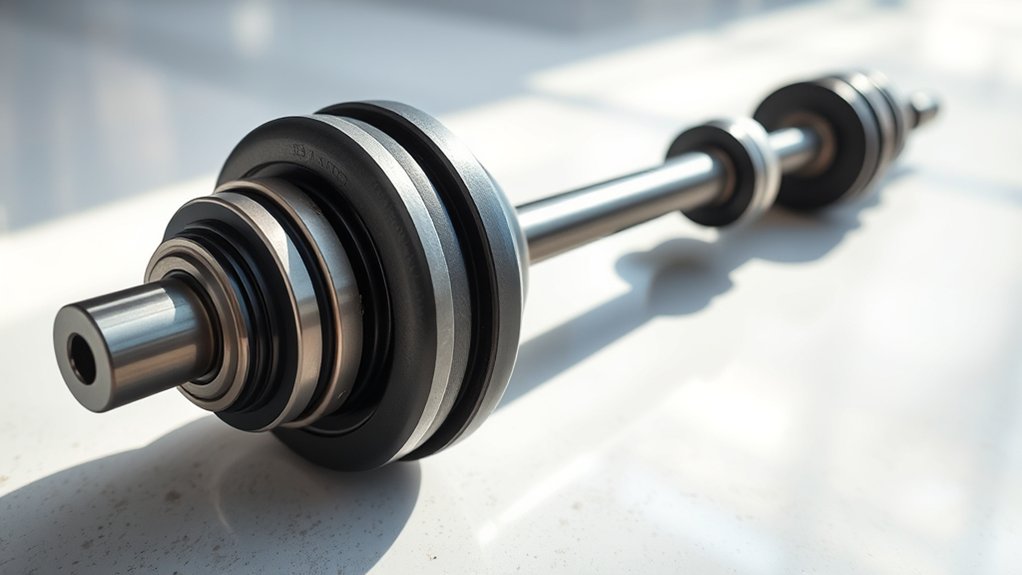
Your CV axle plays a crucial role in transferring engine power to your wheels, starting with torque from the transmission. This component includes the inner and outer CV joints, which work together to ensure smooth power delivery.
The inner CV joint flexes and slides to handle suspension bumps without losing power. Meanwhile, the outer CV joint adjusts for steering, keeping rotation smooth even when turning.
A protective boot seals grease in and keeps dirt out, preventing damage and vibration. This boot is essential for maintaining the longevity of the CV axle.
If you want to spot wear signs and learn ways to keep your CV axle running longer, there’s more to discover. Understanding how each part functions can help you maintain your vehicle’s performance and avoid costly repairs.
Key Takeaways
- The engine generates torque, which the transmission adjusts and sends through the CV axle to the wheels for propulsion.
- The inner CV joint allows the axle to change length during suspension movement, maintaining constant power flow.
- The outer CV joint flexes to accommodate steering angles while keeping rotational speed constant during turns.
- The CV boot protects joints from dirt and retains grease, ensuring smooth operation and preventing damage.
- Worn CV joints cause clicking noises and vibrations, so regular inspection and maintenance prevent failure.
What Is a CV Axle and Why It Matters
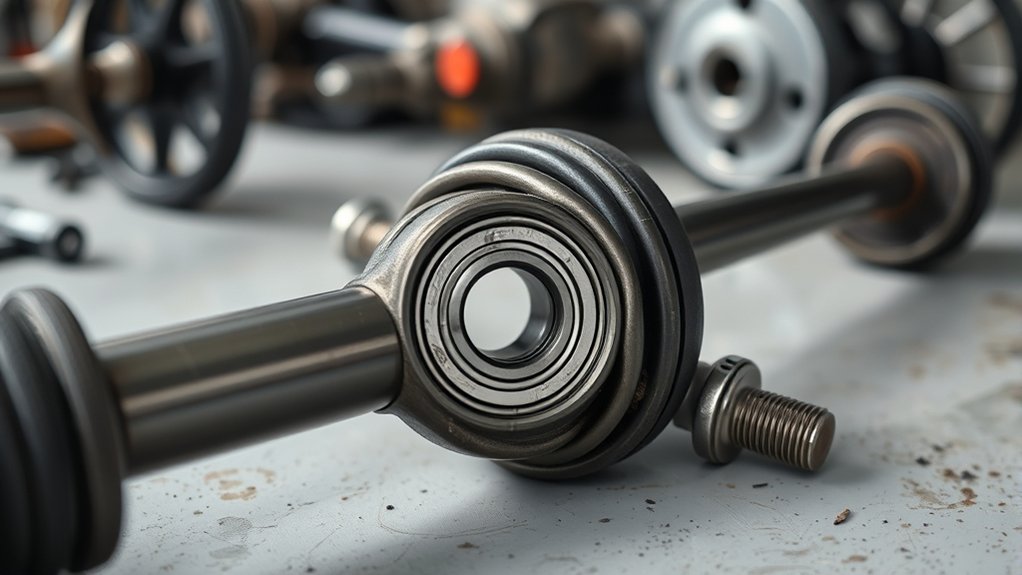
A CV axle, or constant velocity axle, is an essential component that connects your vehicle’s transmission to the wheels. It plays a critical role in delivering power smoothly, even as your wheels turn and your suspension moves. Without it, your car wouldn’t be able to transfer engine power effectively, especially during turns or when driving over uneven surfaces.
The CV axle guarantees that the wheels receive consistent torque at varying angles, which keeps your ride steady and responsive. If this part fails, you’ll notice vibrations, clicking noises, or difficulty steering, signaling that your vehicle’s drivability is compromised. Understanding why a CV axle matters helps you appreciate its role in maintaining your car’s performance and safety every time you hit the road.
The Main Parts of a CV Axle
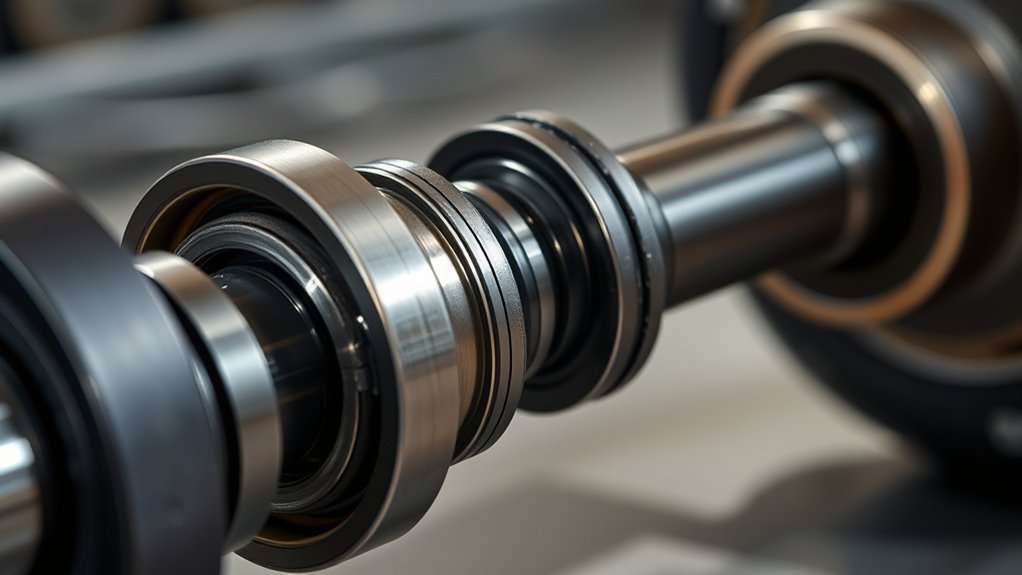
Since the CV axle plays such a key role in your vehicle’s performance, it helps to understand what makes it up. The CV axle mainly consists of three parts: the inner joint, the shaft, and the outer joint. The inner joint connects to the transmission, allowing power to flow from the engine.
The shaft itself is a solid metal rod that transmits torque between the two joints. At the other end, the outer joint links to the wheel hub, enabling your wheels to turn smoothly. Both joints are covered by protective rubber boots filled with grease, ensuring they stay lubricated and free from dirt.
Knowing these components helps you appreciate how the CV axle keeps your vehicle moving reliably.
How the CV Axle Transfers Power Smoothly
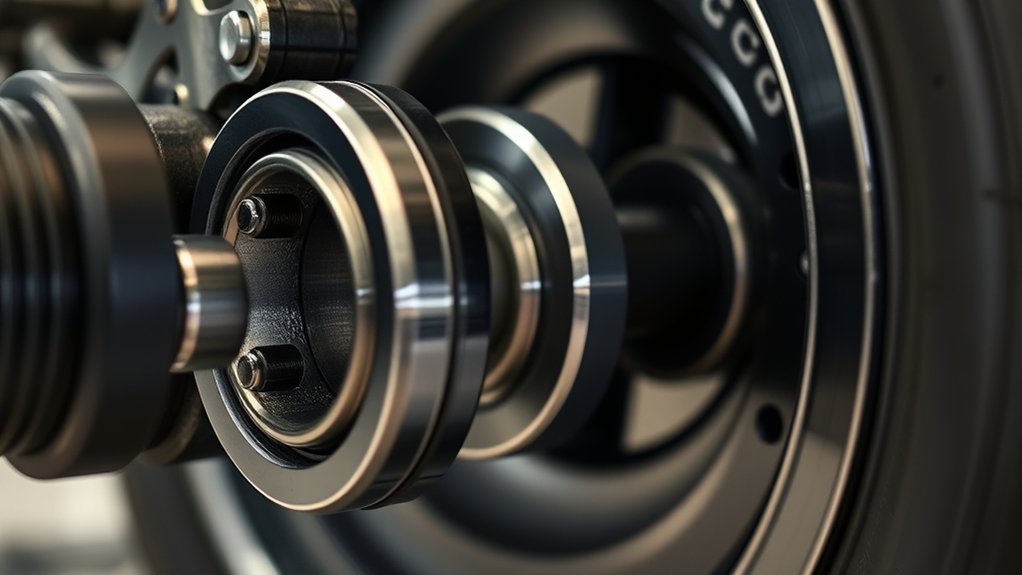
You’ll see how the CV axle uses flexible joints to keep power flowing even when your wheels turn or move up and down. These joints maintain a constant velocity, so your axle spins smoothly without jerking.
Understanding how torque transfers through this system helps you appreciate how your car moves efficiently.
Flexible Joint Functionality
Although the CV axle appears straightforward, its flexible joints play a crucial role in transferring power smoothly from the transmission to the wheels. These joints allow the axle to bend and flex, accommodating the up-and-down motion of the suspension and the steering angle changes without interrupting power delivery.
You’ll notice that the flexible joints:
- Absorb shocks and vibrations, ensuring a smoother ride.
- Maintain constant rotational speed despite angular changes.
- Prevent binding or wear by allowing the axle to adjust dynamically.
Constant Velocity Mechanism
When the suspension moves or you turn the steering wheel, the CV axle must keep delivering power without losing speed or torque. The constant velocity mechanism guarantees this by allowing the axle’s joints to rotate smoothly at varying angles. Inside the CV joint, specially designed bearings and grooves work together to maintain uniform rotational speed, no matter the joint’s position.
This means the wheel gets consistent power even as it moves up and down or turns left and right. By balancing the forces inside the joint, the mechanism prevents vibrations and uneven motion. This smooth transfer of power is essential for maintaining control and comfort while driving, especially around corners or over uneven terrain.
Torque Transmission Process
How exactly does the CV axle transmit torque smoothly from the engine to the wheels? It guarantees consistent power delivery, even when your wheels turn or the suspension moves. The CV joints play a vital role by allowing flexible rotation without losing torque, adapting to angles while maintaining speed.
Here’s how it works:
- The engine’s rotational force gets transferred through the transmission to the CV axle.
- The CV joints adjust to the wheel’s movement, keeping the torque steady despite steering or bumps.
- This smooth transfer prevents vibrations and power loss, guaranteeing efficient wheel rotation.
The Inner CV Joint and Suspension Movement
Because the inner CV joint connects the axle to the transmission, it must accommodate the up-and-down movement of your vehicle’s suspension. This joint allows the axle shaft to change length as the suspension compresses or extends, guaranteeing smooth power delivery without binding or stress.
The inner CV joint’s unique design lets it maintain constant velocity while adjusting to vertical movement.
Here’s a quick look at how the inner CV joint manages suspension movement:
| Movement Type | Joint Action | Effect on Power Transmission |
|---|---|---|
| Suspension Compression | Axle shaft shortens | Maintains torque transfer |
| Suspension Extension | Axle shaft lengthens | Prevents joint damage |
| Vertical Movement | Joint pivots and slides | Ensures smooth rotation |
This flexibility keeps your ride smooth and your drivetrain protected.
The Outer CV Joint and Steering Turns
Although the outer CV joint primarily handles steering turns, it plays an essential role in transmitting power smoothly to your wheels as they pivot left or right. This joint allows your wheels to follow the steering angle while maintaining consistent torque delivery, ensuring a smooth and stable ride. It compensates for changes in angle, especially when making sharp turns or maneuvering uneven roads.
Here’s what makes the outer CV joint key for steering:
- It enables flexible movement between the axle and wheel hub during turns.
- It maintains constant rotational speed despite the varying angles.
- It absorbs shocks from wheel movement while steering for better control.
Understanding this helps you appreciate how your vehicle’s steering and power delivery stay synchronized and efficient.
What the CV Boot Does and Why It’s Important
Since the CV boot protects the joints from dirt, moisture, and debris, it plays a crucial role in keeping your CV axle functioning smoothly. Think of it as a flexible shield that wraps around the CV joint, sealing in the grease that lubricates moving parts. Without this protection, dirt and water would cause the joint to wear out quickly, leading to costly repairs or replacements.
If the boot cracks or tears, grease can leak out and contaminants can get in, causing the joint to grind and eventually fail. You might notice clicking noises or vibrations when turning if the boot is damaged.
Regularly inspecting and replacing a worn CV boot helps you avoid more serious axle problems down the road, keeping your vehicle safe and reliable.
How the Axle Shaft Connects Transmission to Wheels
Keeping the CV boot intact guarantees the joint stays lubricated and protected, which is key for the axle shaft to do its job. The axle shaft connects the transmission to the wheels by transmitting torque smoothly while accommodating suspension movements. It fits snugly into the transmission output and the wheel hub, linking power flow between them.
This connection lets your vehicle move efficiently and respond to steering and bumps without losing power.
Here’s what makes this connection work:
- Splined Ends: These match corresponding grooves in the transmission and hub to prevent slipping.
- CV Joints: They allow the shaft to flex while maintaining constant velocity.
- Secure Fasteners: Bolts and clips keep everything tightly in place, preventing disconnection.
Step 1: Power Leaves the Transmission
When the engine generates power, it sends torque into the transmission, which then directs that energy to the CV axle. You can think of the transmission as a control center, adjusting the torque and speed to match your driving needs. As you accelerate or decelerate, the transmission changes gears to guarantee the right amount of power flows efficiently.
This power exits through the transmission’s output shaft, connecting directly to the CV axle’s inner joint. At this point, the CV axle begins to receive rotational force, ready to transfer it down the line. Understanding this step is vital because it marks the moment mechanical energy starts moving from the engine’s core components to the wheels, enabling your vehicle to move forward.
Step 2: Inner CV Joint Moves With Suspension
As your suspension moves up and down, the inner CV joint flexes to keep the axle connected smoothly. This flexibility lets the joint adapt without interrupting power flow from the transmission.
You’ll see how it maintains constant power transfer even while your wheels bounce over bumps.
Suspension Movement Impact
Since the suspension constantly moves to absorb bumps and maintain stability, the inner CV joint has to adjust accordingly. You rely on this joint to accommodate the up-and-down motion without interrupting power delivery from the transmission.
If it didn’t flex with the suspension, you’d feel harsh impacts and risk damaging drivetrain components.
This movement impacts:
- The smooth transfer of torque through varying suspension angles
- The durability of the CV joint, which must handle constant motion
- The overall ride quality by minimizing vibrations and noise
Inner Joint Flexibility
The inner CV joint adjusts constantly to keep up with your suspension’s movements, ensuring power flows smoothly from the transmission to the wheels. As your vehicle encounters bumps or dips, the suspension moves up and down, changing the distance and angle between the transmission and the wheel hub. The inner joint flexes to accommodate these shifts, preventing any binding or stress on the axle shaft.
This flexibility helps maintain a consistent connection, allowing the axle to extend or compress slightly without losing torque. Without this adaptability, the drivetrain would experience excessive wear or even failure. So, the inner CV joint’s design lets it pivot and slide, matching suspension motions precisely to keep your drive smooth and reliable during every road condition.
Maintaining Power Transfer
How exactly does the inner CV joint keep power flowing smoothly when your suspension moves? It adjusts to changes in length as your suspension compresses and extends, ensuring continuous torque delivery to the wheels. This flexibility prevents binding or loss of power, even as the distance between the transmission and wheel hub varies.
Here’s how it maintains seamless power transfer:
- The joint’s plunging mechanism absorbs suspension movement by sliding in and out.
- It keeps the axle’s rotational speed constant despite changes in angle.
- Lubrication inside the joint reduces friction, ensuring smooth operation.
Step 3: Outer CV Joint Handles Steering
When you turn the steering wheel, the outer CV joint adjusts the axle to match your car’s direction. This joint flexes smoothly to accommodate the angle changes, ensuring power flows efficiently to the wheels without interruption.
It handles both the vertical movement from bumps and the horizontal movement from steering, maintaining a solid connection.
| Outer CV Joint Function | Impact on Driving | Significance |
|---|---|---|
| Adapts to steering angle | Smooth turns | Prevents binding |
| Allows axle flexibility | Absorbs bumps | Protects drivetrain |
| Maintains power flow | Consistent torque | Enhances control |
| Reduces vibration | Comfortable ride | Extends part life |
| Handles speed changes | Stable handling | Safety critical |
This joint plays a vital role in your vehicle’s steering and overall performance.
Step 4: Power Reaches the Wheels Without Vibration
You rely on the CV axle to deliver smooth torque to the wheels, keeping your drive steady and efficient. Its design includes vibration dampening mechanisms that prevent any shaking or noise as power flows through.
This guarantees you get a comfortable ride without unwanted vibrations.
Smooth Torque Transmission
Although the CV axle handles complex movements, it guarantees torque reaches your wheels smoothly and without vibration. This smooth torque transmission is vital for maintaining control and comfort while driving. The CV joints flex and adjust continuously, ensuring power flows evenly regardless of steering angle or suspension movement.
You’ll notice your ride stays steady, even on rough roads or sharp turns.
Here’s how the CV axle achieves this:
- The constant velocity joints maintain a consistent rotational speed between the transmission and wheels.
- High-quality grease inside the joints reduces friction and wear, preserving smooth motion.
- The axle shaft’s design distributes torque evenly, preventing sudden jolts or power spikes.
This precise engineering helps you enjoy seamless power delivery every time you drive.
Vibration Dampening Mechanisms
Because power transfer through the CV axle involves constant movement and changes in angle, vibration dampening mechanisms play a crucial role in preventing unwanted shaking. These mechanisms absorb and reduce vibrations that could otherwise cause discomfort or damage.
You’ll find that components like rubber boots, dampening cushions, and balanced joints work together to keep your ride smooth.
Here’s a quick look at how these parts help:
| Component | Function | Benefit |
|---|---|---|
| Rubber Boots | Protect joints, absorb shock | Prevents wear and tear |
| Dampening Cushions | Reduce vibration transmission | Smoothens rotation |
| Balanced Joints | Maintain consistent movement | Minimizes shaking |
Understanding these parts helps you appreciate how your CV axle keeps power flowing quietly and efficiently.
Signs Your CV Axle Is Wearing Out
When your CV axle starts to wear out, it often sends clear signals that something’s wrong. Ignoring these signs can lead to more serious damage and costly repairs. You should keep an eye out for specific symptoms that indicate your CV axle needs attention.
Early signs of CV axle wear warn you before costly damage occurs—stay alert to avoid repairs.
Here are some common signs you might notice:
- Clicking noises when turning, especially sharp corners, signaling worn joint components.
- Vibration while driving, which can feel like the car is shaking or wobbling.
- Grease leakage around the axle area, often caused by torn CV boots.
If you experience any of these issues, it’s a good idea to have your CV axle inspected promptly to prevent further damage.
Tips to Maintain and Extend Your CV Axle’s Life
To keep your CV axle functioning smoothly and avoid costly repairs, you should regularly check its condition and take simple preventive steps. Begin by inspecting the CV boots for cracks or tears, as damaged boots let dirt and moisture in, causing premature wear. Keep an ear out for clicking noises during turns, which signal potential issues.
Avoid harsh driving conditions like sudden acceleration or sharp turns, as these strain the axle. Regularly clean the underside of your vehicle to remove debris that could damage the boots. If you notice any grease leaks around the axle, address them promptly.
Ultimately, schedule routine maintenance with your mechanic to ensure the CV axle stays in top shape, extending its life and saving you from unexpected breakdowns.
Frequently Asked Questions
How Much Does It Cost to Replace a CV Axle?
You’ll typically pay between $300 and $800 to replace a CV axle, depending on your car model and labor costs.
Doing it yourself can save money, but professional installation guarantees safety and proper function.
Can I Drive With a Damaged CV Axle?
You can drive with a damaged CV axle, but it’s like steering a wild beast—dangerous and unpredictable.
You’ll risk severe damage or losing control, so don’t wait; get it fixed immediately to stay safe.
What Tools Are Needed to Replace a CV Axle?
You’ll need a jack, jack stands, socket set, breaker bar, torque wrench, pry bar, hammer, and possibly a ball joint separator.
Don’t forget safety gloves and eye protection before you start replacing your CV axle.
How Long Does CV Axle Replacement Take?
You can expect a CV axle replacement to take about 1 to 2 hours. It depends on your experience and the vehicle model, but with the right tools, you’ll get it done efficiently without rushing.
Are All CV Axles the Same for Every Car Model?
Think of CV axles like puzzle pieces—each car needs its unique fit. You can’t just swap them around because they’re designed to match specific models, sizes, and torque requirements, ensuring smooth power delivery to your wheels.
Conclusion
Think of your CV axle as the heartbeat of your car’s drivetrain, pulsing power smoothly from engine to wheels. When it works well, every turn feels seamless, like a dance on the road.
But just like any essential part, it needs care and attention. Keep an eye out for signs of wear, and treat it right—because a healthy CV axle means your ride stays strong, steady, and ready for every twist and turn ahead.
Regular maintenance and timely repairs will ensure your CV axle continues to function properly. This helps maintain smooth power transfer and prevents costly damage. Remember, understanding how a CV axle works step by step is key to keeping your vehicle running safely and efficiently.

