

You should leave your car battery charger connected just long enough to fully charge the battery, which typically takes 1 to 12 hours depending on the charger type and battery condition.
Understanding how long to leave a car battery charger on your car is essential for maintaining battery health and ensuring optimal performance. Using the right charger and monitoring the process can prevent damage and extend battery life.
Use a slow charger for longer, gentle charging or a smart charger that automatically switches to maintenance mode.
Always connect cables correctly and monitor the voltage—12.6 volts means full charge.
Avoid overcharging to protect battery life.
Keep following to discover more essential charging tips.
Key Takeaways
- Use a charger matching your battery type and voltage, and double-check all connections before powering on.
- Slow chargers (2 amps) typically require 10-12 hours, while fast chargers (10 amps) take 1-2 hours to fully charge.
- Monitor charging progress via charger indicators or a multimeter reading 12.6–12.8 volts for a full charge.
- Disconnect the charger immediately after full charge to prevent overcharging, battery damage, and safety hazards.
- Prefer smart chargers with maintenance mode for safe, automatic adjustment, but avoid leaving them connected unattended for days.
How Do You Know When Your Car Battery Needs Charging?
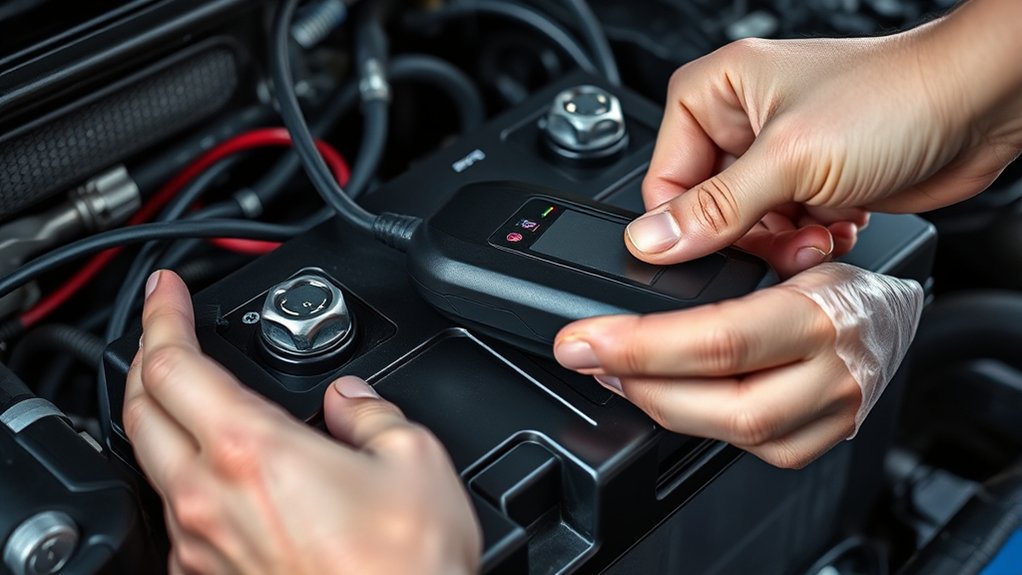
If your car struggles to start or the engine turns over slowly, your battery likely needs charging. You might also notice dim headlights or electrical components acting up, which are clear signs your battery’s power is low. Another hint is a warning light on your dashboard, often shaped like a battery symbol.
If you’ve left your lights on overnight or haven’t driven for a while, your battery could be drained. Using a multimeter, you can check the voltage; a fully charged battery reads around 12.6 volts or higher. Anything below 12.4 volts means it’s time to recharge.
Paying attention to these signs helps you avoid getting stranded and ensures your car runs smoothly when you need it most.
What Are the Different Types of Car Battery Chargers?
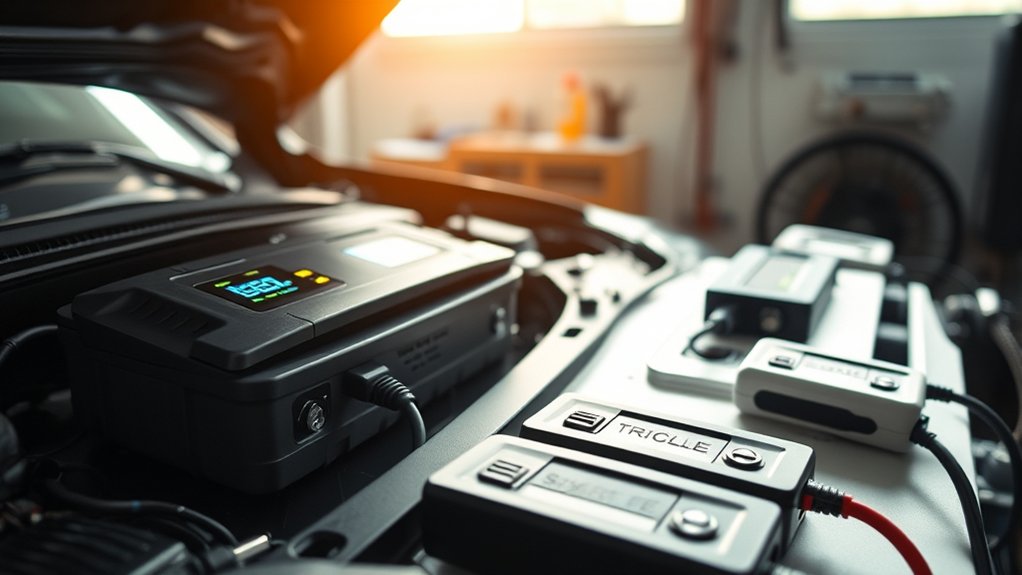
You’ll find several types of car battery chargers, each with different technology and features. Understanding these differences helps you pick the right charger for your battery’s needs.
Let’s look at the main types and how they work.
Types Of Battery Chargers
Three main types of car battery chargers can help you restore your battery’s power: trickle chargers, smart chargers, and jump starters. Trickle chargers supply a low, steady current to slowly recharge your battery, making them ideal for long-term maintenance. Smart chargers, equipped with microprocessors, automatically adjust the charging rate based on your battery’s condition, preventing overcharging and extending battery life.
Jump starters provide a quick burst of power to start a dead battery immediately but don’t recharge it fully. Choosing the right charger depends on your needs—whether you want slow maintenance charging, automatic adjustment, or an emergency start. Understanding these types helps you pick the best option and use your charger safely and effectively.
Charger Technology Differences
Understanding how different charger technologies work can help you choose the best option for your car battery’s needs. There are three main types: trickle chargers, smart chargers, and fast chargers. Trickle chargers deliver a low, steady current to maintain battery charge over time, ideal if you don’t use your car often.
Smart chargers adjust the charging rate based on the battery’s condition, preventing overcharging and extending battery life. Fast chargers provide high current to quickly recharge a battery but can generate heat and risk damage if used improperly. Knowing these differences lets you pick a charger that matches your battery type and usage, ensuring safe, efficient charging without shortening your battery’s lifespan.
Always follow the manufacturer’s instructions for the best results.
How Long Does It Usually Take to Charge a Car Battery?
Although charging times can vary, most car batteries take several hours to reach a full charge. The exact duration depends on your battery’s size, its current charge level, and the charger’s amperage. For example, a slow charger delivering 2 amps may take 10-12 hours, while a fast charger at 10 amps might do it in 1-2 hours.
If your battery is deeply discharged, expect longer charging times. Keep in mind that trickle chargers work gradually to avoid overcharging but require patience. To get an accurate estimate, check your charger’s specifications and your battery’s capacity, usually measured in amp-hours.
Monitoring the charging process helps you avoid leaving the charger on too long or disconnecting it prematurely.
How to Connect a Car Battery Charger Safely
To connect your car battery charger safely, start by attaching the positive cable to the positive terminal and the negative cable to the negative terminal. Always wear protective gear and work in a well-ventilated area to avoid sparks and fumes.
Following these steps helps prevent accidents and guarantees a proper charge.
Proper Cable Connection
When connecting a car battery charger, you’ll want to make certain the cables are attached correctly to prevent sparks or damage. Start by identifying the positive (red) and negative (black) terminals on your battery. Connect the red clamp to the positive terminal first.
Then attach the black clamp to the negative terminal or a grounded metal part away from the battery. This sequence reduces the risk of short circuits.
| Step | Cable Color | Connection Point |
|---|---|---|
| 1 | Red | Positive battery terminal |
| 2 | Black | Negative battery terminal |
| 3 | Black | Metal ground (if advised) |
| 4 | Red | Avoid connecting to negative |
| 5 | Black | Avoid connecting to positive |
Double-check connections before powering on the charger.
Safety Precautions
Since working with car batteries involves handling electricity and potentially hazardous materials, you need to follow strict safety precautions to protect yourself and your vehicle. First, always wear protective gloves and safety goggles to shield your skin and eyes from acid splashes. Make sure the charger is unplugged before connecting or disconnecting cables.
Connect the positive (red) clamp to the battery’s positive terminal first, then the negative (black) clamp to a grounded metal part away from the battery to prevent sparks. Avoid smoking or open flames nearby, as batteries emit flammable gases. Work in a well-ventilated area to disperse fumes.
Double-check that the charger settings match your battery type and voltage. Following these steps guarantees a safe and effective charging process.
How Long Should You Leave a Car Battery Trickle Charger On?
Although trickle chargers supply a low, steady current designed to maintain your car battery, you shouldn’t leave them connected indefinitely. Typically, you can safely leave a trickle charger on for several days to weeks, depending on your battery’s condition and the charger’s specifications. If you’re using it to maintain a battery during long-term storage, leaving it connected for a few weeks is usually fine.
However, it’s best to periodically check your battery and charger to verify everything’s working properly and the battery isn’t overcharged. Avoid leaving the charger on for months at a time without supervision, as this can lead to battery damage or reduced lifespan. Always follow the manufacturer’s guidelines for your specific charger model.
How Do Smart Car Battery Chargers Manage Charging Time?
Because smart car battery chargers automatically adjust their output, they take the guesswork out of managing charging time. When you connect a smart charger, it first assesses your battery’s condition and voltage level. Then, it delivers the right amount of current to charge your battery efficiently without overcharging.
As the battery nears full charge, the charger reduces its power to a trickle or maintenance level, preventing damage and extending battery life. You don’t need to monitor it constantly because the charger switches between charging stages—bulk, absorption, and float—on its own.
This intelligent process guarantees your battery gets charged safely and thoroughly, so you can leave the charger connected for longer periods without worry.
How to Tell When Your Car Battery Is Fully Charged
When you want to know if your car battery is fully charged, you can rely on several clear indicators. First, check your charger’s display or indicator lights; many smart chargers show a green light or “full” message when charging is complete. If your charger lacks this feature, use a multimeter to measure the battery voltage—fully charged car batteries typically read about 12.6 to 12.8 volts.
Also, the battery itself won’t feel excessively warm, as overheating can signal overcharging. Some chargers automatically switch to a maintenance or float mode once charging ends, preventing overcharge and signaling completion. By paying attention to these signs, you’ll know when to disconnect your charger safely without risking battery damage or undercharging.
What Happens If You Leave Your Car Battery Charger On Too Long?
If you leave your car battery charger on too long, you risk damaging the battery and reducing its lifespan. Overcharging causes excessive heat buildup, which can lead to swelling, leaks, or even battery failure. You may notice the battery becoming unusually warm or emitting a strong odor, both signs of stress.
Prolonged charging also accelerates the loss of electrolyte fluid inside the battery, decreasing its ability to hold a charge effectively. In extreme cases, it can cause permanent damage to the battery’s internal components, forcing you to replace it sooner than expected. To avoid these problems, it’s *essential* to monitor the charging process and disconnect the charger once the battery is fully charged.
Leaving it connected indefinitely isn’t safe or beneficial.
Tips to Extend Your Car Battery Life With Proper Charging
To keep your car battery in good shape, you should follow proper charging habits that prevent overcharging and damage. This guarantees your battery lasts longer and performs reliably.
Here are some tips to help you extend your battery life with proper charging:
- Use a smart charger that automatically switches to maintenance mode once fully charged.
- Avoid leaving the charger connected for days without monitoring.
- Charge your battery in a cool, dry place to prevent overheating.
- Regularly check battery terminals for corrosion and clean them as needed.
- Disconnect the charger safely by turning it off before unplugging to avoid sparks.
Frequently Asked Questions
Can I Charge a Car Battery in Cold Weather?
Yes, you can charge a car battery in cold weather, but it takes longer. Make certain you use a charger designed for low temperatures and keep the battery warm if possible to guarantee effective and safe charging.
Is It Safe to Charge a Battery Without Removing It From the Car?
Of course, it’s perfectly safe—if you enjoy sparks and potential damage! Seriously though, you can charge the battery without removing it, but just make sure you disconnect the negative cable and avoid metal contact to keep things safe.
How Often Should I Charge a Car Battery if Unused?
You should charge your car battery every 4 to 6 weeks if it’s unused. This keeps it from losing power and extends its life.
Don’t let it sit too long without a charge, or it may die.
Can a Car Battery Charger Damage My Vehicle’s Electronics?
No, a quality car battery charger won’t damage your vehicle’s electronics if used properly. Just avoid cheap chargers and make sure to follow instructions, so you don’t overload or cause voltage spikes that could harm sensitive systems.
What Should I Do if My Battery Won’T Charge at All?
If your battery won’t charge at all, check the charger connections and battery terminals for corrosion or looseness.
If everything looks fine, test the battery with a multimeter or take it to a professional for diagnosis.
Conclusion
Now that you know how long to leave your car battery charger on, you’re ready to keep your battery in tip-top shape. Remember, patience is key—charging too quickly or leaving it on too long can backfire.
By following these tips and using the right charger, you’ll avoid getting stuck in a pickle and keep your car running smoothly. A well-charged battery means fewer headaches and more reliable rides ahead!
Proper maintenance and knowing the correct charging time are essential for battery longevity. Always use a quality car battery charger and monitor the process closely. This ensures your vehicle stays ready to go whenever you need it.

