

You control your machine’s speed and power by adjusting its gear ratio, a key concept in mechanics and engineering that compares the teeth on two gears to determine how fast and strong they turn. Understanding gear ratios is essential for optimizing performance in vehicles, bicycles, and various machinery.
A higher gear ratio gives you more torque but less speed, while a lower ratio boosts speed at the cost of force.
Gear ratios help balance pedal effort, engine power, or machinery load for efficiency. By tweaking these ratios, you can tailor your machine’s operation to specific tasks and conditions.
Keep exploring, and you’ll find how gear ratios impact different devices and systems.
Key Takeaways
- Gear ratio compares the number of teeth between driving and driven gears to determine their relative rotational speeds.
- It is calculated by dividing the driven gear teeth by the driving gear teeth and expressed as a simplified ratio.
- Higher gear ratios increase torque but reduce speed, while lower ratios increase speed but decrease torque.
- Gear ratios affect power delivery, efficiency, and mechanical advantage in various machines and vehicles.
- Adjusting gear ratios balances speed, force, and energy use to optimize performance for specific tasks or terrains.
What Is a Gear Ratio and Why It Matters
What exactly is a gear ratio, and why should you care about it? Simply put, a gear ratio compares the rotational speeds of two gears working together. It tells you how many times one gear turns relative to the other.
When you understand this, you can predict how your machine or vehicle will perform—whether it’ll prioritize speed, torque, or a balance of both. Gear ratios matter because they directly affect power delivery and efficiency. For example, a higher gear ratio can increase torque, helping you climb hills with ease, while a lower ratio can boost speed on flat roads.
How Gear Teeth Count Determines Gear Ratios
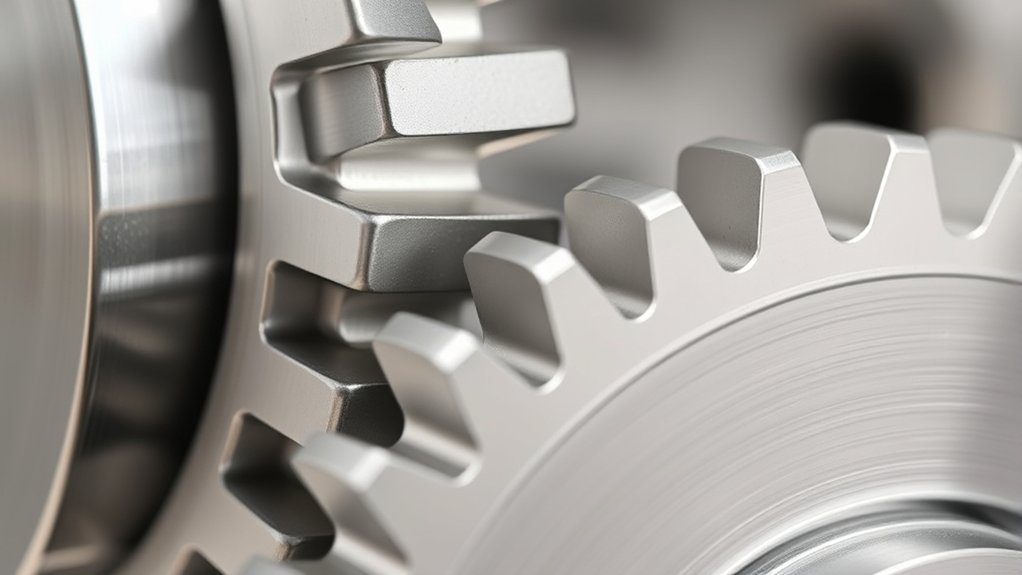
You’ll find that the number of teeth on each gear directly affects the gear ratio. By counting teeth and comparing them, you can calculate how the gears will change speed and torque. Understanding this helps you see how gear setups impact overall performance.
Teeth Count Basics
Although gear ratios might seem complex at first, they boil down to the simple relationship between the number of teeth on two meshing gears. When you look at a pair of gears, the teeth count directly affects how they interact. The gear with more teeth turns slower but with more force, while the gear with fewer teeth spins faster but with less force.
Understanding this helps you see why gear sizes matter. By counting teeth, you can predict how the gears will perform together. This basic concept is the foundation of all gear ratio discussions, so getting comfortable with teeth counts gives you a clear picture of how mechanical advantage and speed changes happen in gear systems.
Calculating Gear Ratios
Since gear ratios depend directly on the number of teeth each gear has, calculating them becomes straightforward once you know those counts. To find the gear ratio, you simply divide the number of teeth on the driven gear by the number of teeth on the driving gear. Here’s how to do it:
- Count the teeth on the driving gear (input gear).
- Count the teeth on the driven gear (output gear).
- Divide the driven gear’s teeth by the driving gear’s teeth.
- Express the result as a ratio (e.g., 3:1).
This ratio tells you how many turns the driving gear makes for one turn of the driven gear. Remember, larger gear teeth counts result in different mechanical advantages, which you’ll explore later.
Impact On Speed
Knowing how to calculate gear ratios sets the stage for understanding their direct effect on speed. When you change the number of teeth on gears, you alter the ratio, which controls how fast one gear turns relative to another. If the driving gear has fewer teeth than the driven gear, the driven gear spins slower but with more torque.
Conversely, if the driving gear has more teeth, it speeds up the driven gear but reduces torque. This relationship means you can tailor speed output by adjusting gear teeth count. For example, a high gear ratio slows speed but increases power, ideal for climbing.
A low gear ratio boosts speed but lowers torque, perfect for fast movement. By managing gear teeth, you directly influence how fast your machine or vehicle moves.
How to Calculate Gear Ratios Step-by-Step
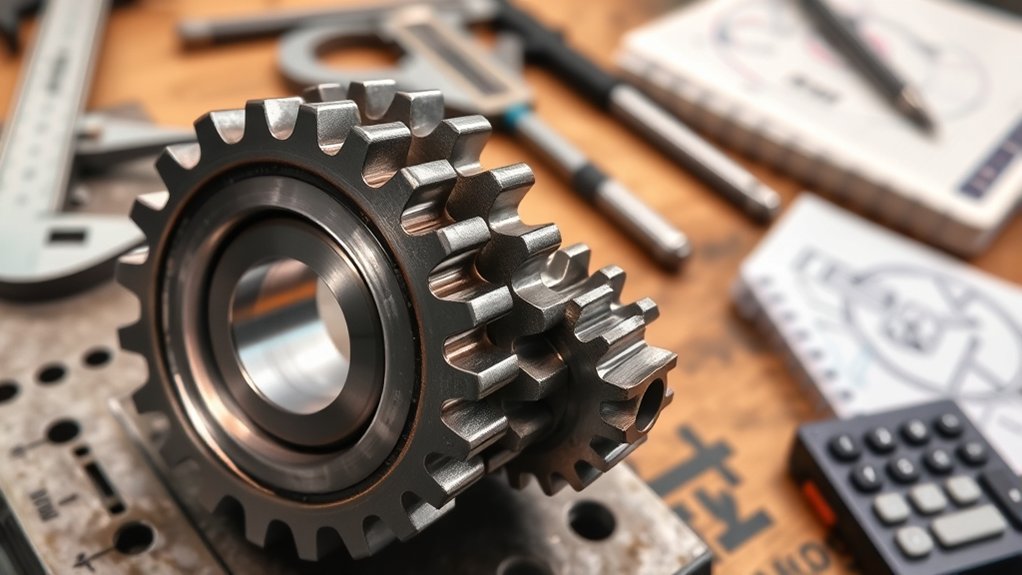
Now that you know how gear teeth affect ratios, let’s walk through calculating gear ratios step-by-step.
You’ll start by comparing the input gear teeth to the output gear teeth and then simplify the ratio to its lowest terms.
This process makes it easy to understand how your gears interact.
Understanding Gear Teeth
Although gear ratios might seem complex at first, you can easily calculate them by focusing on the number of teeth each gear has. These teeth interlock, ensuring smooth movement and proper force transfer between gears. Understanding gear teeth is essential because:
- The number of teeth determines the gear’s size and speed ratio.
- Teeth must be evenly spaced to avoid slippage.
- More teeth on a gear mean it turns slower but with more torque.
- Fewer teeth result in faster rotation but less torque.
Calculating Input Versus Output
How do you determine the relationship between the input and output gears? Start by counting the number of teeth on both gears. The input gear is the one you turn, and the output gear is the one driven.
To calculate the gear ratio, divide the number of teeth on the output gear by the number of teeth on the input gear. For example, if the input gear has 10 teeth and the output gear has 40, the gear ratio is 40 divided by 10, which equals 4. This means the output gear turns slower but with more torque.
Conversely, if the output gear has fewer teeth, it spins faster but with less torque. Knowing this ratio helps you understand the speed and force changes between gears in a system.
Simplifying Gear Ratio Results
When you calculate a gear ratio, you often end up with a fraction or a decimal that’s easier to understand once simplified. Simplifying gear ratios helps you quickly grasp the relationship between gears and their speed or torque changes.
Here’s how you simplify your results step-by-step:
- Find the ratio by dividing the number of teeth on the driven gear by the number of teeth on the driving gear.
- Convert to a fraction if you have a decimal result.
- Reduce the fraction to its simplest form by dividing both numerator and denominator by their greatest common divisor (GCD).
- Interpret the simplified ratio to understand how many turns the driving gear makes for each turn of the driven gear.
This process makes gear ratios clear and practical.
How Gear Ratios Affect Speed and Torque Output
Because gear ratios determine the relationship between the input and output gears, they directly influence the speed and torque you get from a system. When the gear ratio increases, torque increases but speed decreases, and vice versa. This trade-off lets you tailor performance based on your needs.
| Gear Ratio | Speed Output | Torque Output |
|---|---|---|
| 1:1 | Equal to input speed | Equal to input torque |
| 2:1 | Half the input speed | Twice the input torque |
| 0.5:1 | Twice the input speed | Half the input torque |
Understanding this helps you decide how to balance speed and power, whether you’re tuning a bike or designing machinery.
Why Different Mechanical Systems Use Gear Ratios Differently
Although gear ratios serve the same basic purpose, different mechanical systems use them in unique ways to meet specific performance goals. When you work with various machines, you’ll notice how gear ratios adapt to needs such as:
Gear ratios tailor mechanical performance to meet diverse goals across different machines and applications.
- Maximizing Speed: Systems like cars use higher gear ratios to boost top speed.
- Increasing Torque: Heavy machinery opts for lower gear ratios to amplify torque for tough jobs.
- Balancing Efficiency: Some devices, like electric motors, fine-tune ratios to optimize energy use.
- Controlling Precision: Robotics often require precise movement, demanding carefully chosen gear ratios.
Gear Ratios and Their Impact on Cycling Performance
When you adjust your bike’s gear ratio, you directly affect how efficiently power transfers from your legs to the wheels. Finding the right balance between cadence and speed helps you maintain control and stamina during your ride.
Let’s explore how these factors shape your cycling performance.
Power Transfer Efficiency
How exactly do gear ratios influence your power transfer efficiency on a bike? When you choose the appropriate gear ratio, you maximize how effectively your pedaling force turns into forward motion.
Here’s how gear ratios affect power transfer efficiency:
- Lower gear ratios reduce the force needed but increase pedal revolutions, which can waste energy if too low.
- Higher gear ratios require more force per pedal stroke but cover more distance, demanding efficient energy use.
- An ideal gear ratio balances pedal force and cadence, minimizing energy loss in chain and drivetrain friction.
- Poorly matched ratios cause strain or slipping, reducing the efficiency of power transfer from your legs to the wheels.
Cadence and Speed Balance
Since your cadence directly affects your speed, choosing the right gear ratio helps you maintain an efficient and comfortable pedaling rhythm. When you select a lower gear ratio, you can pedal faster with less resistance, which is ideal for climbing or accelerating.
Conversely, a higher gear ratio requires more force per pedal stroke but lets you cruise at higher speeds on flat terrain. Balancing cadence and speed means adjusting your gear ratio to match your fitness level and the terrain. If you push too hard in a high gear, you risk fatigue; too low, and you might spin inefficiently.
How Gear Ratios Work in Car Transmissions
Although gear ratios might seem complex at first, they play an essential role in controlling your car’s speed and power. When you shift gears, you’re changing the gear ratio, which adjusts how torque and speed transfer from the engine to the wheels.
Here’s how it works in car transmissions:
- Lower gears provide more torque but less speed, helping you start moving or climb hills.
- Higher gears offer less torque but more speed, ideal for cruising efficiently on highways.
- The transmission uses different gear pairs to optimize engine performance based on driving conditions.
- Gear ratios balance engine RPM and wheel speed, preventing the engine from overworking or stalling.
What Compound Gears Do to Your Gear Ratio
When you combine two or more gears on the same shaft, you create a compound gear that changes the overall gear ratio more effectively than a single gear pair. This setup lets you multiply gear ratios by linking multiple gear pairs in sequence. Each compound gear stage adds its own ratio, so the final output ratio becomes the product of these individual ratios.
You can achieve higher or more precise gear ratios in a compact space, which single pairs can’t provide. Compound gears are common in complex machines like clocks or transmissions, where fine control over speed and torque is critical. By using compound gears, you gain flexibility in designing gear trains that meet specific performance goals without needing large, bulky gears.
How Gear Ratios Influence Mechanical Advantage and Efficiency
Understanding gear ratios helps you see how they directly affect mechanical advantage and efficiency in a system. When you adjust gear ratios, you change how force and speed are transmitted, impacting performance.
Here’s how gear ratios influence these factors:
- Mechanical Advantage: Higher gear ratios increase torque, making it easier for you to move heavy loads with less effort.
- Speed Trade-off: Lower gear ratios boost speed but reduce torque, so you gain velocity at the cost of force.
- Energy Efficiency: Proper gear ratios minimize energy loss by matching the load and input force, improving overall system efficiency.
- Wear and Tear: Balanced gear ratios reduce strain on components, extending your machine’s lifespan and maintaining smooth operation.
Knowing this helps you optimize gear setups for your specific needs.
Common Gear Ratio Issues and How to Fix Them
Since gear ratios play a crucial role in your machine’s performance, encountering issues with them can lead to decreased efficiency or even damage. Common problems include incorrect gear alignment, worn teeth, and improper lubrication. Misaligned gears cause uneven wear and noise, so you should regularly check and adjust their positioning.
Worn teeth reduce power transmission, so inspect gears for damage and replace any that show significant wear. Lack of lubrication increases friction and heat, leading to premature failure. Make sure to apply the right lubricant consistently and clean gears before doing so.
Addressing these issues quickly helps maintain smooth operation and extends your machine’s lifespan. Regular maintenance and timely fixes keep your gear ratios functioning at their best without costly breakdowns.
How to Choose the Right Gear Ratio for Your Needs
Keeping your gear system in good condition helps maintain performance, but selecting the right gear ratio from the start makes all the difference.
To choose the best gear ratio for your needs, consider these key factors:
- Purpose – Are you focused on speed, torque, or balance? Different activities demand different ratios.
- Terrain – Flat surfaces favor higher ratios for speed, while hilly terrain requires lower ratios for better control.
- Load – Heavier loads need lower gear ratios to reduce strain and improve power delivery.
- Efficiency – Choose a ratio that maximizes energy use without overworking your system.
Comparing Gear Ratios Across Bikes, Cars, and Machinery
How do gear ratios differ when applied to bikes, cars, and machinery? Each uses gear ratios to balance speed, power, and control but in unique ways. Bikes often have higher gear ratios for speed on flat terrain, while cars use variable ratios to optimize acceleration and fuel economy.
Machinery usually features lower gear ratios to maximize torque for heavy lifting or cutting.
| Application | Typical Gear Ratio Range |
|---|---|
| Bikes | 2:1 to 5:1 |
| Cars | 3:1 to 6:1 (per gear) |
| Heavy Machinery | 10:1 to 50:1 |
| Light Machinery | 4:1 to 15:1 |
| Sports Cars | 4:1 to 7:1 |
Understanding these differences helps you pick the right gear ratio for your specific needs.
How Changing Gear Ratios Boosts Overall Efficiency
When you adjust gear ratios, you directly influence the balance between speed and torque, which can considerably improve efficiency. By selecting the right ratio, you maximize power delivery to match your specific needs, reducing wasted energy.
Here’s how changing gear ratios boosts overall efficiency:
- Improves fuel or energy consumption by aligning engine or motor output with workload demands.
- Enhances performance by providing the right torque for different conditions, like climbing or cruising.
- Reduces mechanical wear since components operate within optimal stress ranges, extending lifespan.
- Increases adaptability allowing you to switch between power-focused and speed-focused settings depending on the task.
Frequently Asked Questions
How Do Gear Ratios Affect Noise Levels in Machinery?
You’ll find that higher gear ratios often increase noise because the gears spin faster, causing more friction and vibration. Lower ratios usually run quieter, but it depends on gear quality and lubrication too, so keep those in mind.
Can Gear Ratios Impact Fuel Consumption in Vehicles?
You’ll find gear ratios act like a maestro, orchestrating your engine’s rhythm to save fuel. By choosing the right ratio, you’ll reduce wasted energy, letting your vehicle sip gas gently instead of guzzling it recklessly.
What Materials Are Best for Gears to Optimize Ratio Performance?
You’ll want gears made from hardened steel or alloy steel to optimize ratio performance. These materials offer durability, strength, and wear resistance, ensuring smooth power transfer and long-lasting efficiency in your gear system.
How Do Gear Ratios Influence Maintenance Intervals?
Gear ratios affect maintenance intervals because higher ratios often increase stress and wear on gears, so you’ll need to check and service them more frequently. Lower ratios usually mean smoother operation and longer maintenance gaps.
This is because higher gear ratios put more load on the components, accelerating wear. As a result, maintenance tasks like lubrication and inspection become more critical. Conversely, lower ratios reduce the strain on gears, allowing for extended service intervals.
Are There Digital Tools to Simulate Gear Ratio Effects?
Yes, you can use digital tools like gear ratio calculators and simulation software to see how different ratios affect performance. These tools help you experiment virtually before making physical changes to your gears or drivetrain.
They provide a convenient way to understand the impact of gear ratio changes without needing to physically test each setup.
This can save time and resources while optimizing your gear configurations for desired outcomes.
Conclusion
Understanding gear ratios is key to getting the most out of any mechanical system you use. Remember, “a stitch in time saves nine”—choosing the right gear ratio early on prevents bigger issues later.
By knowing how gear teeth count affects speed and torque, you can optimize performance whether you’re working on bikes, cars, or machines.
So, take control, calculate carefully, and watch your efficiency and power soar. Gear ratio knowledge is essential for maximizing mechanical advantage and improving overall system performance.

