

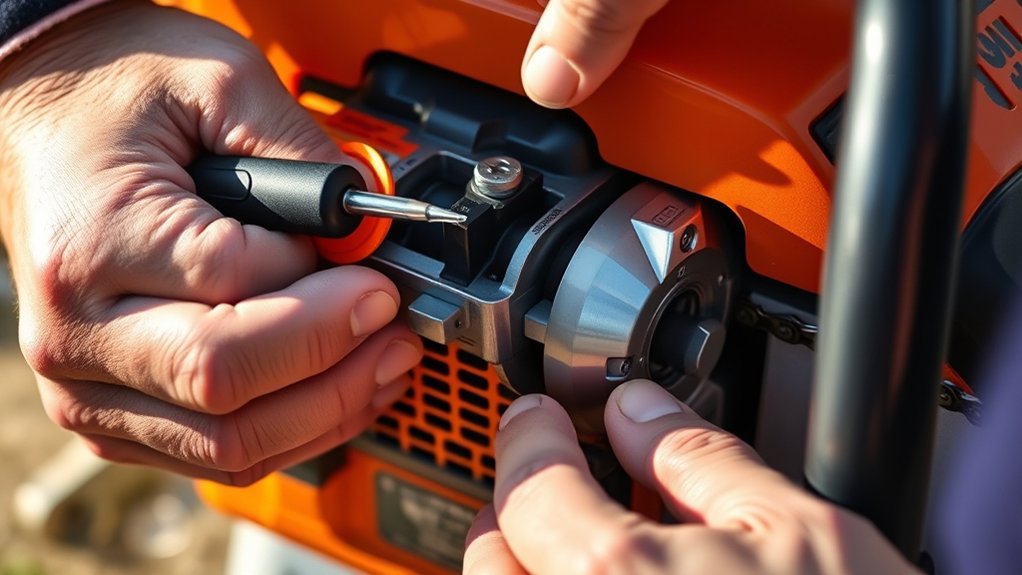
To adjust your Husqvarna chainsaw carburetor effectively, you need to follow precise steps for optimal performance. Proper carburetor adjustment ensures smooth idling, efficient acceleration, and maximum power output.
Before starting, clean the chainsaw thoroughly and secure it safely to avoid accidents.
Identify the three adjustment screws: idle (T), low-speed (L), and high-speed (H). Begin by setting the idle and low-speed screws to their initial positions. Then, warm up the engine to operating temperature.
Fine-tune the idle and low-speed screws for smooth idling and stable engine performance.
Next, carefully adjust the high-speed screw to achieve peak power without hesitation or engine strain. Test the acceleration to confirm responsive throttle response.
Make any final tweaks as needed to balance performance and fuel efficiency.
Regular maintenance and timely adjustments will guarantee your Husqvarna chainsaw delivers lasting, reliable performance.
Learn how each step unlocks your chainsaw’s full potential.
Key Takeaways
- Clean the chainsaw and secure it with the chain brake engaged before starting carburetor adjustments.
- Identify the idle (T), low-speed (L), and high-speed (H) screws on the carburetor for precise tuning.
- Warm up the engine, then adjust the low-speed screw for the highest smooth idle and responsive throttle.
- Fine-tune the high-speed screw by turning it clockwise until RPM drops, then counterclockwise for smooth maximum power.
- Adjust the idle screw so the chain barely moves at idle without stalling, ensuring safe and stable operation.
Prepare Your Husqvarna Chainsaw for Carburetor Adjustment

Before you adjust the carburetor, make sure your Husqvarna chainsaw is clean and in a safe, stable position. Remove any dirt, sawdust, or debris from the body, especially around the air filter and carburetor area. Place the chainsaw on a flat surface or securely hold it to prevent it from moving during adjustment.
Confirm the chain brake is engaged to avoid accidental chain movement. Also, check that the chain is properly tensioned and sharp for safety and better control. Disconnect the spark plug wire to prevent accidental starts while working.
With these precautions, you create a safe environment to focus on fine-tuning your chainsaw’s carburetor without distractions or hazards. Taking a few moments to prepare will save time and prevent mishaps later on.
Identify Carburetor Screws and Their Functions

Before you start adjusting, you need to identify the carburetor screws on your Husqvarna chainsaw. These screws control fuel flow, idle speed, and mixture settings. Knowing where each adjustment screw is located will help you fine-tune your saw effectively.
Types Of Carburetor Screws
How do you identify the different screws on your Husqvarna chainsaw carburetor and understand their roles? There are typically three main types you’ll encounter, each designed for a specific tuning purpose. Knowing these screws helps you make precise adjustments confidently.
| Screw Type | Location | Visual Cue |
|---|---|---|
| Idle Speed Screw | Near the throttle arm | Often with a spring around it |
| Low-Speed Screw | On the carburetor body | Smaller, sometimes recessed |
| High-Speed Screw | Close to fuel inlet | Usually larger with a flat head |
Each screw’s unique position and shape let you quickly spot and adjust them. This ensures your chainsaw runs smoothly and efficiently.
Screw Function Overview
Why does each screw on your Husqvarna chainsaw carburetor matter? Because every screw controls a specific function that affects engine performance. The idle speed screw manages how fast the engine runs when you’re not pulling the throttle.
The low-speed mixture screw controls the fuel-to-air ratio at low RPMs, ensuring smooth acceleration and preventing stalling. The high-speed mixture screw adjusts the fuel mixture at higher RPMs, optimizing power and preventing engine overheating.
Knowing what each screw does helps you make precise adjustments for better fuel efficiency, smoother operation, and longer engine life. Understanding these functions is essential before you start tuning—this way, you avoid damaging your carburetor or engine with incorrect screw turns.
Locating Adjustment Screws
Finding the adjustment screws on your Husqvarna chainsaw carburetor is easier than you might think. Typically, you’ll find three main screws: the low-speed screw (L), the high-speed screw (H), and the idle speed screw (T). The L screw controls fuel flow at low throttle, the H screw manages fuel at high throttle, and the T screw adjusts the engine’s idle speed.
These screws are usually located on the side of the carburetor body and often marked with small letters or symbols. Before you start adjusting, make sure you can clearly identify each screw to avoid confusion. Using a magnifying glass or good lighting can help you spot the tiny markings.
Correctly locating these screws is vital for precise tuning and peak chainsaw performance.
Spot Signs Your Carburetor Is Running Rich or Lean
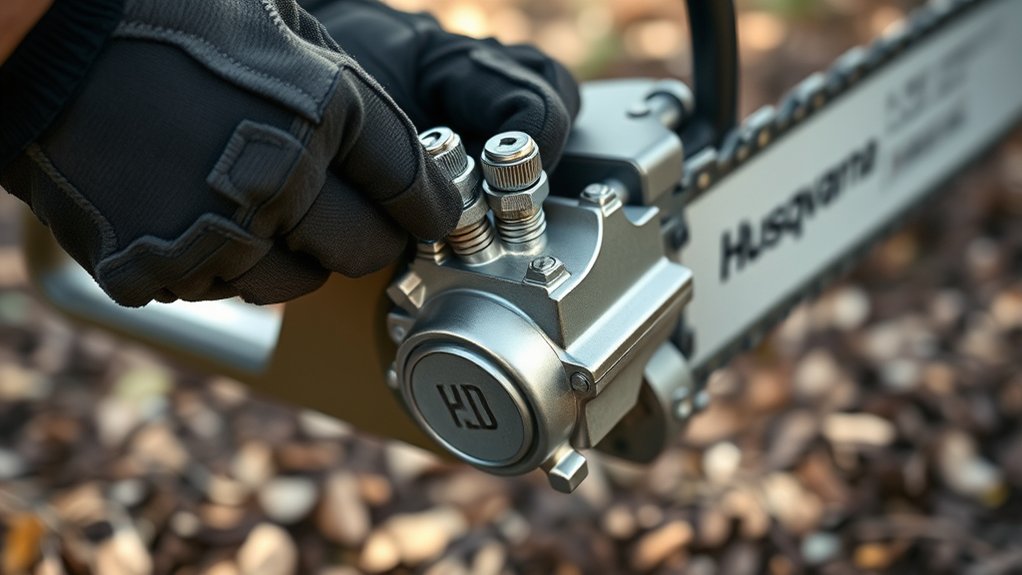
You’ll notice certain symptoms when your carburetor is running rich, like black smoke or sluggish engine response. On the other hand, a lean mix might cause your chainsaw to sputter or stall under load. Recognizing these signs helps you adjust the carburetor for peak engine performance.
Symptoms Of A Rich Mixture
Several clear signs indicate when your Husqvarna chainsaw’s carburetor is running a rich mixture. You’ll notice black, sooty smoke coming from the exhaust, which means there’s too much fuel and not enough air. The chainsaw may sputter or stall during acceleration because the excess fuel floods the engine.
You might also experience poor throttle response and a sluggish feel when cutting. Additionally, the spark plug will appear black and wet, signaling incomplete combustion. Fuel consumption tends to increase, so you’ll need to refuel more often.
If you spot these symptoms, it’s a strong indication your carburetor needs adjustment to lean out the mixture for ideal performance and fuel efficiency. Addressing this quickly prevents engine fouling and prolongs your chainsaw’s life.
Signs Of A Lean Mix
Three key signs reveal when your Husqvarna chainsaw’s carburetor is running a lean mixture. You’ll notice the engine runs hotter than usual, which can cause overheating. The chainsaw may also sputter or hesitate under load, struggling to maintain power.
Additionally, the spark plug appears white or very light gray, indicating insufficient fuel.
| Symptom | Description | What It Means |
|---|---|---|
| Overheating | Engine gets excessively hot | Lean fuel-to-air ratio |
| Sputtering | Engine hesitates under load | Not enough fuel supply |
| White Spark Plug | Plug shows white/light gray color | Too much air, not enough fuel |
Watch for these signs to know when your carburetor needs adjustment for a proper fuel mix.
Effects On Engine Performance
Understanding how a rich or lean carburetor mixture affects your chainsaw’s engine performance can save you time and prevent damage. If your carburetor runs rich, the engine gets too much fuel and not enough air, leading to sluggish performance.
Conversely, a lean mixture means too much air and not enough fuel, causing overheating and potential engine wear.
Watch for these signs:
- Rich mixture: Black smoke from the exhaust and poor acceleration.
- Lean mixture: Engine sputters, backfires, or stalls frequently.
- Rich mixture: Fouled spark plugs covered in black soot.
- Lean mixture: Overheating and difficulty maintaining idle speed.
Spotting these signs early helps you adjust the carburetor properly and keep your chainsaw running smoothly.
Set the Idle Speed Screw to a Safe Starting Point
Before you start the engine, you’ll want to set the idle speed screw to a safe starting point to prevent the chainsaw from revving too high or stalling unexpectedly. Locate the idle speed screw, usually marked with an “S” or “T” on the carburetor body. Turn the screw clockwise gently until it lightly seats, but don’t force it.
Then, back it out about one full turn as a baseline setting. This guarantees the engine gets enough air and fuel to run steadily at idle without over-revving. Once set, you’ll have a stable starting point to fine-tune later.
Adjust the Carburetor’s Low-Speed Mixture Screw for Smooth Idling
How do you guarantee your Husqvarna chainsaw runs smoothly at idle? Adjusting the carburetor’s low-speed mixture screw is key. This screw controls the fuel-to-air ratio at low engine speeds, affecting idle quality.
Follow these steps:
- Locate the low-speed mixture screw, usually marked “L.” Turn the screw clockwise until it gently seats, then back it out 1 to 1.5 turns as a starting point.
- Start the chainsaw and let it warm up for a few minutes.
- Slowly turn the screw in small increments, listening for the highest smooth idle speed without the engine bogging or dying.
Fine-tuning this screw ensures your chainsaw idles steadily and responds well when you engage the throttle.
Tune the Carburetor’s High-Speed Mixture Screw for Optimal Power
Now it’s time to focus on the high-speed mixture screw, which controls fuel flow at full throttle. You’ll want to adjust it carefully to achieve peak power without running too lean or rich.
Follow the steps to find the sweet spot that maximizes your chainsaw’s performance.
High-Speed Mixture Basics
Although adjusting the high-speed mixture screw might seem tricky at first, it’s crucial for getting your Husqvarna chainsaw to run at peak power. This screw controls the fuel-to-air ratio when the engine runs at high speeds, affecting performance and efficiency. Here’s what you need to know:
- Turning the screw clockwise leans the mixture, reducing fuel flow.
- Turning it counterclockwise richens the mixture, increasing fuel flow.
- A proper balance prevents engine overheating and ensures smooth acceleration.
- Always start with small adjustments—about a quarter turn at a time—to avoid overcorrecting.
Understanding these basics helps you maintain maximum power and prolong your chainsaw’s life. Next, you’ll learn how to fine-tune it for peak performance.
Adjusting For Peak Power
One key step to releasing your Husqvarna chainsaw’s full potential is fine-tuning the high-speed mixture screw. Start by warming up the engine to operating temperature. Then, slowly turn the high-speed screw clockwise until the engine begins to falter or revs drop.
From this point, turn the screw counterclockwise until the engine runs smoothly and reaches its highest RPM. This adjustment guarantees the engine gets the ideal fuel-to-air ratio at high speeds, maximizing power and efficiency. Avoid over-tightening, which can cause the engine to run too lean, risking damage.
After tuning, test the chainsaw under load to confirm peak performance. If the saw hesitates or bogs down, make small adjustments until it runs cleanly and powerfully.
Fine-Tune Idle Speed for Stable Chain Movement
Adjusting the idle speed properly guarantees your Husqvarna chainsaw’s chain moves smoothly without stalling or spinning uncontrollably. To fine-tune this, follow these steps carefully:
- Locate the idle speed screw, usually marked with an “S” or “T” on the carburetor.
- Start the chainsaw and let it warm up for a few minutes.
- Slowly turn the idle screw clockwise to increase speed or counterclockwise to decrease it.
- Adjust until the chain barely moves when idling, but the engine doesn’t stall.
Proper idle speed keeps your chainsaw safe and efficient. If the chain spins at idle, turn the screw down; if the engine stalls, turn it up.
Make small adjustments and test frequently for the best stability.
Test Your Chainsaw’s Acceleration After Carburetor Adjustments
Now that you’ve fine-tuned the idle speed to guarantee smooth chain movement, it’s time to check how your chainsaw responds when you accelerate. Start the engine and give it a quick throttle pull. The engine should rev up smoothly without hesitation or bogging down.
If it accelerates sharply and maintains power, your carburetor adjustments are on point. However, if the engine stutters, lags, or sputters during acceleration, it indicates the fuel mixture might still need tweaking. Make sure to test acceleration under consistent conditions, like a warm engine and steady throttle input.
This way, you get an accurate sense of performance. Proper acceleration response ensures your chainsaw will cut efficiently and safely when you need full power.
Make Final Carburetor Tweaks Based on Performance and Smoke
Although your chainsaw may run smoothly after initial adjustments, you’ll want to make final tweaks based on how it performs under load and the color of the exhaust smoke. This guarantees peak power and fuel efficiency. Follow these steps:
- Check smoke color: Blue or black smoke means a rich mixture; adjust the low-speed screw clockwise to lean it out.
- Observe engine load: If it bogs down cutting, slightly open the high-speed screw counterclockwise for more fuel.
- Listen for smooth idle: If the idle is rough, fine-tune the idle screw until the engine runs steadily without stalling.
- Test acceleration: Rapid throttle response means proper settings; if sluggish, revisit the high-speed adjustment.
Keep tweaking in small increments to avoid over-adjusting.
Keep Your Carburetor Running Smoothly With Regular Maintenance
To keep your Husqvarna chainsaw running at its best, you should perform regular carburetor maintenance. Start by cleaning the air filter frequently to prevent debris from clogging the carburetor. Inspect fuel lines for cracks or leaks and replace them if necessary.
Use fresh, properly mixed fuel to avoid residue buildup. Periodically remove the carburetor and clean its internal parts with a carburetor cleaner to eliminate varnish and dirt. Check the spark arrestor and clean it to maintain proper exhaust flow.
Adjust the carburetor settings after maintenance to ensure peak performance. Keeping your carburetor well-maintained reduces engine problems, improves fuel efficiency, and extends your chainsaw’s lifespan. Regular care saves you time and money by preventing costly repairs down the road.
Frequently Asked Questions
What Type of Fuel Mix Is Best for Husqvarna Chainsaws?
You should use a 50:1 fuel mix of high-quality unleaded gasoline and two-stroke engine oil for Husqvarna chainsaws. This mix guarantees proper lubrication and engine performance, helping your saw run smoothly and last longer.
How Often Should I Replace the Chainsaw’s Air Filter?
You should replace your chainsaw’s air filter every 25 hours of use or sooner if you work in dusty conditions.
Regularly check it, and clean or replace it to keep your saw running smoothly and efficiently.
Can I Use Aftermarket Carburetor Parts Safely?
About 40% of chainsaw failures come from poor carburetor parts. You can use aftermarket parts safely if they match OEM specs and quality. Always check reviews and avoid cheap, low-quality components to keep your saw running smoothly.
What Safety Gear Is Recommended When Adjusting the Carburetor?
You should wear safety goggles to protect your eyes, gloves to avoid cuts or fuel exposure, and hearing protection if the chainsaw’s running.
Also, work in a well-ventilated area to avoid inhaling fumes.
How Do Temperature Changes Affect Carburetor Performance?
You’ll notice carburetor performance changes with temperature because fuel vaporizes differently. Cold weather thickens fuel, making it harder to start, while heat can cause it to run too rich.
Adjustments help maintain smooth running.
Conclusion
Adjusting your Husqvarna chainsaw carburetor is like tuning a finely crafted instrument—each screw you turn brings harmony to its performance. By following these steps, you’ll guarantee smooth idling, responsive acceleration, and efficient fuel use.
Remember, small tweaks can make a big difference, so take your time and listen to your saw’s “song.” Regular maintenance will keep it running sharp, ready to tackle any job with precision and power.
Consistent carburetor adjustments ensure your Husqvarna chainsaw operates at peak performance. Proper tuning not only enhances efficiency but also extends the life of your chainsaw. Keep your chainsaw well-maintained for reliable and powerful cutting every time.

