

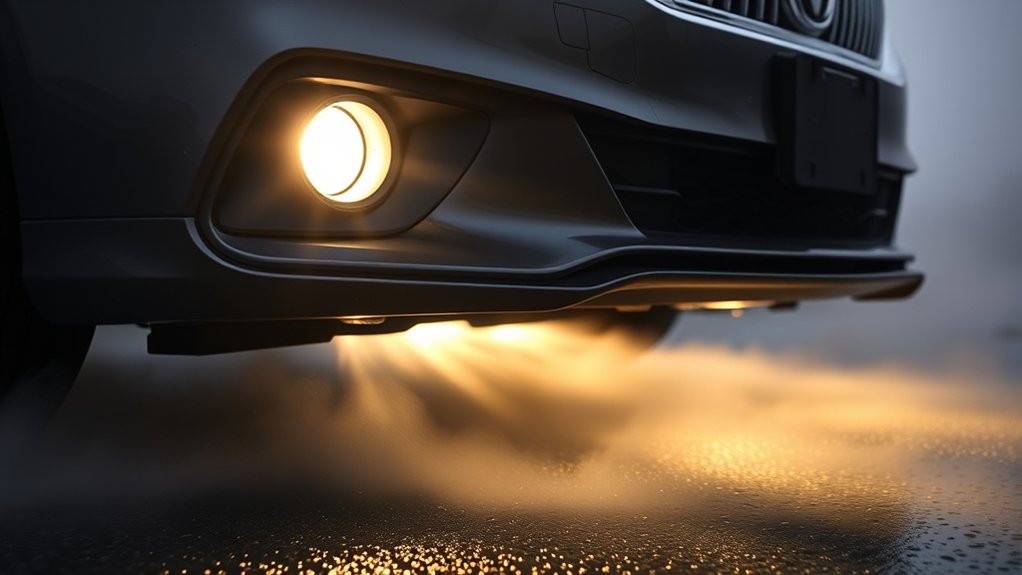
You use fog lights to improve your visibility in fog, rain, or snow by casting a wide, low beam that stays close to the road surface. These specialized lights cut through mist without causing glare, making driving safer in poor weather conditions. Fog lights are an essential part of your vehicle’s lighting system designed specifically for challenging visibility.
They’re mounted low on your vehicle to shine underneath fog layers, highlighting lane edges and obstacles. Often using yellow bulbs, they reduce light scattering to help you see better in foggy or snowy environments. Proper use of fog lights enhances your ability to navigate safely when regular headlights may cause blinding reflections.
Keep going, and you’ll uncover more about their proper use and maintenance. Understanding how fog lights work and when to use them can greatly improve your driving experience in adverse weather.
Regular maintenance ensures they perform effectively when you need them most.
Key Takeaways
- Fog lights emit a wide, low beam mounted near the bumper to illuminate road edges below fog or mist layers. They use yellow or amber light, which scatters less and reduces glare in foggy or rainy conditions. The beam angle is horizontally wide but vertically narrow to minimize reflection and enhance near-ground visibility.
- Fog lights are designed to supplement headlights, improving visibility in poor weather without blinding reflections. Proper use involves turning them on only in low visibility conditions and positioning them low to cut under fog layers.
How Fog Lights Differ From Regular Headlights
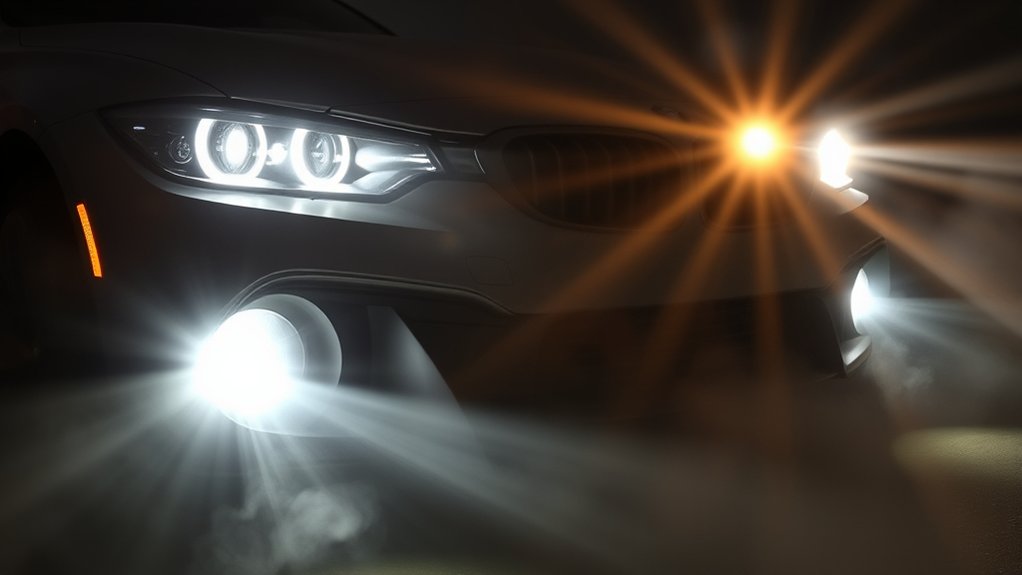
Although both fog lights and regular headlights help you see better while driving, they serve different purposes and function in distinct ways. Your regular headlights illuminate the road far ahead, allowing you to spot obstacles and navigate in general night or low-light conditions.
Fog lights, however, are designed specifically for use in fog, rain, or snow. They emit a wide, low beam that reduces glare and improves visibility near the ground where fog tends to be denser. Unlike headlights, which can reflect off fog particles and impair your vision, fog lights cut through the mist without creating blinding reflections.
When you use fog lights, you get enhanced close-range visibility, making it easier to see lane markings and edges of the road in poor weather conditions.
Why Fog Lights Are Mounted Low on Vehicles
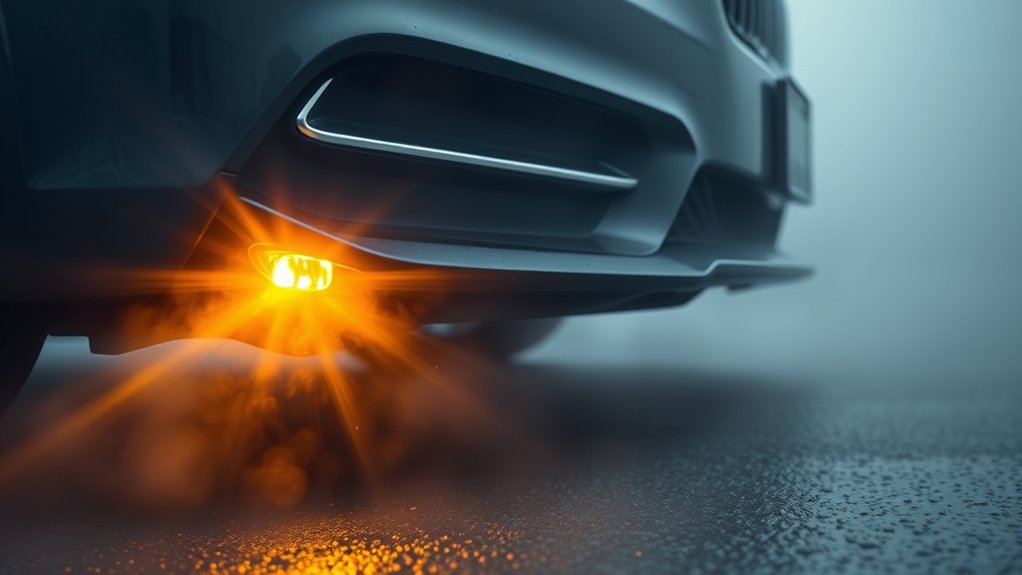
Because fog tends to hover close to the ground, fog lights are mounted low on vehicles to shine beneath the dense mist. This positioning helps you see the road more clearly without the light reflecting back directly into your eyes. When you drive in foggy conditions, your regular headlights can create glare, making it harder to spot obstacles.
Fog lights, placed near the bumper, reduce this glare by illuminating the road surface and edges. You’ll notice better visibility of lane markings and curbs, which improves your safety. Also, mounted low, these lights focus on the area immediately in front of your vehicle, helping you navigate tight spaces and avoid hazards that sit close to the ground.
This strategic placement is key to their effectiveness.
How Fog Light Beams Cut Through Fog
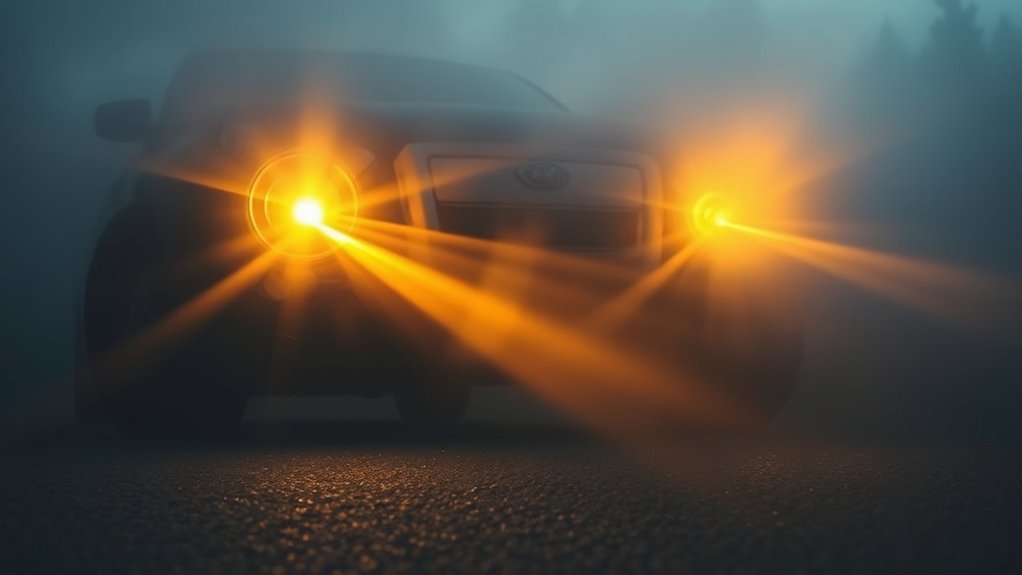
You’ll notice fog lights use a wide, low beam angle to spread light evenly without bouncing back into your eyes. The color and wavelength of the light also play a big role in cutting through fog effectively.
Plus, minimizing glare and reflection helps you see the road clearly without distractions.
Beam Angle And Spread
How exactly do fog lights manage to cut through dense fog when regular headlights often fail? It’s all about their beam angle and spread. Fog lights are designed with a wide, low beam that hugs the road rather than shooting straight ahead.
This helps reduce the amount of light that reflects off fog droplets and blinds you. Here’s how their beam characteristics help you see better:
- Wide horizontal spread illuminates the road edges
- Narrow vertical angle limits light reflection upward
- Low mounting position cuts under the fog layer
- Focused beam avoids scattering in fog
- Even light distribution prevents hot spots
This precise beam pattern improves visibility, letting you navigate safely through thick fog.
Light Color And Wavelength
Why do fog lights often use yellow or amber bulbs instead of standard white ones? It’s all about how light interacts with water droplets in fog. Yellow and amber lights have longer wavelengths than white light, which helps them penetrate fog more effectively.
Shorter wavelengths, like blue or violet, scatter more in fog, reducing visibility. When you use yellow light, it cuts through the mist with less scattering, so you see better without overwhelming glare. This means you can spot obstacles and road markings more clearly.
Minimizing Glare And Reflection
Although fog scatters light in all directions, fog lights are designed to minimize glare and reflection by projecting a wide, low beam pattern. This approach helps you see the road without the light bouncing back into your eyes.
To cut through fog effectively, fog lights:
- Aim downward to reduce light reflection from water droplets
- Spread light horizontally to illuminate the road edges
- Use specific angles to avoid blinding other drivers
- Employ yellow or selective wavelengths that scatter less
- Feature lenses and reflectors optimized for beam control
Types of Bulbs Used in Fog Lights
You’ll find that most fog lights use halogen bulbs because they’re affordable and reliable. However, LED fog lights are becoming popular since they last longer and use less energy.
Let’s look at what makes each type unique for fog light use.
Halogen Bulbs Overview
How do halogen bulbs differ from other types used in fog lights? You’ll find that halogen bulbs are one of the most common choices because they offer a bright, warm light that cuts through fog effectively. They use a tungsten filament surrounded by halogen gas, which helps the bulb last longer and stay brighter.
When choosing halogen bulbs, here are key points to take into account:
- Affordable and widely available
- Produce a yellowish light ideal for foggy conditions
- Simple design makes replacement easy
- Generate more heat compared to newer options
- Typically consume more power than LEDs or HIDs
Understanding these features helps you appreciate why halogen bulbs remain popular despite newer technologies emerging.
LED Fog Light Benefits
Why should you consider LED fog lights for your vehicle? LEDs offer brighter, more focused light that cuts through fog and rain better than traditional bulbs. They consume less power, so they won’t drain your battery as quickly, making them more efficient overall.
You’ll also enjoy longer lifespan with LEDs, meaning fewer replacements and less hassle. Their compact size allows for more flexible designs and better beam control, improving your visibility without blinding other drivers. Plus, LEDs turn on instantly, giving you immediate illumination when you need it most.
If you want reliable, energy-efficient, and clear fog lighting, switching to LED fog lights is a smart upgrade that enhances both safety and convenience.
How Fog Lights Improve Visibility in Bad Weather
Fog lights cut through dense fog, rain, and snow by casting a wide, low beam that reduces glare and reflection. This design helps you see the road more clearly without blinding other drivers.
Here’s how fog lights improve your visibility in bad weather:
- Illuminate the road surface close to your vehicle, revealing lane markings and obstacles
- Minimize light bouncing back from fog or precipitation, reducing eye strain
- Provide a broader field of vision compared to standard headlights
- Enhance contrast, making objects stand out against foggy backgrounds
- Help other drivers spot your vehicle sooner in poor conditions
When to Turn On Your Fog Lights
You should turn on your fog lights whenever visibility drops due to fog, heavy rain, or snow. They’re especially helpful during nighttime driving when regular headlights might reflect off the fog and reduce your vision.
Just remember to check local laws, as some areas have specific rules about when fog lights can be used.
Low Visibility Conditions
When should you switch on your fog lights to improve safety on the road? You want to use them whenever visibility drops considerably due to weather or environmental factors. Fog lights cut through the haze better than regular headlights, helping you see the road and making your vehicle more visible to others.
Turn on your fog lights in these low visibility conditions:
- Dense fog or heavy mist
- Driving through heavy rain or drizzle
- Snowfall reducing sight distance
- Dust storms or blowing sand
- Thick smoke from nearby fires
Nighttime Driving Situations
Although headlights provide general illumination at night, fog lights offer targeted lighting that enhances visibility in specific situations. You should turn on your fog lights when driving in dense fog, heavy rain, or snow, as they reduce glare and light up the road close to your vehicle.
Use them during twilight or dawn when visibility is low but headlights alone aren’t enough. Avoid using fog lights in clear conditions to prevent dazzling other drivers.
| Situation | Why Use Fog Lights? | Benefit |
|---|---|---|
| Dense Fog | Cuts through thick mist | Better road edge visibility |
| Heavy Rain | Reduces glare from wet surfaces | Clearer view of the road |
| Snowfall | Lights up snowy road surface | Improves reaction time |
| Twilight/Dawn | Low natural light | Enhances short-range vision |
| Rural Roads at Night | Limited street lighting | Highlights road boundaries |
Legal Restrictions Awareness
How do legal restrictions impact your use of fog lights? You need to know when it’s appropriate to switch them on to avoid fines and ensure safety. Fog lights are designed for low visibility conditions like fog, heavy rain, or snow—not as regular driving lights.
Laws vary by location but generally require you to use fog lights only when visibility drops below a certain distance.
Keep these points in mind:
- Use fog lights only in poor visibility conditions
- Turn them off when visibility improves
- Avoid using fog lights with high beams
- Check your local laws before use
- Use fog lights to complement, not replace, headlights
Staying aware of these rules helps you stay safe and legal on the road.
Common Fog Light Usage Mistakes
Since fog lights are designed for specific conditions, many drivers misuse them by turning them on in clear weather or heavy rain, which can actually reduce visibility for others. You might think fog lights improve your overall vision, but using them unnecessarily can cause glare, distracting other drivers. Another common mistake is relying solely on fog lights instead of your regular headlights in foggy conditions.
Fog lights complement your low beams—they don’t replace them. Also, avoid using your high beams in fog; they reflect off the fog particles and worsen visibility. In conclusion, some drivers forget to turn off fog lights when conditions improve, which can drain your battery or wear out the bulbs prematurely.
Using fog lights correctly ensures safety for you and everyone else on the road.
Maintaining and Replacing Fog Lights
When was the last time you checked your fog lights? Keeping them in good shape ensures you stay safe in low-visibility conditions. Regular maintenance helps you avoid sudden failures.
Regularly checking your fog lights is key to staying safe in low-visibility conditions and preventing unexpected failures.
Here’s how you can maintain and replace your fog lights effectively:
- Inspect bulbs monthly for signs of dimming or damage.
- Clean the lens regularly to remove dirt and grime.
- Check the wiring and connections for corrosion or loose contacts.
- Replace bulbs with the correct type specified in your vehicle’s manual.
- Test fog lights after maintenance to ensure they function properly.
Replacing fog lights yourself is usually straightforward, but if you notice persistent issues, seek professional help to avoid electrical problems. Staying proactive keeps your fog lights reliable when you need them most.
How Fog Lights Impact Your Car’s Electrical System
Regularly maintaining and replacing your fog lights not only guarantees they work properly but also helps protect your car’s electrical system from strain. Fog lights draw power directly from your battery and alternator, so faulty wiring or bulbs can cause voltage drops or shorts. This can lead to dimmer lights or electrical issues in other systems.
Ensuring your fog lights are in good shape prevents unnecessary load on your electrical components and keeps your car running smoothly.
| Component | Impact on Electrical System | Maintenance Tip |
|---|---|---|
| Fog Light Bulb | Power draw, heat generation | Replace burnt-out bulbs promptly |
| Wiring Harness | Voltage stability | Check for corrosion or damage |
| Switch & Relay | Current flow control | Test for proper operation |
| Battery & Alternator | Power supply | Monitor charge and output levels |
Fog Light Laws by State
Although fog lights serve a crucial safety role in low-visibility conditions, you need to know that their use and installation are regulated differently across states. To avoid fines or safety issues, it’s important to check your local laws before adding or using fog lights. Here are five key points to consider:
- Some states restrict fog light use to weather conditions like fog, snow, or heavy rain.
- Certain states require fog lights to be mounted at specific heights on your vehicle.
- Color restrictions are common; most states allow only white or amber fog lights.
- In some areas, using fog lights alongside high beams is prohibited.
- States vary on whether aftermarket fog lights need to meet specific brightness standards.
Always verify your state’s rules to stay compliant and safe on the road.
Frequently Asked Questions
Can Fog Lights Be Used During Heavy Rain or Snow?
Yes, you can use fog lights during heavy rain or snow. They improve visibility by cutting through the harsh weather, helping you see the road better and making your vehicle more noticeable to others in poor conditions.
Do Fog Lights Affect Fuel Efficiency?
No, fog lights don’t substantially affect your fuel efficiency since they use low wattage bulbs. You can use them without worrying about extra fuel consumption, but always switch them off when they’re not needed to save energy.
Are LED Fog Lights Better Than Halogen Ones?
Yes, LED fog lights are better because they use less energy, last longer, and produce brighter, clearer light than halogen ones.
You’ll see better visibility in foggy conditions while saving on energy and replacement costs.
Can Fog Lights Cause Glare for Other Drivers?
Yes, fog lights can cause glare, yet they’re designed to minimize it by aiming low and wide.
If you misuse or overuse them, though, you’ll blind other drivers instead of helping them see clearly.
How Do Fog Lights Interact With Automatic Headlight Systems?
Your automatic headlight system usually won’t activate fog lights on its own; you’ll need to turn them on manually. They work independently to improve visibility in fog without interfering with automatic headlight functions.
Conclusion
When fog thickens like a ghostly curtain, your fog lights act as sharp blades slicing through the haze. Mounted low and shining wide, they reveal the road beneath the mist, guiding you safely forward.
By understanding how they work and using them wisely, you’ll drive with confidence even when the world feels shrouded. Keep them maintained, follow the laws, and let your fog lights be your trusted companions in the darkest, foggiest nights.
Proper use of fog lights enhances visibility and safety during low-visibility conditions. Regular maintenance ensures they function effectively. Always remember, fog lights are essential tools for safe driving in fog, rain, and snow.

