

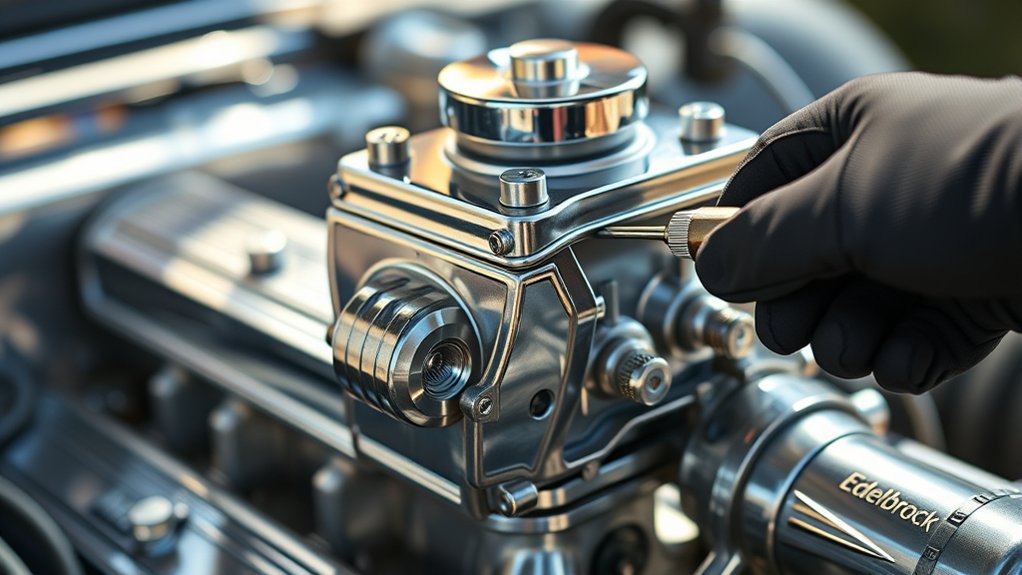
To adjust your Edelbrock carburetor in seven simple steps, start by gathering the necessary tools and preparing the engine. Make sure to park on level ground and allow the engine to cool before beginning. Proper adjustment of your Edelbrock carburetor ensures optimal performance and fuel efficiency.
First, identify the idle speed and mixture screws. Use a tachometer to set the correct idle RPM and carefully fine-tune the air-fuel mixture for smooth operation.
Next, adjust the accelerator pump to improve throttle response and prevent hesitation during acceleration.
Set the choke properly to aid cold starts and ensure the engine warms up efficiently.
Finally, take the vehicle for a test drive to evaluate performance. Make any final tweaks needed to achieve peak performance and reliability.
Keep going to uncover detailed tuning tips for your Edelbrock carburetor.
Key Takeaways
- Disconnect the battery, inspect and clean the carburetor exterior before starting adjustments.
- Use a tachometer to set the idle speed by adjusting the idle speed screw to the recommended RPM.
- Adjust the idle mixture screws by turning until the engine stumbles, then backing off to achieve smooth idle.
- Fine-tune the accelerator pump stroke to ensure quick and strong fuel delivery during throttle application.
- Test drive the vehicle, monitor engine response, and make final adjustments for smooth, consistent performance.
Get Your Tools Ready and Prep Your Edelbrock Carburetor
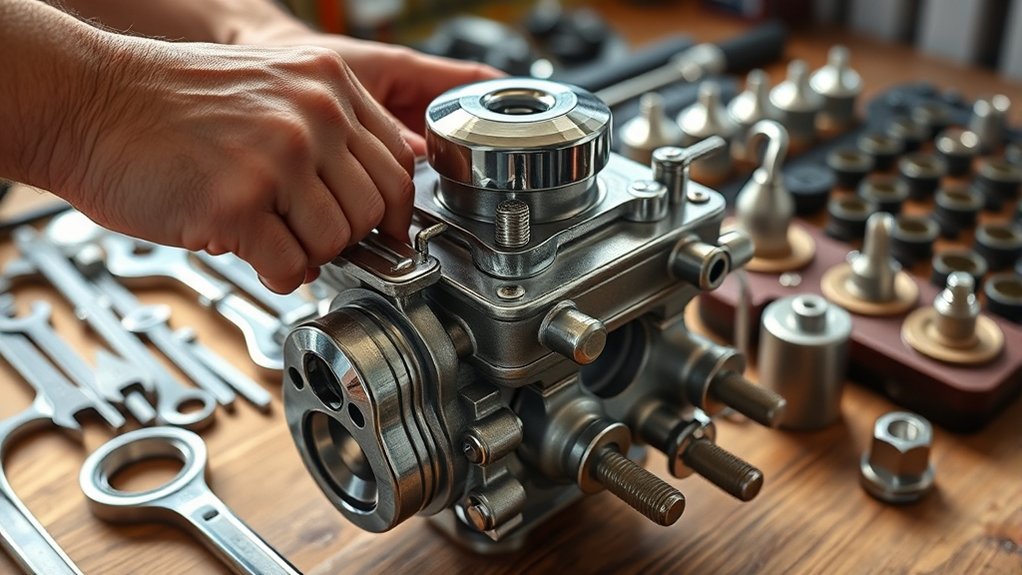
Before you begin adjusting your Edelbrock carburetor, make sure you have all the necessary tools on hand. You’ll need a flathead screwdriver, a socket wrench set, and a tachometer to monitor engine speed accurately. Have a clean rag ready to wipe any spills or dirt.
Also, confirm your vehicle is parked on a level surface with the engine cool to avoid burns. Disconnect the negative battery cable to prevent accidental starts. Once you’ve gathered your tools, open the hood and visually inspect the carburetor for dirt, debris, or leaks.
Cleaning the exterior with a carburetor cleaner helps you work efficiently. Preparing your carburetor this way sets a solid foundation for precise adjustments and ensures safety throughout the process.
Locate and Identify Edelbrock Carburetor Adjustment Screws
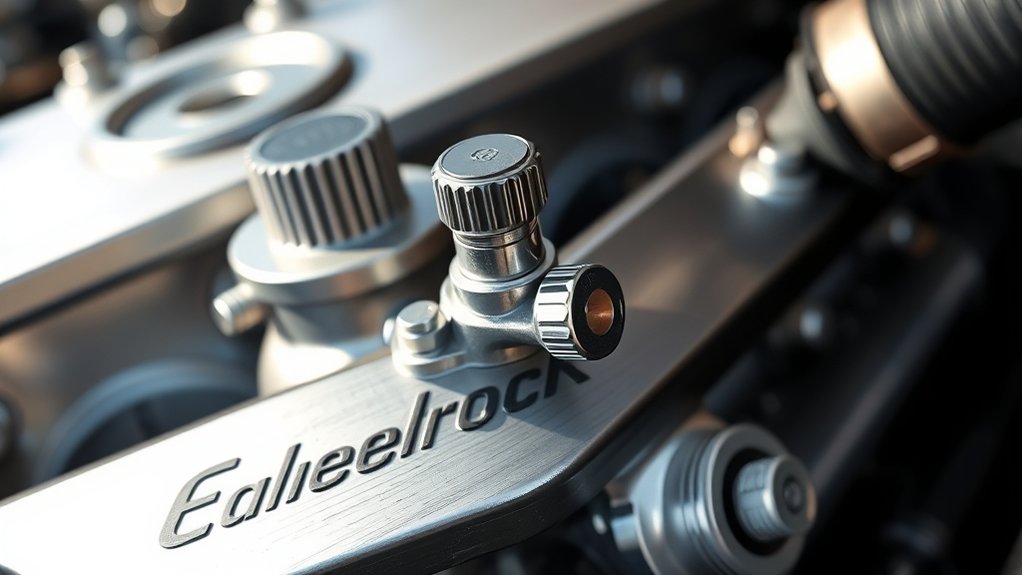
Once you’re ready to adjust your Edelbrock carburetor, you’ll need to locate the key adjustment screws that control fuel mixture and idle speed. These screws are typically positioned on the front or sides of the carburetor’s throttle body. Look for two main screws: the idle mixture screw, which adjusts the air-fuel ratio at idle, and the idle speed screw, which controls the throttle plate position.
The idle mixture screw often has a spring around it to prevent accidental changes. The idle speed screw is usually larger and directly connected to the throttle linkage. Be sure to consult your specific Edelbrock model’s manual, as screw locations can vary slightly.
Identifying these screws correctly ensures precise tuning and maximum engine performance.
Set the Edelbrock Carburetor Idle Speed
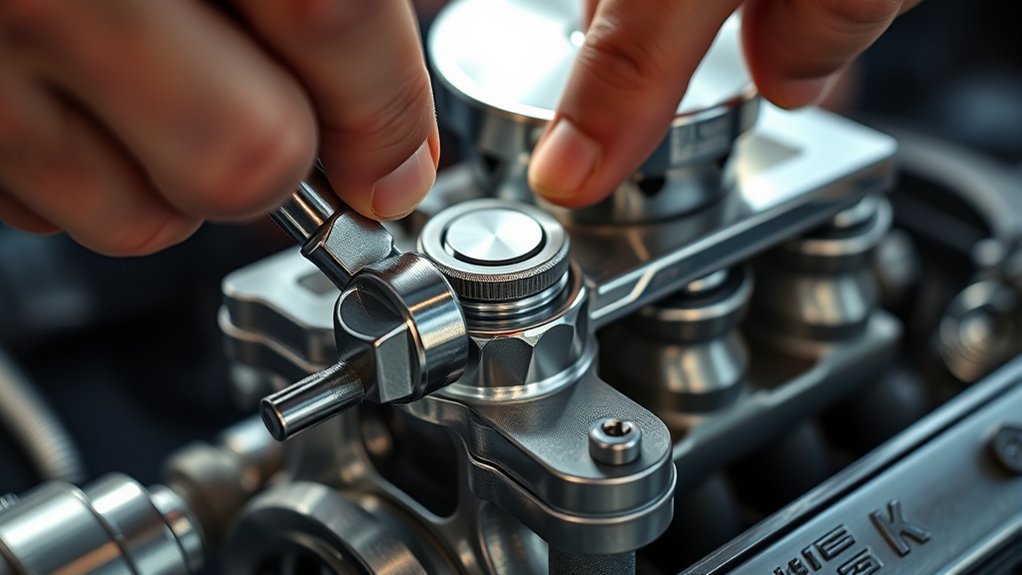
Start by locating the idle adjustment screw on your Edelbrock carburetor. Use a tachometer to monitor the engine’s RPM for precise adjustments. Turn the screw slowly to find the ideal idle speed without causing the engine to stall.
Locate Idle Adjustment Screw
Where exactly do you find the idle adjustment screw on your Edelbrock carburetor? It’s usually located on the side of the carburetor body, near the throttle lever. This screw controls the idle speed by adjusting the throttle plate’s position when the engine is at rest.
To locate it easily, look for a small, slotted screw that’s accessible without removing parts.
Here’s a quick guide to identify it:
| Location | Appearance | Function |
|---|---|---|
| Side of carburetor | Small slotted screw | Controls idle throttle |
| Near throttle arm | Usually brass or steel | Adjusts idle speed |
| Easily accessible | No tools needed for access | Sets baseline RPM |
Once you find it, you’re ready to fine-tune your idle speed.
Use Tachometer For Accuracy
Although you can adjust the idle screw by feel, using a tachometer guarantees you set the Edelbrock carburetor idle speed with precision. Connect the tachometer according to its instructions—usually to the ignition coil or distributor. Start the engine and let it warm up to operating temperature.
Watch the tachometer’s reading as you turn the idle adjustment screw. Your goal is to reach the manufacturer’s recommended idle RPM, often found in your vehicle’s service manual or Edelbrock’s guide. This approach removes guesswork, ensuring your engine runs smoothly and efficiently at idle.
Adjust Screw Slowly
When you turn the idle adjustment screw, do so slowly to avoid overshooting the ideal setting. Making quick or large adjustments can throw off your carburetor’s performance and cause the engine to run rough.
Instead, take your time and make small turns, then let the engine settle before checking the RPM.
Here’s how to adjust the screw effectively:
- Turn the screw a quarter turn at a time for fine control
- Wait 10-15 seconds after each adjustment for the engine to stabilize
- Use your tachometer to monitor RPM changes precisely
Adjust the Edelbrock Carburetor Idle Mixture Screws
Before fine-tuning your Edelbrock carburetor’s performance, you’ll need to adjust the idle mixture screws carefully. These screws control the air-fuel mixture at idle, affecting engine smoothness and fuel efficiency. Start by locating the two idle mixture screws on the carburetor’s base.
With the engine warmed up and running, turn each screw slowly clockwise until the engine stumbles, then back them out counterclockwise until the engine runs smoothly. Alternate between screws, making small adjustments to find the highest, steady idle speed. Avoid turning the screws too far in or out to prevent a lean or rich mixture, which can cause rough idling or stalling.
Once balanced, tighten the screws gently to secure their position without over-tightening. This step guarantees your engine idles reliably before further tuning.
Fine-Tune the Edelbrock Carburetor Accelerator Pump
Now it’s time to fine-tune the accelerator pump, which helps deliver extra fuel during quick throttle openings.
You’ll want to adjust the pump stroke to get the right amount of fuel injected at the right time. After that, test the pump response to verify your carburetor reacts smoothly and quickly.
Accelerator Pump Function
How does the accelerator pump impact your Edelbrock carburetor’s performance? It plays a crucial role in delivering an extra shot of fuel when you quickly open the throttle, preventing hesitation and ensuring smooth acceleration. If it’s not working properly, your engine might stumble or lag when you step on the gas.
Here’s what the accelerator pump does for you:
- Provides an immediate fuel burst to avoid lean conditions during throttle changes
- Enhances throttle response for quicker acceleration
- Helps maintain consistent engine performance under varying loads
Understanding this function helps you diagnose performance issues and ensures your Edelbrock carburetor reacts perfectly when you need power fast. Next, you’ll learn how to adjust the pump stroke to fine-tune this effect even further.
Adjusting Pump Stroke
Since the accelerator pump directly affects throttle response, adjusting its stroke is essential for peak performance. To fine-tune the pump stroke on your Edelbrock carburetor, first locate the accelerator pump lever connected to the throttle linkage. Loosen the retaining clip or screw that holds the pump arm in place.
Next, adjust the stroke length by sliding the pump arm in or out—shortening it reduces fuel delivery, while lengthening it increases the shot of fuel during acceleration. Make small adjustments, then retighten the clip securely. Avoid overextending the stroke, as too much fuel can cause bogging or hesitation.
This precise adjustment guarantees the accelerator pump delivers the right amount of fuel right when you need it, improving throttle response and overall engine performance.
Testing Pump Response
After adjusting the pump stroke, you’ll want to test the accelerator pump response to guarantee your changes deliver the right amount of fuel during acceleration. Start by manually operating the throttle lever and watching the accelerator pump discharge. You’re looking for a strong, immediate squirt of fuel without hesitation or flooding.
Next, take your vehicle for a short drive, paying close attention to throttle response. If you notice any stutter or lag, further adjustment may be necessary.
Focus on these key points during testing:
- Verify the fuel squirts consistently with each throttle movement
- Watch for smooth acceleration without bogging down
- Listen for engine hesitation or backfires that indicate a lean or rich mix
Fine-tuning here ensures your Edelbrock carburetor performs at its best under load.
Adjust the Edelbrock Carburetor Choke for Cold Starts
When your engine is cold, adjusting the Edelbrock carburetor choke guarantees smooth starts and prevents stalling. Begin by locating the choke housing on the carburetor. Loosen the choke plate by turning the adjustment screw counterclockwise until the plate just begins to close.
Make sure the choke linkage moves freely without binding. Next, manually close the choke plate slightly and release it; it should open gradually as the engine warms. If it stays closed too long or opens too quickly, adjust the choke pull-off vacuum diaphragm by turning its screw to fine-tune the opening rate.
This assures the choke responds properly to engine temperature changes. Proper choke adjustment improves cold-start performance and helps your engine run efficiently right from the start.
Test Drive and Finalize Edelbrock Carburetor Adjustments
How do you know if your Edelbrock carburetor adjustments are spot on? The best way is to take your vehicle for a test drive. Pay close attention to how the engine responds during acceleration, idle, and cruising.
If you notice any hesitation, stalling, or rough idling, further tweaks are needed.
During the test drive, focus on:
- Smooth throttle response without lag or bogging
- Consistent idle speed without fluctuations
- No backfiring or unusual engine noises
Once you confirm these points, your Edelbrock carburetor is dialed in perfectly. If not, return to the adjustment steps and fine-tune accordingly.
This final test ensures your engine runs efficiently and delivers optimal performance every time you hit the road.
Frequently Asked Questions
What Are Common Symptoms of a Poorly Adjusted Edelbrock Carburetor?
You’ll notice rough idling, poor acceleration, and stalling if your Edelbrock carburetor’s off. It might also cause black smoke from the exhaust or reduced fuel efficiency.
You’ll want to tweak it promptly to fix these issues.
How Often Should I Adjust My Edelbrock Carburetor?
How often do you want your engine running smoothly? You should adjust your Edelbrock carburetor at least once a year or whenever you notice rough idling or decreased performance.
Don’t wait for problems to start tuning it.
Can Edelbrock Carburetors Be Rebuilt or Do They Need Replacement?
Yes, you can rebuild Edelbrock carburetors with a rebuild kit, saving money and maintaining performance. You only need to replace them if the damage is severe or parts are unavailable.
Regular maintenance helps extend their life.
What Fuel Type Is Best for Edelbrock Carburetors?
You’ll want to use unleaded gasoline with an octane rating of 87 or higher for Edelbrock carburetors. Avoid ethanol blends above 10% to prevent damage and maintain peak performance and fuel efficiency.
Are Edelbrock Carburetors Compatible With Modern Fuel Injection Systems?
You won’t find Edelbrock carburetors dancing seamlessly with modern fuel injection systems—they’re from different eras. You’ll need adapters or custom setups if you want them to play together, blending old-school charm with new tech.
Conclusion
Adjusting your Edelbrock carburetor is like tuning a finely crafted musical instrument. Each screw and setting plays its part to create the perfect harmony under your hood. With patience and care, you transform your engine’s performance from a rough tune into a smooth symphony.
So, take the wheel and make those adjustments carefully. Enjoy the thrilling rhythm of your engine singing just right on every drive. Properly adjusting an Edelbrock carburetor ensures better fuel efficiency, smoother idling, and enhanced overall performance.

