

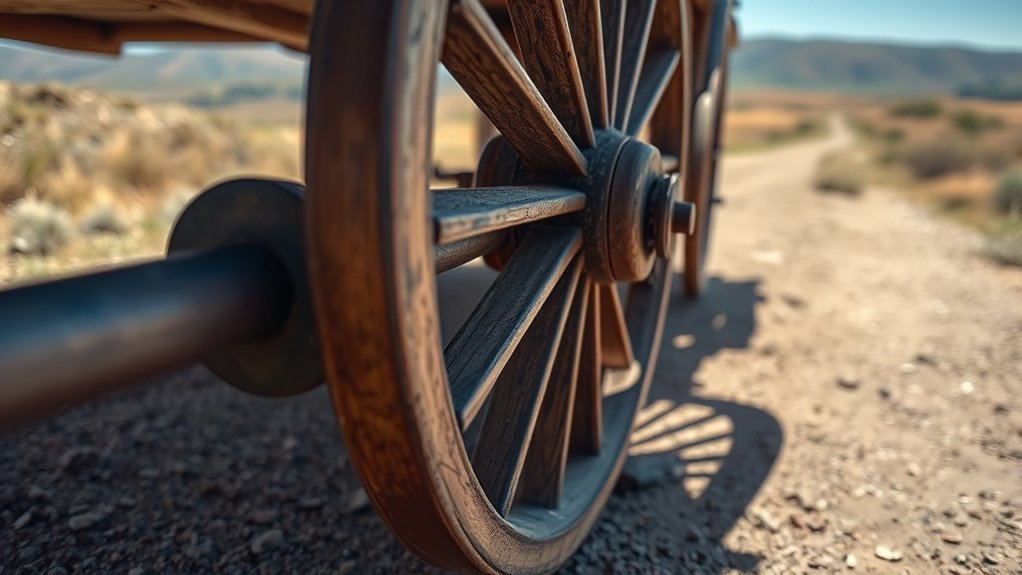
When you turn a wheel attached to a smaller axle, you create a mechanical advantage that increases the distance traveled. This simple machine converts rotational motion into greater linear distance, allowing you to move farther with less effort.
The relationship between wheel size and axle size plays a crucial role in how efficiently this system works.
The larger the wheel, the more ground you cover with each turn, which means fewer rotations are needed to travel the same distance. This reduces the amount of force required, making tasks easier and motion smoother.
Understanding how the wheel and axle work together reveals how this design revolutionizes movement and transport.
By examining wheel size, the role of the axle, and overall design, you can see why this basic system has such a significant impact on distance and efficiency.
Key Takeaways
- The larger wheel turns a smaller axle, converting rotational motion into greater linear distance traveled.
- Increasing the wheel’s circumference allows more ground to be covered per rotation, reducing axle rotations needed.
- Force applied at the wheel’s larger radius amplifies torque, enabling more efficient movement over longer distances.
- The wheel-to-axle size ratio determines how much the distance is increased during rotation.
- Reduced friction from rolling motion helps maintain smooth, continuous movement, maximizing effective distance traveled.
What Is a Wheel and Axle and How Does It Work?
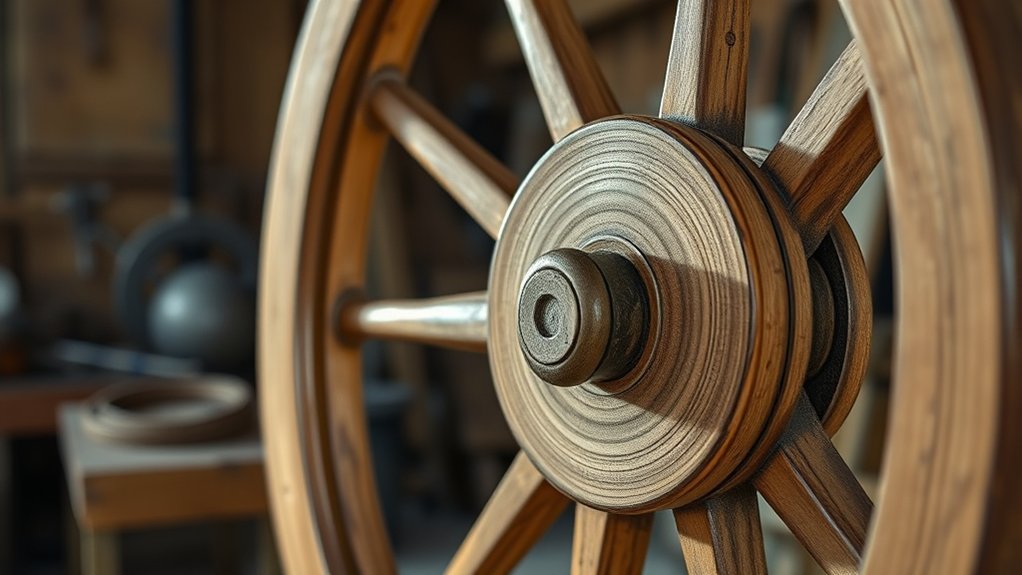
How exactly does a wheel and axle work to make moving objects easier? When you use a wheel attached to a smaller axle, turning the wheel causes the axle to rotate too. This setup reduces the effort you need to move or lift things.
The larger wheel covers more ground with each turn, while the smaller axle increases force. So, you apply less force over a longer distance, making tasks feel lighter. The wheel and axle work together by converting your input into a mechanical advantage, letting you move heavy objects more efficiently.
You’ll find this simple machine in everyday items like doorknobs, cars, and rolling carts, all designed to make work easier by multiplying your effort.
How Rotational Motion Turns Into Linear Distance
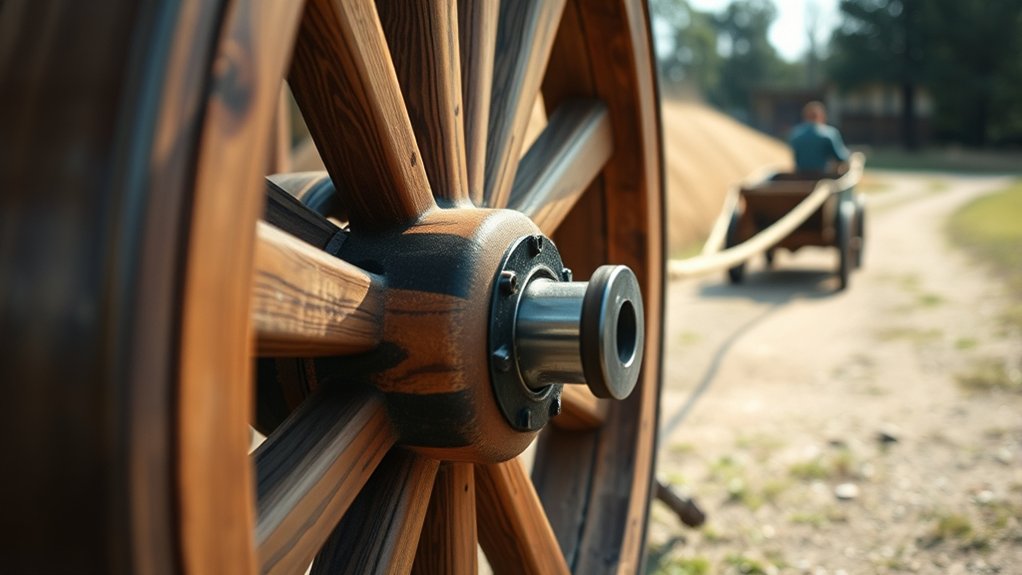
When you turn the wheel, its circular motion translates into a straight path for the axle. This shift from rotation to linear movement lets you cover more ground with less effort. Understanding this conversion helps explain how the wheel and axle amplify the distance you travel.
Rotational To Linear Conversion
Why does turning a wheel make something move forward? When you rotate a wheel, its circular edge rolls across a surface, pushing it forward. This rotational motion converts into linear motion because every point on the wheel’s circumference travels a certain distance along a straight line.
As you spin the wheel, the axle connected to it also turns, but the wheel’s contact with the ground ensures the whole system moves forward instead of just spinning in place. The key is the wheel’s grip on the surface, which prevents slipping and forces linear displacement.
Distance Amplification Mechanism
Ever wondered how turning a small wheel can make an object move a much greater distance? The wheel and axle work together to amplify distance by converting rotational motion into linear movement. When you rotate the wheel, its larger circumference covers more ground than the smaller axle turns, resulting in greater output distance.
Here’s how the distance amplification mechanism works:
- The wheel’s larger radius means it travels farther per rotation.
- The axle rotates fewer times but moves the load linearly.
- Rotational motion translates into linear displacement.
- The ratio of wheel to axle size determines the distance increase.
How the Wheel and Axle Create Mechanical Advantage
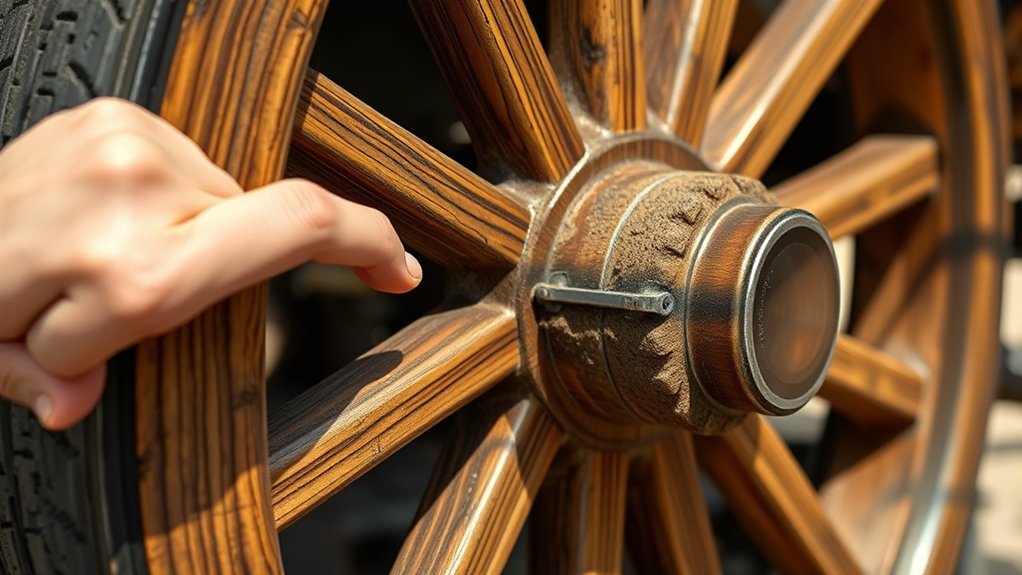
You’ll see how the wheel and axle work together to multiply the force you apply, making tasks easier. By turning a small force over a larger distance, the rotation creates a mechanical advantage that helps you move heavier loads.
Understanding this relationship between force and distance is key to seeing how the wheel and axle increase efficiency.
Force Multiplication Explained
Although the wheel and axle may seem simple, they multiply force in a way that makes your work easier. When you apply force to the larger wheel, the axle turns with greater force but less distance. This mechanical advantage means you don’t have to push as hard to move an object.
Here’s how force multiplication works:
- The larger wheel requires less force to turn.
- The smaller axle delivers greater output force.
- Force is spread over a larger distance on the wheel.
- The axle converts that force into powerful rotation.
Rotation and Distance Relationship
How exactly does the wheel and axle increase the distance over which force is applied? When you turn the larger wheel, it rotates around the smaller axle. Because the wheel has a bigger radius, it covers more distance with each rotation than the axle does.
This means you move the wheel a longer distance while the axle turns a shorter distance but with greater force. The relationship between their radii determines this mechanical advantage. By rotating the wheel, you effectively increase the distance your input force travels, allowing you to move a heavier load attached to the axle with less effort.
How Larger Wheel Size Increases Distance Moved
Why does increasing the size of a wheel help it move farther with each turn? When you use a larger wheel, the distance covered in one full rotation increases because the wheel’s circumference grows. This means every time the wheel spins once, it rolls over more ground than a smaller wheel would.
A larger wheel covers more ground per rotation, making each turn more efficient and effective.
Here’s why a bigger wheel matters:
- Larger circumference equals greater distance per rotation
- Reduces the number of rotations needed to cover the same distance
- Enhances efficiency by minimizing energy spent on repeated rotations
- Smooths out movement over uneven surfaces due to bigger contact area
How the Axle Helps Increase Movement
Where does the axle fit into increasing movement? The axle acts as the central shaft that connects to the wheel, allowing it to rotate smoothly. When you turn the wheel, the axle spins as well, translating your input into motion.
Because the axle has a smaller diameter than the wheel, it covers less distance per rotation. This difference means the axle can rotate multiple times while the wheel completes one full turn, effectively increasing the total movement. By linking the wheel and axle, you create a system where the axle’s rotation helps control and amplify movement.
This setup lets you move objects farther and more efficiently than if you were relying on the axle or wheel alone.
How Force on the Wheel and Axle Affects Distance
When you apply force to the wheel, it spreads differently across the wheel and axle, which changes how far you can move an object. The torque created by this force directly impacts the distance the wheel turns.
Understanding this relationship helps you see why the wheel and axle system can increase movement efficiently.
Force Distribution Effects
How does applying force to the wheel and axle change the distance an object moves? When you push or pull on the wheel, the force distributes between the wheel and axle, affecting how far the object travels. The larger wheel radius means a small force moves a greater distance along its edge, while the smaller axle radius amplifies the force but reduces the distance it covers.
Understanding this helps you see how force distribution impacts movement.
Consider these key points:
- Force applied to the wheel covers more distance due to its larger circumference.
- The axle experiences greater force but moves over a shorter distance.
- Proper force distribution ensures efficient energy transfer.
- Imbalanced force can cause slippage or less movement.
You control distance by managing where and how you apply force.
Torque and Distance Relationship
Why does applying force at different points on the wheel and axle change the distance an object moves? It all comes down to torque, which is the twisting force that causes rotation. When you apply force farther out on the wheel’s rim, you generate more torque because torque equals force times the radius.
This increased torque lets the wheel turn more easily, moving the object a greater distance with less effort. Conversely, applying force closer to the axle produces less torque, so the wheel won’t rotate as effectively, reducing the distance moved. Understanding this relationship helps you see why using a larger wheel radius can increase distance—
You’re fundamentally maximizing torque for the same amount of force, making your effort more efficient and the object travel farther.
How the Wheel and Axle Reduce Effort When Moving Objects
Have you ever wondered what makes it easier to move heavy objects using a wheel and axle? The key lies in how the wheel and axle work together to reduce the effort you need to apply. When you turn the larger wheel, it rotates the smaller axle, multiplying the force you exert.
This mechanical advantage means you don’t have to push or pull as hard.
Here’s how the wheel and axle reduce effort:
- The larger wheel turns a smaller axle, increasing force.
- The force spreads over a greater distance, requiring less effort.
- Friction decreases as rolling replaces sliding motion.
- The design allows smoother, continuous movement with less strain.
Real-World Examples of Distance Increase Using the Wheel and Axle
When you use a wheel and axle in everyday tools, you’ll notice they often help increase the distance over which force is applied. For instance, turning a doorknob lets you apply force over a greater distance on the wheel, making it easier to open the door.
Similarly, a screwdriver’s handle acts as a wheel, allowing you to rotate the axle (the screw) a longer distance with less effort. Even a rolling office chair uses small wheels and axles to move you farther with a gentle push.
These examples show how the wheel and axle system extends the distance your force travels, making tasks feel smoother and less strenuous. You’ll see this principle in many simple machines around you every day.
How the Wheel and Axle Transformed Transportation
You’ve already seen how a wheel and axle help increase the distance over which force is applied in everyday tools. When it comes to transportation, this simple mechanism revolutionized how you move people and goods. By reducing friction and enabling smoother motion, wheels and axles made travel faster and less tiring.
They transformed heavy loads into manageable tasks and opened new possibilities for trade and exploration.
Here’s how the wheel and axle changed transportation:
- Enabled carts and wagons to carry heavier loads with less effort
- Allowed chariots and carriages to move swiftly across vast distances
- Made bicycles and early vehicles more efficient and accessible
- Laid the foundation for modern cars, trains, and machinery you rely on today
This innovation truly reshaped your world by increasing mobility and connectivity.
What Limits the Distance Increase of a Wheel and Axle?
Although a wheel and axle can increase the distance over which force is applied, several factors limit just how much distance you can gain. The size difference between the wheel and axle, friction, material strength, and practical design constraints all play a role. If the wheel is too large compared to the axle, the system becomes inefficient or unstable.
Friction between moving parts reduces the smooth transfer of force, limiting distance. Also, materials can only withstand so much stress before bending or breaking. Finally, real-world designs balance distance increase with durability and control.
| Limiting Factor | Impact on Distance Increase |
|---|---|
| Wheel-to-axle ratio | Too large or small reduces gain |
| Friction | Decreases smooth motion |
| Material strength | Limits size and force applied |
| Stability | Affects control and efficiency |
| Design constraints | Balance distance with durability |
Frequently Asked Questions
Who Invented the Wheel and Axle?
You can’t credit a single person for inventing the wheel and axle since it emerged around 3500 BCE in Mesopotamia. Early civilizations gradually developed it to improve transportation and tools, shaping human progress over time.
What Materials Are Best for Making Wheels and Axles?
You don’t want wheels and axles made of cotton candy—though tempting. Instead, choose durable materials like steel or hardwood; they handle stress, last longer, and keep you rolling smoothly without turning your ride into a sticky mess.
How Do Wheel and Axle Systems Compare to Pulleys?
You’ll find wheel and axle systems rotate to multiply force or speed, while pulleys change direction and can also multiply force. Both help you lift or move loads more easily but work differently in mechanics.
Can Wheel and Axle Mechanisms Be Used Underwater?
Yes, you can use wheel and axle mechanisms underwater. Just make sure they’re made from corrosion-resistant materials, like stainless steel or plastics, so they don’t rust or seize up.
Proper sealing also keeps them working smoothly.
How Do Maintenance Needs Vary for Different Wheel and Axle Types?
You’ll find maintenance varies by type; larger wheels need regular lubrication and inspection, while smaller or sealed axles require less.
Underwater types demand corrosion checks. Staying proactive prevents wear and guarantees smooth performance.
Conclusion
You clearly can count on a wheel and axle to cleverly convert your effort into extended movement. By balancing the bigger wheel and smaller axle, you boost both distance and drive without breaking a sweat. This simple, smart system smoothly saves your strength while steadily stretching your reach.
So, whether you’re rolling, rotating, or racing, remember: the wheel and axle work wonders, widening ways and whisking you forward with winning efficiency. The wheel and axle increase distance by reducing the effort needed to move an object. This mechanical advantage makes it easier to travel farther with less force.

