

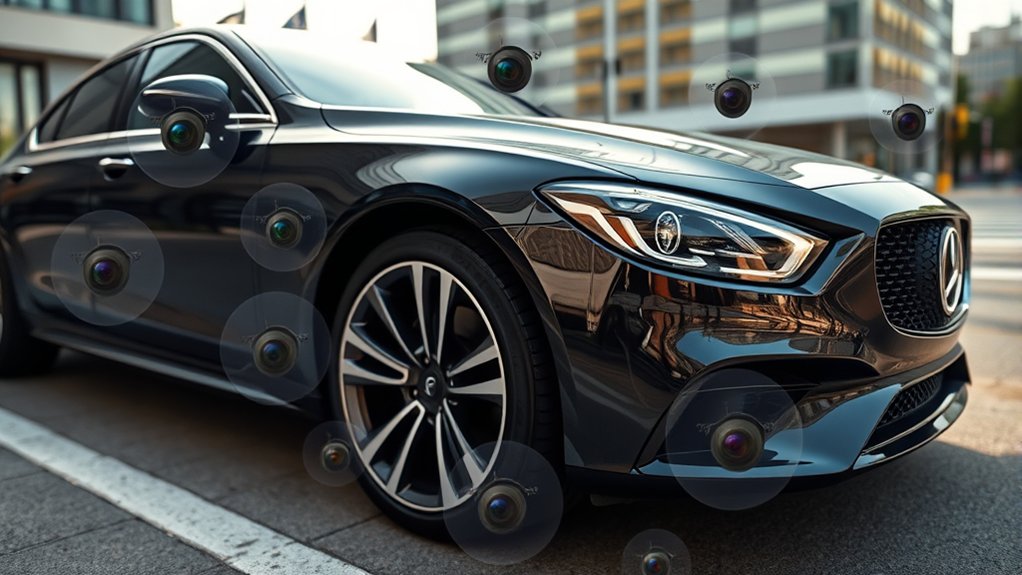
A 360 camera system on cars is designed to provide a comprehensive view of the vehicle’s surroundings, enhancing safety and convenience. By using multiple cameras strategically placed around the car, the system captures a full, real-time bird’s-eye view.
This technology helps drivers monitor blind spots and navigate tight spaces with greater confidence.
The images from these cameras are instantly stitched together by a central processor, creating a seamless panoramic view. The system also adjusts for lens distortions and varying lighting conditions to maintain a clear and accurate image.
This makes parking and maneuvering in crowded areas much easier.
Advanced sensors and artificial intelligence further enhance the system’s capabilities. These smart features improve object detection and alert drivers to potential hazards.
This combination of technologies makes 360 camera systems an essential tool for modern vehicle safety and convenience.
Key Takeaways
- Multiple cameras around the car capture overlapping views to create a comprehensive 360-degree surround image.
- A central processor stitches these images in real time, correcting distortions and blending colors for a seamless bird’s-eye view.
- The system displays the combined view on the dashboard screen to help eliminate blind spots and assist with parking.
- Ultrasonic sensors and calibration software complement cameras for accurate obstacle detection and spatial awareness.
- AI integration enhances object detection, adapts to conditions, and provides real-time alerts to improve safety.
What Is a 360 Camera System on Cars
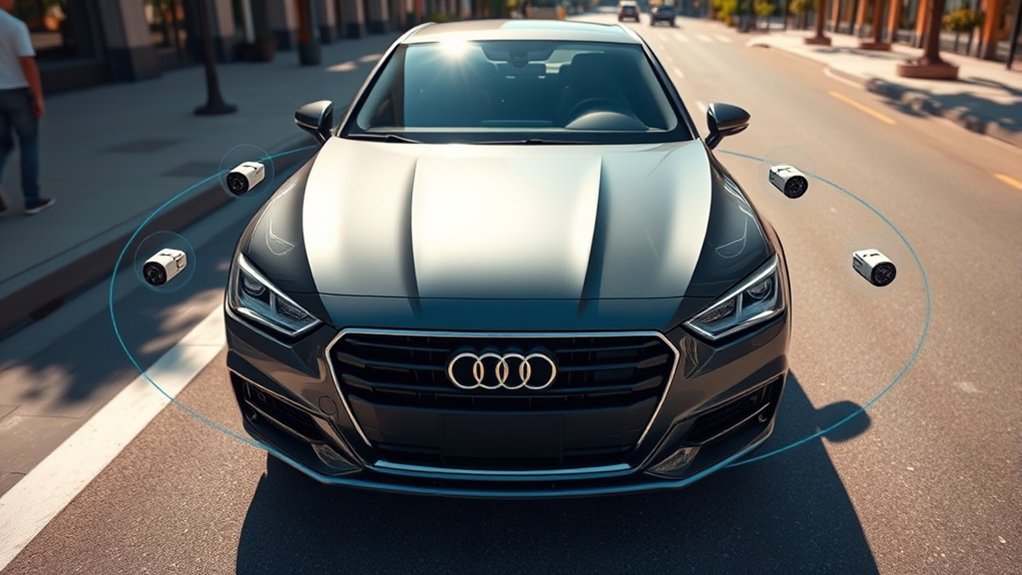
While driving, you might wonder how to eliminate blind spots and park with ease. That’s where a 360 camera system on cars comes in. It’s a smart setup that uses multiple cameras placed around your vehicle—usually at the front, rear, and sides.
These cameras work together to give you a complete, bird’s-eye view of your car’s surroundings on the dashboard screen. When you’re parking or steering through tight spaces, this system helps you spot obstacles you might miss otherwise. It’s designed to boost your confidence and safety by making tricky maneuvers simpler.
You don’t have to guess what’s around your vehicle anymore; the 360 camera system shows you everything clearly and in real-time, right from your driver’s seat.
How Do 360 Cameras Capture a Car’s Surroundings?
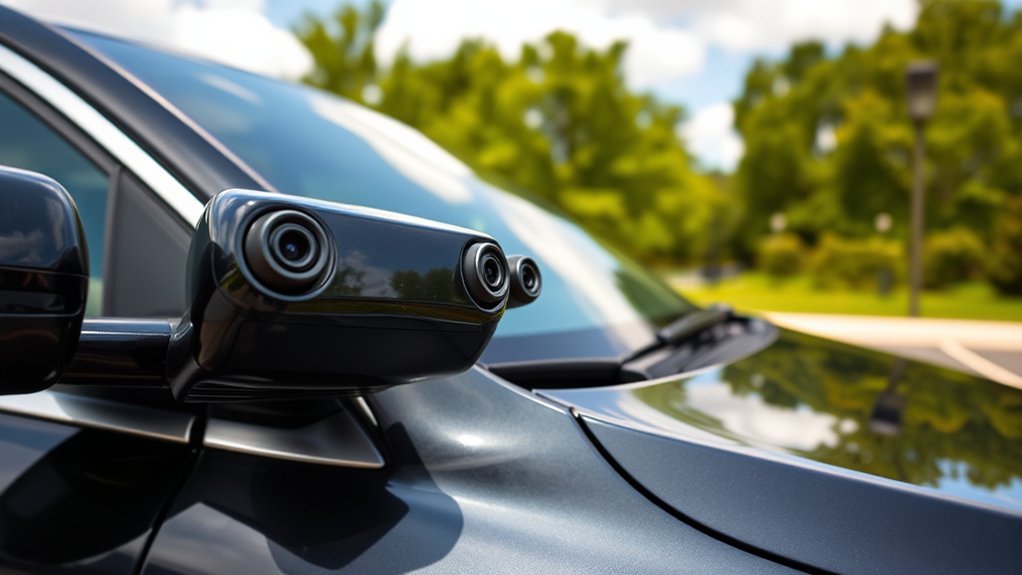
You’ll notice 360 cameras use multiple lenses placed around your car to capture every angle. These images are then stitched together seamlessly using advanced technology to create a complete view.
This process happens in real time, giving you a clear surround view as you drive.
Multiple Lens Positioning
Because a single camera can’t capture every angle around your car, 360 cameras use multiple lenses placed strategically on the vehicle. These lenses work together to cover all sides, minimizing blind spots.
Typically, you’ll find cameras mounted at the front, rear, and under each side mirror. This setup guarantees a seamless, all-around view by capturing overlapping fields of vision.
Here’s a quick look at typical lens positioning:
| Lens Position | Location on Car | Coverage Area |
|---|---|---|
| Front Camera | Front grille | Forward view |
| Rear Camera | Rear bumper | Backward view |
| Side Cameras | Under side mirrors | Side views |
| Optional Camera | Roof or pillars | Overhead/side views |
This arrangement helps your 360 system create a complete picture of your surroundings.
Image Stitching Technology
Although multiple lenses capture different views around your car, they don’t work independently. Each lens records its own wide-angle image, but these images overlap. The camera system uses image stitching technology to seamlessly merge these overlapping views into one continuous, bird’s-eye perspective.
It analyzes common features and edges shared between images, aligning them precisely to avoid distortions or gaps. This process corrects lens distortions and blends color and brightness for a consistent look. By stitching the images together in real time, the system creates a clear, all-encompassing view of your car’s surroundings.
Without this technology, you’d see disjointed, confusing images rather than a smooth panoramic view that helps you park and navigate safely.
Real-Time Surround View
How exactly do 360 cameras capture a car’s surroundings in real time? They use multiple wide-angle cameras placed around the vehicle—usually on the front, rear, and sides. Each camera continuously streams video to a central processing unit inside the car.
This unit instantly stitches the images together using advanced algorithms, creating a seamless, bird’s-eye view of your car’s environment. Thanks to powerful processors, this happens with minimal delay, so you see real-time visuals on your dashboard screen. This immediate feedback helps you navigate tight spaces, avoid obstacles, and park with confidence.
How Multiple 360 Car Cameras Work Together
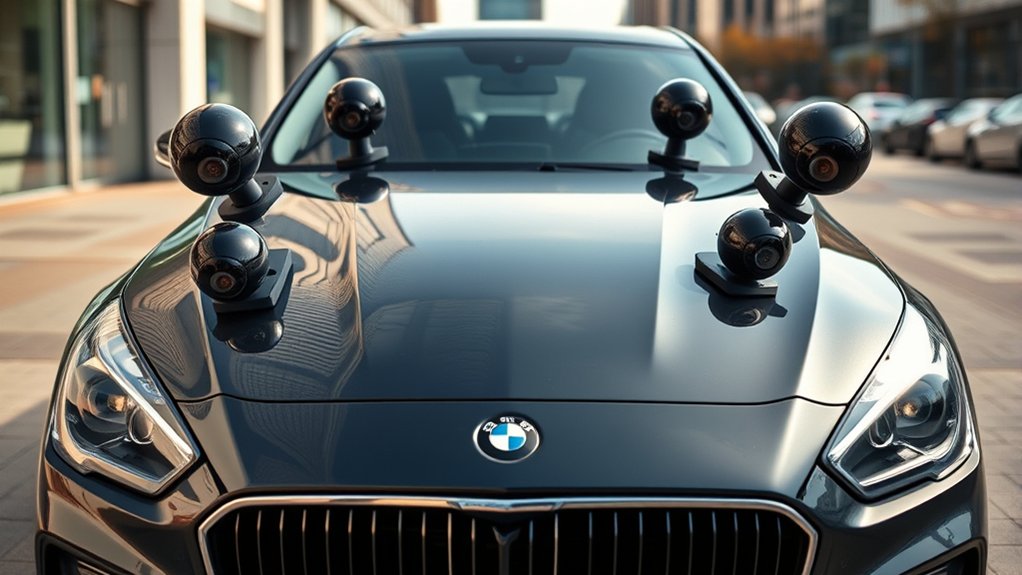
When multiple 360 cameras are installed on a car, they work in unison to create a seamless, all-around view. Each camera captures a specific angle around your vehicle, ensuring no blind spots remain. Here’s how they collaborate:
- Positioning: Cameras are strategically placed (front, rear, sides) to cover every direction.
- Synchronization: They capture images simultaneously to maintain real-time accuracy.
- Data Transmission: Each camera sends its feed to a central processing unit inside your car.
- Integration: The system combines these feeds into one all-encompassing view you see on your display.
How Image Stitching Creates the Bird’s-Eye View
You’ll notice that the cameras capture overlapping angles to cover every side of your car. The system then aligns these angles precisely to avoid distortion.
Finally, it blends the images seamlessly, creating the smooth bird’s-eye view you see on your screen.
Camera Angle Alignment
Although each camera captures a different perspective around your car, they must align perfectly to create a seamless bird’s-eye view. This alignment guarantees the stitched images fit together without distortion or overlap, giving you an accurate overhead look.
To achieve this, the system:
- Calibrates each camera’s angle relative to the car’s body.
- Uses software to correct lens distortion for uniform image geometry.
- Matches common features across adjacent images to synchronize viewpoints.
- Adjusts the position of each image so edges line up precisely.
Seamless Image Blending
Because each camera captures overlapping sections around your car, the system must blend these images smoothly to create a continuous, distortion-free bird’s-eye view. The software identifies common points in overlapping areas and aligns them precisely. It then adjusts brightness, contrast, and color to guarantee uniformity across all images.
This process eliminates visible seams and mismatched edges, making the stitched image look natural. Advanced algorithms also correct lens distortions and compensate for slight differences in camera angles. As a result, you get a seamless, real-time 360-degree perspective that helps you navigate tight spaces with confidence.
This seamless image blending is what turns multiple camera feeds into one clear, all-encompassing view around your vehicle.
Key Sensors and Software in 360 Car Cameras
When you rely on a 360 camera in your car, several key sensors and sophisticated software work together to provide a seamless view of your surroundings. These components guarantee you get accurate, real-time visuals without distortion or delay. Here’s what’s involved:
- Wide-angle cameras – Positioned around the car, they capture overlapping views to cover every angle.
- Image processors – They stitch the multiple camera feeds into a single, unified image.
- Ultrasonic sensors – These detect nearby obstacles and feed data to the system for enhanced awareness.
- Calibration software – It continuously adjusts the system to maintain precise alignment and clear visuals.
Together, these sensors and software components create the all-encompassing and reliable 360-degree perspective you trust while driving.
How 360 Cameras Help Eliminate Blind Spots and Improve Parking
The combination of wide-angle cameras, ultrasonic sensors, and image processing doesn’t just create a seamless view—it actively helps you eliminate blind spots while driving. By stitching together images from multiple angles, the system lets you see areas around your car that traditional mirrors miss. This real-time, 360-degree perspective means you can spot pedestrians, cyclists, or obstacles lurking just outside your normal field of vision.
When parking, the 360 camera simplifies tight spots by giving you a bird’s-eye view, so you can judge distances more accurately. Ultrasonic sensors alert you if you’re getting too close to objects, reducing the risk of bumps or scrapes. Overall, this technology boosts your confidence and safety, making blind spots and tricky parking maneuvers much less stressful.
Common Challenges With 360 Car Cameras
Although 360 car cameras offer impressive benefits, they come with a few common challenges you should be aware of. These issues can affect your experience and the system’s reliability.
- Image Distortion – The wide-angle lenses sometimes create fish-eye effects, making distances tricky to judge.
- Weather Impact – Rain, snow, or fog can obscure the cameras, reducing image clarity.
- Lighting Conditions – Glare from the sun or headlights can cause washouts or dark spots on the display.
- Calibration Errors – Improper installation or bumps can misalign cameras, resulting in inaccurate views.
Knowing these challenges helps you understand the system’s limits and guarantee you use it safely.
Maintenance Tips and Troubleshooting for 360 Car Cameras
Since 360 car cameras rely on precise alignment and clear lenses, you’ll need to perform regular maintenance to keep them functioning properly. Start by cleaning the lenses with a soft cloth and mild cleaner to remove dirt and smudges that can distort images. Check camera alignment periodically, especially after impacts or car washes, to guarantee accurate stitching of the panoramic view.
If you notice image glitches or lag, restart the system or update the software, as outdated firmware can cause glitches. Also, inspect wiring and connections for damage or corrosion to avoid signal loss. If problems persist, consult your vehicle’s manual or visit a professional.
Staying proactive with these steps helps maintain your 360 camera’s reliability and ensures safe driving assistance.
Why 360 Cameras Are Becoming a Must-Have Safety Feature
When you drive, having a clear, all-encompassing view of your surroundings can make all the difference in avoiding accidents. 360 cameras provide this by eliminating blind spots and giving you a seamless, bird’s-eye perspective of your car. This technology is becoming a must-have safety feature because it helps you:
- Detect pedestrians and cyclists in tight spots.
- Park confidently in crowded or narrow spaces.
- Avoid collisions with objects that are hard to see.
- Navigate tricky turns or busy intersections safely.
With these benefits, 360 cameras reduce stress and improve your overall awareness on the road. They’re not just a luxury—they’re a practical tool that helps keep you and others safer every time you get behind the wheel.
Future Trends in 360 Car Camera Technology
You’ll soon notice 360 car cameras delivering sharper, more detailed images with enhanced resolution. These systems will also work hand-in-hand with AI to provide smarter, real-time driving assistance.
Staying updated on these trends will help you get the most out of your vehicle’s safety features.
Enhanced Image Resolution
As 360 cameras become more integral to vehicle safety and navigation, their image resolution is rapidly evolving to meet higher standards. You’ll notice clearer, sharper images that help you detect obstacles and pedestrians more easily. This improvement comes from advances like:
- Higher megapixel sensors capturing more detailed visuals.
- Improved lens technology reducing distortion and enhancing clarity.
- Better low-light performance for nighttime or adverse weather conditions.
- Enhanced image stitching algorithms creating seamless panoramic views.
With these upgrades, you’ll get a more accurate and detailed surround view, making parking and maneuvering safer and less stressful. As resolution climbs, expect your 360 camera to deliver near-real-time, high-definition images that keep you fully aware of your vehicle’s surroundings, boosting overall driving confidence.
Integration With AI
Improved image resolution sets the stage for smarter 360 camera systems by providing richer data for analysis. When these cameras integrate with AI, you get real-time object detection, lane recognition, and hazard prediction that boost your driving safety. The AI processes the visual input instantly, alerting you to pedestrians, cyclists, or sudden obstacles you might miss.
It also adapts to different lighting and weather conditions, ensuring consistent performance. With AI, your 360 camera can even learn your driving habits and suggest safer routes or parking spots. This integration transforms a simple camera into an intelligent assistant, making your driving experience more intuitive and secure.
As AI technology evolves, expect your car’s 360 system to become even more proactive and reliable.
Frequently Asked Questions
Can 360 Cameras Be Installed on Any Car Model?
Yes, you can install 360 cameras on most car models, but some may need custom mounts or wiring. You’ll want to check compatibility and maybe get professional help to guarantee proper installation and peak performance.
Do 360 Car Cameras Affect Fuel Efficiency?
Think of a 360 camera as a tiny feather on your car—it won’t weigh you down or sip fuel. You won’t notice any drop in efficiency, so you can enjoy the full view without sacrificing mileage.
How Much Does a 360 Camera System Typically Cost?
You’ll typically pay between $200 and $1,000 for a 360 camera system, depending on the brand and features. Installation might cost extra, so be sure to factor that in when budgeting for your car upgrade.
Are 360 Cameras Waterproof or Weather-Resistant?
Yes, 360 cameras on cars are usually weather-resistant or waterproof to handle rain, snow, and dirt. You can trust they’ll keep working in tough conditions, ensuring a clear, reliable view no matter the weather.
Can 360 Cameras Record Video Continuously While Driving?
Back in the days of silent films, continuous recording wasn’t common, but today, your 360 camera can record non-stop while you drive. It captures every angle seamlessly, ensuring you don’t miss a single moment on the road.
Conclusion
With 360 cameras cutting blind spots by up to 90%, you’re getting a safer, smarter driving experience. These systems give you a complete view around your car, making parking and maneuvering easier than ever. As technology improves, you’ll see even clearer images and faster processing.
Maintaining your cameras clean and updated guarantees they work smoothly. Embracing 360 cameras means you’re investing in safety and convenience every time you hit the road. Integrating these advanced 360 camera systems into your vehicle enhances overall driving awareness and accident prevention.

