

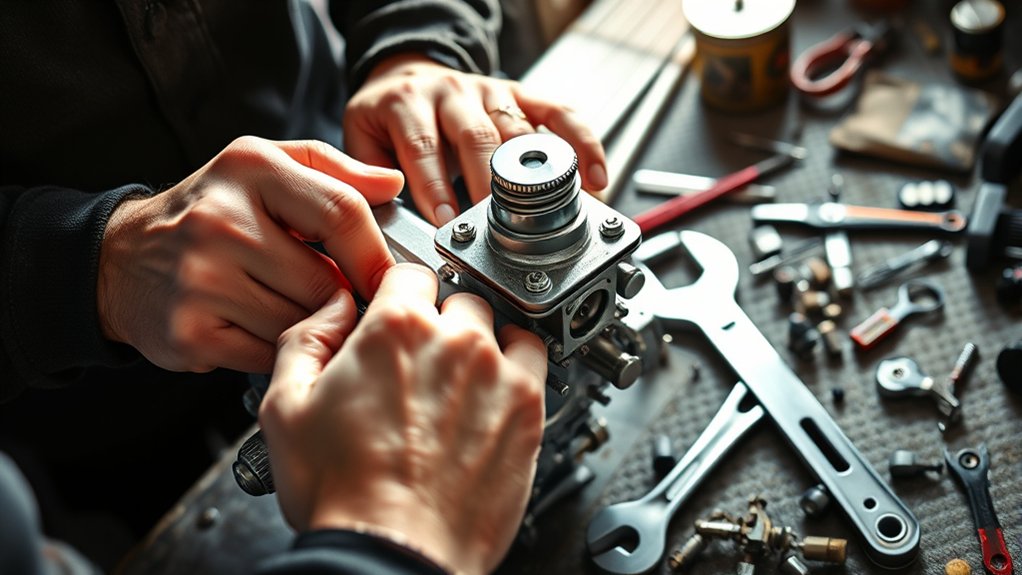
To adjust your carburetor idle effectively, it is important to understand the signs that indicate adjustment is needed, such as rough idling or stalling. Properly adjusting the carburetor idle can improve engine performance and fuel efficiency.
Before starting, gather essential tools like screwdrivers, a tachometer, and a flashlight to make the process easier and more accurate.
Begin by warming up your engine for 5-10 minutes until it reaches normal operating temperature.
Next, locate the idle speed and mixture screws on the carburetor.
Turn the idle speed screw to achieve a smooth RPM, then adjust the mixture screw slowly to find the best idle setting.
Finally, test the engine to ensure steady and reliable performance.
Following these steps, you’ll be well-prepared to fine-tune your engine and maintain optimal running conditions.
Key Takeaways
- Warm up the engine for 5-10 minutes until it reaches normal operating temperature before making any adjustments.
- Locate the idle speed and mixture screws on the carburetor near the throttle linkage using a flashlight if needed.
- Use a screwdriver to adjust the idle speed screw clockwise or counterclockwise to reach the manufacturer’s recommended RPM.
- Slowly turn the mixture screw to achieve the highest, smoothest idle, making quarter-turn adjustments while the engine runs.
- Test the engine for stable, smooth idle performance and adjust screws as necessary for optimal fuel mixture and speed.
Identify When Your Carburetor Idle Needs Adjustment
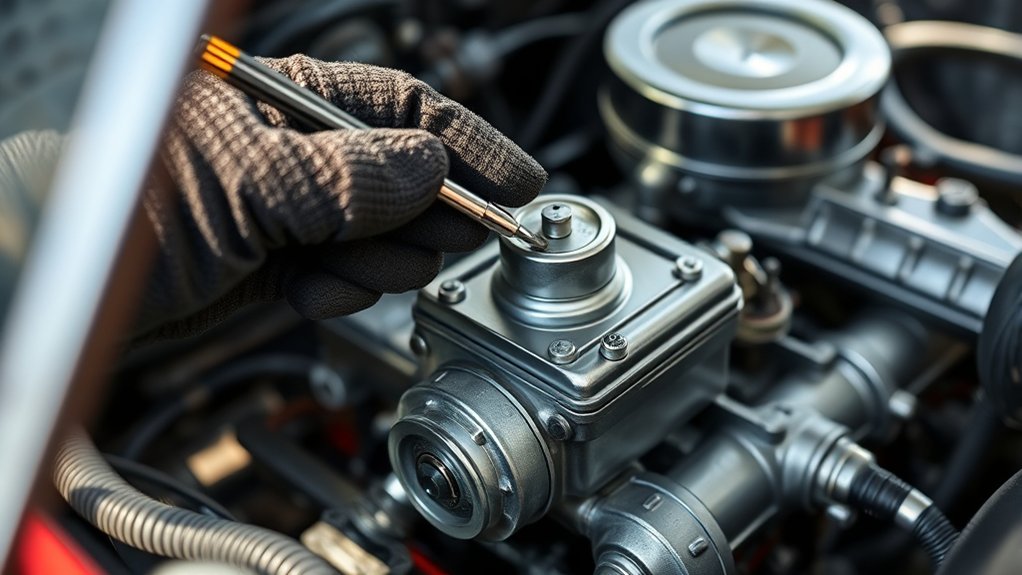
Although you might not notice it immediately, your carburetor idle needs adjustment when your engine idles roughly, stalls frequently, or revs too high or low without input. You’ll likely feel these issues as hesitation or uneven engine sound when your vehicle is at a stop.
If your engine dies shortly after idling or struggles to maintain a steady speed, that’s a clear sign your carburetor isn’t delivering fuel properly. You may also notice black smoke from the exhaust or decreased fuel efficiency, indicating a rich mixture caused by improper idle settings.
Gather the Tools You Need
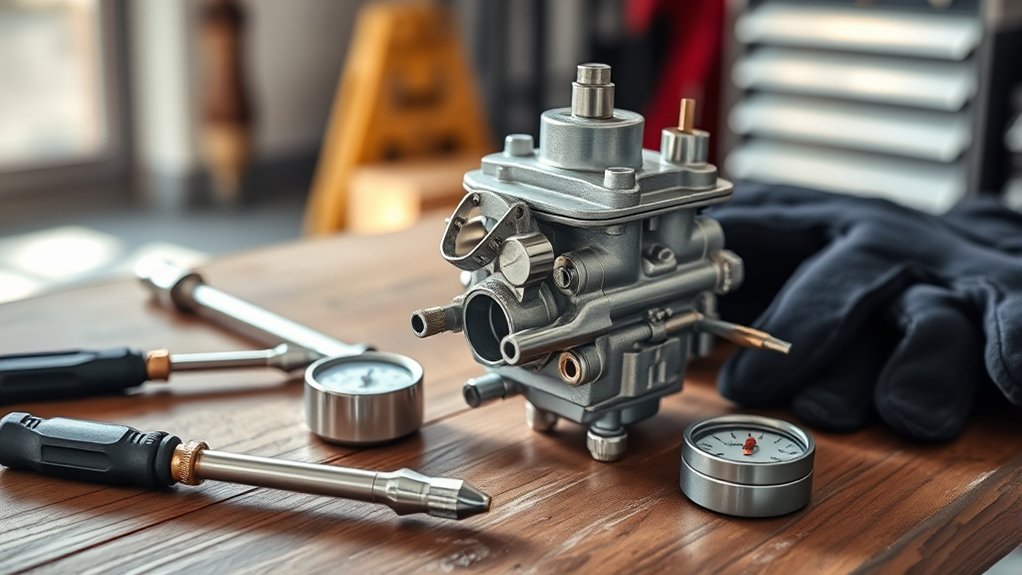
Once you’ve recognized the signs that your carburetor idle needs adjustment, the next step is to gather the right tools. You’ll need a flathead screwdriver or a Phillips screwdriver depending on your carburetor’s screws. A small wrench or socket set may be necessary for some models.
Keep a tachometer handy if your vehicle doesn’t have one built in; it helps you monitor engine RPM accurately. Have a flashlight nearby to see clearly in tight spaces. Additionally, keep a clean rag to wipe off any dirt or fuel residue as you work.
Organizing these tools before you start saves time and frustration, letting you focus on making precise adjustments to your carburetor idle.
Warm Up the Engine to the Right Temperature
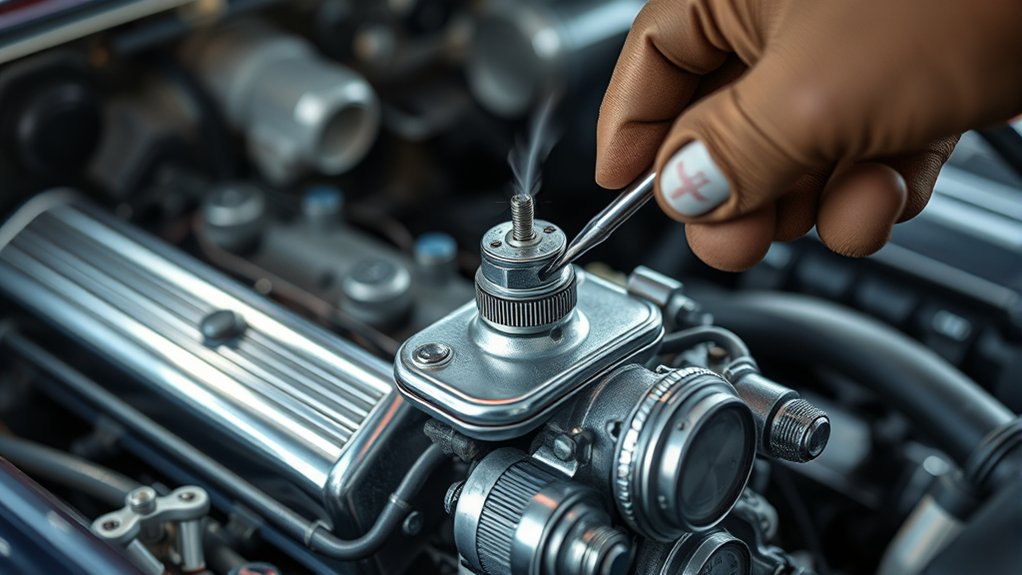
Why is warming up the engine to the right temperature essential before adjusting the carburetor idle? When the engine is cold, the idle speed and mixture settings won’t reflect normal operating conditions, leading to inaccurate adjustments.
Warming the engine ensures idle settings reflect true operating conditions, preventing inaccurate carburetor adjustments.
You need the engine at its proper temperature to ensure the carburetor’s idle settings are stable and reliable.
Here’s how to warm it up properly:
- Start the engine and let it run without load for about 5-10 minutes.
- Watch the temperature gauge closely until it reaches the normal operating range.
- Avoid revving or applying heavy throttle during warm-up, as it can skew idle speed.
Once warmed up, your adjustments will be precise and effective.
Find the Idle Adjustment Screws
Before you start adjusting the carburetor idle, you need to locate the idle adjustment screws. These screws are usually found on the side of the carburetor body. Look closely near the throttle linkage; you’ll often see two small screws—one controls the idle speed, and the other adjusts the air-fuel mixture at idle.
Depending on your carburetor model, these screws might be labeled or color-coded, but if not, consult your vehicle’s manual to be sure. Use a flashlight if necessary to spot them clearly. Be careful not to confuse these with the main mixture screws or choke adjustments.
Once you’ve identified the idle adjustment screws, you’ll be ready to make precise tweaks to improve your engine’s idle performance.
Adjust the Carburetor Idle Speed Screw for Smooth RPM
After locating the idle adjustment screws, focus on the idle speed screw to set a smooth and stable RPM. This screw controls how fast the engine idles when the throttle’s closed. To adjust it properly:
- Turn the screw clockwise slowly to increase RPM or counterclockwise to decrease it.
- Listen carefully and watch the tachometer to find the point where the engine runs smoothly without stalling or racing.
- Make small adjustments and allow a few seconds for the engine to respond before turning again.
Aim for the manufacturer’s recommended idle speed, usually found in your vehicle’s manual. Setting this screw correctly guarantees your engine runs efficiently at idle and prevents rough starts or stalling during low-speed operation.
Fine-Tune the Carburetor Idle Mixture Screw
Once you’ve set a stable idle speed, you can fine-tune the carburetor idle mixture screw to optimize the air-fuel ratio for smoother idling and better fuel efficiency. Locate the mixture screw, usually found on the carburetor’s side. Turn it slowly clockwise to lean the mixture (less fuel) or counterclockwise to richen it (more fuel).
Listen carefully to the engine’s response as you adjust—your goal is the highest, smoothest idle speed without hesitation or roughness. Small adjustments, about a quarter turn at a time, work best. After each tweak, wait a few seconds for the engine to stabilize before proceeding.
Avoid over-leaning, which can cause stalling or overheating. With patience, this fine-tuning improves performance and fuel economy during idle.
Test Idle Performance and Final Speed
Although you’ve fine-tuned the mixture screw, you still need to test the idle performance to guarantee your adjustments deliver a stable and smooth engine operation. Start your engine and listen carefully for any roughness or hesitation.
Next, observe the tachometer to verify the idle speed matches the manufacturer’s recommended RPM. Finally, make minor tweaks if necessary to balance smoothness and correct speed.
Here’s how to test effectively:
- Listen for engine smoothness: No sputtering or stalling should occur.
- Check the idle speed: Confirm it’s within the specified RPM range.
- Adjust idle speed screw: If the speed is off, turn the idle speed screw slowly until you reach ideal RPM without compromising smoothness.
This guarantees your carburetor idle is perfectly set for reliable performance.
Frequently Asked Questions
What Causes a Carburetor to Become Clogged?
You get a clogged carburetor when dirt, debris, or old fuel gums up the jets and passages. Not cleaning it regularly or using bad fuel causes buildup, restricting fuel flow and messing up your engine’s performance.
How Often Should You Clean Your Carburetor?
You should clean your carburetor at least once a year or every 10,000 to 15,000 miles.
If you notice rough idling or poor performance, clean it sooner to keep your engine running smoothly and efficiently.
Can a Faulty Carburetor Affect Fuel Efficiency?
Yes, a faulty carburetor can hurt your fuel efficiency. It messes with the air-fuel mixture, causing your engine to burn more fuel than necessary.
Fixing it helps your vehicle run smoother and saves you money.
What Are Common Signs of a Bad Carburetor?
You’ll notice rough idling, engine stalling, poor acceleration, black smoke from the exhaust, and increased fuel consumption.
If your engine hesitates or floods, your carburetor likely needs cleaning or repair to restore smooth performance.
Is It Necessary to Replace the Carburetor Gasket?
Think of the gasket as a tire’s seal—it’s essential. If it’s cracked or brittle, you’ll want to replace it to prevent leaks. Don’t risk a slow drip; swapping it out keeps your carburetor running smoothly.
Conclusion
Now that you’ve adjusted your carburetor idle, you’ll notice smoother engine performance. Imagine driving your classic car on a chilly morning—before, it sputtered and stalled, but now it purrs steadily at a perfect idle.
With just these simple steps, you’ve improved fuel efficiency and extended your engine’s life. Keep an eye on your idle, and don’t hesitate to make small tweaks.
Your engine will thank you with reliable starts and smooth rides every time. Proper carburetor idle adjustment is key to maintaining optimal engine function and fuel economy.

