


To figure your axle ratio in seven simple steps, start by gathering essential tools like a wrench, tape measure, and marker. Knowing how to calculate your axle ratio is crucial for understanding your vehicle’s performance, including towing capacity, fuel economy, and maintenance needs.
This simple process provides valuable insights that can help optimize your vehicle’s efficiency and durability.
Park your vehicle on a level surface, secure it with the parking brake and wheel chocks, then mark the driveshaft and axle with contrasting paint. Rotate the driveshaft, counting how many turns it takes for the axle to complete one full rotation.
This ratio reveals your vehicle’s performance traits.
Keep going, and you’ll uncover how knowing this helps optimize towing, fuel economy, and maintenance.
Key Takeaways
- Park your vehicle on a flat surface, engage the parking brake, and use wheel chocks for safety.
- Mark the driveshaft and axle with contrasting paint or marker aligned at the starting point.
- Rotate the driveshaft in the normal driving direction, counting full rotations until the axle mark completes one turn.
- Calculate the axle ratio by dividing the number of driveshaft rotations by one full axle rotation.
- Confirm your measurement by checking the owner’s manual, differential tag, or manufacturer’s website with your vehicle VIN.
What Is an Axle Ratio and Why It Matters

What exactly is an axle ratio, and why should you care? The axle ratio is the number of revolutions the driveshaft makes to turn the wheels once. It influences your vehicle’s performance, fuel efficiency, and towing capability.
A higher axle ratio means more torque and power, which helps if you tow heavy loads or drive off-road. However, it can reduce fuel economy. A lower axle ratio improves gas mileage but might limit towing strength or acceleration.
Understanding your axle ratio helps you make informed decisions about upgrades or maintenance. It directly impacts how your vehicle handles and responds under different conditions, so knowing this ratio ensures you get the performance and efficiency you want from your ride.
Find Your Vehicle’s Axle Ratio Info
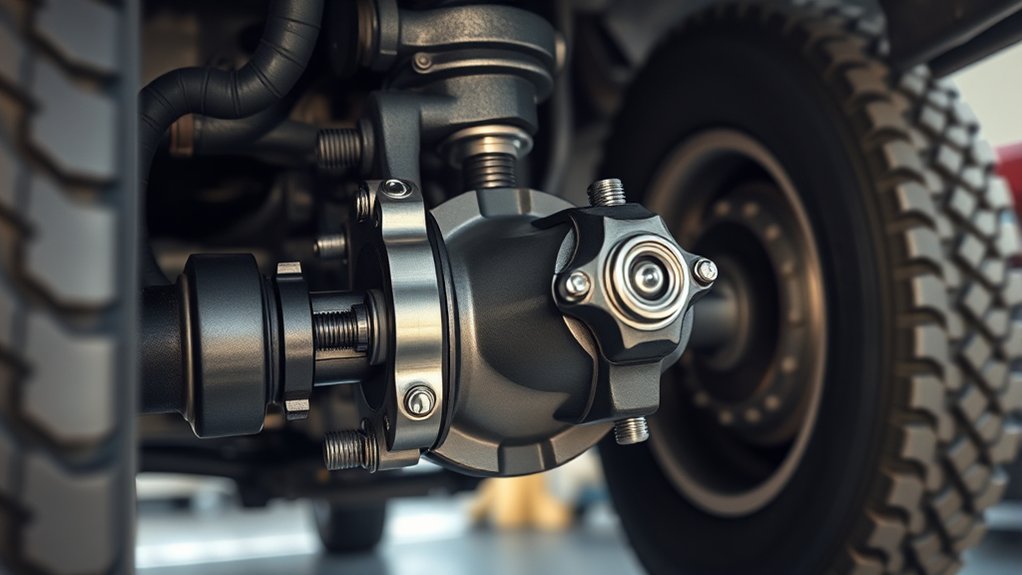
Knowing how your axle ratio affects performance is only half the battle; the next step is figuring out what your vehicle’s specific ratio is. You can often find this info in your owner’s manual or on the vehicle’s service sticker, usually located on the driver’s side door jamb.
Some trucks and SUVs also have a metal tag on the differential housing itself that lists the ratio. If you’re unable to locate these, check the manufacturer’s website or contact a dealership with your VIN handy—they can provide the exact axle ratio for your model.
Knowing this number gives you a clear starting point before making any modifications or measurements. This step guarantees you’re working with accurate data tailored to your vehicle.
Gather Tools to Measure Your Axle Ratio

Before you start measuring, make sure you have the right tools like a wrench, socket set, and a calculator. Prepare your vehicle by parking it on a flat surface and engaging the parking brake.
Always follow safety precautions to avoid any accidents while working under your vehicle.
Essential Measuring Instruments
How can you accurately determine your axle ratio without the right tools? To get precise measurements, you’ll need a few essential instruments. Start with a tape measure or ruler to measure the driveshaft rotation and ring gear teeth.
A marker or paint pen helps mark the driveshaft to count rotations easily. You’ll also want a wrench set or socket set in case you need to remove the differential cover for better access. A flashlight is handy to illuminate tight spaces inside the differential housing.
Ultimately, having a notepad or smartphone ready to record your numbers ensures you don’t lose track. With these tools on hand, you’re fully prepared to gather the accurate data needed to figure out your axle ratio correctly.
Preparing the Vehicle
Although it might seem straightforward, preparing your vehicle properly is essential for accurate axle ratio measurements. Before diving in, gather everything you need to make the process smooth and precise. Here’s what to do:
- Park your vehicle on a level surface to ensure correct wheel rotation measurements.
- Engage the parking brake to keep your vehicle steady.
- Remove any wheel covers or hubcaps that could obstruct your view of the axle or driveshaft.
- Have a tape measure, calculator, and a pen and paper handy for quick calculations and notes.
Getting these steps right sets you up for success and prevents errors that could throw off your axle ratio calculation. Preparation isn’t just a step—it’s the foundation for accurate results.
Safety Precautions
Once you’ve prepped your vehicle, focus on safety as you gather the tools needed to measure your axle ratio. Always wear safety goggles and gloves to protect yourself from debris and sharp edges. Make sure the vehicle is on a level surface and securely parked with the parking brake engaged.
Use wheel chocks to prevent any movement while you work.
Here’s a quick reminder of essential safety gear and why it’s important:
| Safety Gear | Purpose |
|---|---|
| Safety Goggles | Protect eyes from debris |
| Gloves | Prevent cuts and bruises |
| Wheel Chocks | Keep vehicle stable |
Following these precautions helps you work confidently and safely throughout the process.
Prepare Your Vehicle Safely for Measuring Axle Ratio
Before you start measuring, make sure your vehicle is parked on a flat, stable surface and securely positioned to prevent any movement. Put on the necessary safety gear like gloves and eye protection to keep yourself safe.
Taking these precautions will help you work confidently and accurately.
Secure Vehicle Positioning
How do you guarantee your vehicle is safely positioned for measuring the axle ratio? Securing your vehicle properly is vital to avoid accidents and ensure accurate results. Follow these steps:
- Park on a flat, level surface to prevent rolling or shifting. Engage the parking brake firmly to lock the wheels in place. Place wheel chocks on both sides of the tires opposite to the one you’ll measure.
- Put your vehicle in gear (manual) or in “Park” (automatic) to add another layer of stability.
Gather Necessary Safety Gear
Although securing your vehicle is essential, you’ll also need the right safety gear to protect yourself while measuring the axle ratio. Start by putting on safety glasses to shield your eyes from debris or grease. Wear durable gloves to protect your hands from sharp edges and grime.
Consider using steel-toed boots to guard your feet in case you accidentally drop tools or parts. If you’re working under the vehicle, a mechanic’s creeper or mat can keep you comfortable and safe. Avoid loose clothing or jewelry that might get caught in moving parts.
Finally, guarantee your workspace is well-lit and ventilated. Taking these precautions helps you focus on accurately measuring the axle ratio while staying safe throughout the process.
Mark Driveshaft and Axle for One Full Rotation
Once you’ve located the driveshaft and axle, you’ll want to mark them clearly so you can track one full rotation accurately. This step is vital because it sets the foundation for precise measurement. Here’s how to do it:
- Clean the surfaces to guarantee the marks stick well and are visible.
- Use a bright, contrasting marker or paint to make your marks stand out.
- Mark a specific point on the driveshaft and align it with a corresponding point on the axle.
- Double-check your marks to confirm they are perfectly aligned before rotating.
Count Driveshaft Turns per Axle Ratio Rotation
Before you start turning the driveshaft, make sure your marks are clearly visible and aligned. Now, slowly rotate the driveshaft in the direction your vehicle normally moves. Count how many full turns the driveshaft makes until the axle mark completes one full rotation.
Keep your focus on the driveshaft mark passing your reference point each time it spins. This count represents the number of driveshaft rotations per single axle rotation. For example, if the driveshaft turns 4 times for every one axle turn, your ratio is 4:1.
Being precise here is crucial—miscounting will throw off your axle ratio calculation. Take your time, and if needed, repeat the process to confirm your count before moving on to the next step.
Calculate and Understand Your Axle Ratio’s Impact
Since you’ve counted the driveshaft turns per axle rotation, you can now calculate your axle ratio by dividing the number of driveshaft rotations by one axle rotation. Understanding this number helps you see how it affects your vehicle’s performance.
Calculate your axle ratio by dividing driveshaft turns by axle rotations to understand its impact on performance.
A higher axle ratio means more torque and better acceleration but lower fuel efficiency. A lower ratio improves gas mileage but reduces towing power.
Here’s what your axle ratio impacts:
- Acceleration – Higher ratios give quicker starts.
- Fuel Economy – Lower ratios save fuel on highways.
- Towing Capacity – Higher ratios handle heavier loads.
- Engine Stress – The right ratio reduces wear and tear.
Knowing your axle ratio empowers you to make smarter driving and maintenance choices.
Frequently Asked Questions
How Does Axle Ratio Affect Fuel Efficiency?
You’ll find that a higher axle ratio usually means your engine works harder, lowering fuel efficiency. Conversely, a lower ratio lets your vehicle cruise more efficiently, saving gas on highways and reducing fuel consumption overall.
Can Changing Axle Ratio Improve Towing Capacity?
Absolutely, it can! Changing your axle ratio boosts your towing capacity by increasing torque to the wheels. But beware—higher ratios may sacrifice fuel efficiency, so you’ll need to balance power and economy carefully.
What Tools Are Best for Precise Axle Ratio Measurement?
You’ll want a dial caliper and a gear tooth pitch gauge for precise axle ratio measurement. Using these tools helps you accurately measure gear teeth and diameters, ensuring you get exact ratios without guesswork or errors.
These instruments provide the precision needed for reliable results. They reduce the chances of miscalculations when determining axle ratios.
How Often Should Axle Ratio Be Checked or Recalculated?
You should check or recalculate your axle ratio whenever you change tire sizes, gears, or notice performance issues.
Regular inspections during maintenance help you catch problems early and keep your vehicle running smoothly.
Can Axle Ratio Differences Cause Vehicle Handling Issues?
Yes, axle ratio differences can cause handling issues. Studies show vehicles with mismatched axle ratios experience up to 15% uneven tire wear, affecting stability. You’ll notice vibrations, poor traction, and uneven braking if ratios don’t match properly.
Conclusion
Now that you know how to figure your axle ratio in just seven simple steps, isn’t it easier to see why this number matters? Understanding your axle ratio helps you optimize performance, fuel efficiency, and towing capacity.
With your tools ready and your vehicle prepped, you’re set to measure confidently. So, why guess when you can know for sure?
Take control of your ride’s performance starting today by accurately calculating your axle ratio. Knowing your axle ratio is key to maximizing your vehicle’s efficiency and power.

