

To turn on your fog lights in seven easy steps, start by recognizing the fog light symbols on your dashboard. Understanding these symbols is key to safely operating your vehicle in foggy conditions.
Locate the fog light switch, which is usually near the headlight controls or steering column.
Next, turn your headlights on before activating the fog lights. This step ensures your fog lights function properly and comply with safety regulations.
Use the switch—often a button or rotary dial—to turn the fog lights on.
Check the dashboard indicator to confirm they’re active.
If needed, adjust the fog light angle for better visibility.
Following these simple steps will help improve your driving safety in foggy weather.
Keep going to uncover common troubleshooting tips and more.
Key Takeaways
- Locate the fog light switch near the dashboard, headlight controls, or steering column.
- Turn on the headlights before activating the fog lights to ensure proper function.
- Identify the fog light symbol, which resembles a lamp with horizontal and wavy lines.
- Activate fog lights by pressing, turning, or pulling the fog light switch until a click or sound confirms operation.
- Confirm fog lights are on by checking for the illuminated green or amber fog light indicator on the dashboard.
Understand Fog Light Symbols on Your Dashboard
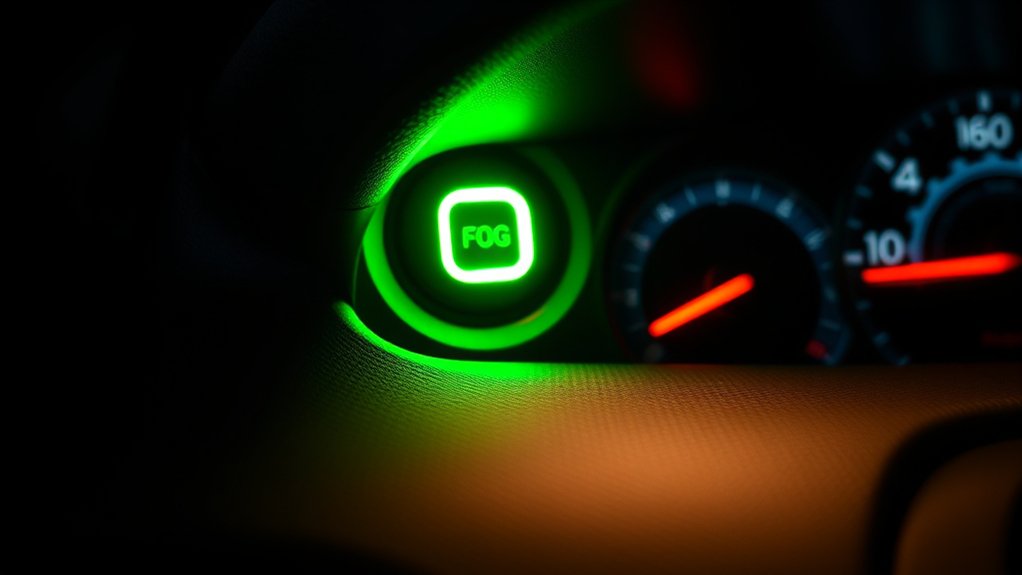
Before you can turn on your fog lights, you need to recognize the symbols on your dashboard. These symbols are usually green or yellow and look like a lamp with three horizontal lines and a wavy line through them. The front fog light symbol points to the left, while the rear fog light symbol points to the right.
When your fog lights are activated, the corresponding symbol lights up, confirming they’re on. Understanding these icons helps you avoid confusion, especially in low visibility conditions. If you see the symbol without turning on your fog lights, it might indicate a malfunction.
Being familiar with these symbols guarantees you use your fog lights correctly and stay safe on the road.
Locate Your Vehicle’s Fog Light Switch
Although fog light controls vary by vehicle, you’ll typically find the fog light switch on or near the dashboard, often integrated with the headlight controls or on the steering column. To locate it quickly, start by checking around the main headlight knob or lever. The fog light switch usually has a symbol resembling a lamp with three horizontal lines and a wavy line through them.
Fog light switches are often near the dashboard, integrated with headlight controls or on the steering column.
Here’s how to find it:
- Look near your headlight control dial on the dashboard.
- Check the steering column stalk for an additional switch.
- Inspect buttons or toggles on the center console.
- Consult your vehicle’s owner manual for exact switch location.
Knowing where this switch is helps you activate fog lights safely and confidently.
Turn On Headlights Before Activating Fog Lights
Before you switch on your fog lights, make certain your headlights are already turned on, as many vehicles require this for fog lights to work. Check your car’s manual to confirm if your fog lights are compatible with your headlight settings.
This step ensures your fog lights function properly and improve your visibility safely.
Headlight Activation Importance
Since fog lights are designed to complement your main headlights, you’ll need to turn on your headlights first to make sure they work properly. Activating your headlights before fog lights ensures maximum visibility and safety during poor weather conditions. It also prevents electrical issues by following the correct vehicle procedure.
Here’s why turning on your headlights first matters:
- Enhances overall road illumination for better visibility.
- Ensures fog lights function as intended, reducing glare.
- Complies with most vehicle safety systems and wiring standards.
- Prevents accidental battery drain or electrical faults.
Always remember, fog lights are an addition, not a replacement, for your headlights. Activating headlights first guarantees your lighting system performs optimally when you need it most.
Fog Light Compatibility Check
Once your headlights are on, the next step is to verify if your fog lights are compatible and ready to activate. Many vehicles require headlights to be on before fog lights can be switched on. This prevents glare and ensures proper lighting.
You’ll want to confirm your car’s fog light system works with your headlight settings.
Here’s a quick compatibility guide to help you:
| Vehicle Type | Headlights Required | Fog Light Activation Method |
|---|---|---|
| Sedan | Low beam | Switch on after headlights |
| SUV | Low or high beam | Automatic or manual switch |
| Truck | Low beam | Button or dial activation |
Check your owner’s manual if unsure, and always test in a safe area before driving.
Activate Fog Lights Using the Switch
Although fog lights offer better visibility in poor conditions, you won’t benefit from them until you activate the switch inside your vehicle. Here’s how to do it quickly and safely:
- Locate the fog light switch, usually found on or near the dashboard or headlight control stalk.
- Make sure your headlights are on, as many cars require this before fog lights can be activated.
- Turn or press the fog light switch; it may be a rotary dial, button, or pull-out knob depending on your vehicle.
- Hold the switch briefly until you feel or hear a click, confirming activation.
Following these steps guarantees your fog lights are ready to improve visibility when needed.
Confirm Fog Light Activation With Dashboard Indicator
Once you switch on your fog lights, check your dashboard for the fog light indicator. This symbol usually looks like a lamp with horizontal lines and helps you confirm the lights are active.
If you don’t see it, your fog lights might not be on yet.
Dashboard Indicator Light Meaning
How can you be sure your fog lights are on without stepping outside? Your dashboard has a specific indicator light that confirms their activation. When you switch on the fog lights, a small symbol lights up, usually in green or amber, depending on your vehicle.
Here’s what you need to know about this indicator:
- It looks like a headlamp with horizontal lines and a wavy vertical line.
- The light appears only when the fog lights are active.
- It’s often located near your headlight indicators.
- If it doesn’t illuminate, your fog lights aren’t on.
Confirming Fog Light Activation
To make sure your fog lights are truly on, keep an eye on the dashboard indicator. This small icon confirms activation and helps avoid confusion, especially in low visibility. When you switch on the fog lights, the indicator usually lights up in green or amber.
If it doesn’t, double-check the switch or consult your vehicle’s manual.
Here’s a quick reference to help you interpret the dashboard indicators:
| Indicator Color | Meaning |
|---|---|
| Green | Front fog lights are on |
| Amber | Rear fog lights are on |
| Off | Fog lights are off |
| Flashing | Possible malfunction |
Watching the indicator guarantees your fog lights are working correctly and improves your safety on the road.
Adjust Fog Light Angle for Better Visibility
Although your fog lights are designed to improve visibility, improperly angled beams can actually reduce their effectiveness. You’ll want to adjust them to guarantee the best illumination without blinding oncoming drivers.
Here’s how to adjust your fog light angle for better visibility:
- Park your car on a level surface about 25 feet from a wall or garage door.
- Turn on your fog lights and mark the center of each beam on the wall with tape.
- Loosen the adjustment screws on your fog light housing using a screwdriver.
- Carefully raise or lower the beams so the top of the light hits just below the tape marks, focusing light on the road, not the sky.
This simple step improves safety and visibility during foggy conditions.
Troubleshoot Common Fog Light Problems
If your fog lights aren’t working as expected, you’ll want to identify and fix common issues quickly to maintain safe driving conditions. First, check the fuse; a blown fuse is a common culprit. Locate the fuse box and inspect the fog light fuse, replacing it if necessary.
Next, examine the bulbs—burnt-out bulbs need replacement. Also, verify the fog light switch is functioning properly, as a faulty switch can prevent activation. Wiring problems, like loose or corroded connections, can also cause failures, so inspect and secure all wiring.
Finally, verify the fog lights’ relay; a bad relay can interrupt power flow. By systematically troubleshooting these areas, you’ll get your fog lights back in working order and improve visibility during foggy conditions.
Frequently Asked Questions
Can Fog Lights Be Used in Heavy Rain or Snow?
Yes, you can use fog lights in heavy rain or snow. They improve visibility by cutting through the fog, rain, or snow better than regular headlights, helping you see the road and stay safer while driving.
Are Fog Lights Legal to Use in All States or Countries?
You can use fog lights legally in some states or countries, but not all. You’ll need to check local laws, follow regulations, and avoid misuse.
Knowing rules protects you, guarantees safety, and prevents fines or penalties.
Do Fog Lights Consume More Battery Power Than Regular Headlights?
No, fog lights don’t consume more battery power than regular headlights since they use smaller bulbs with lower wattage.
You won’t notice a significant difference in battery drain when you turn them on during foggy conditions.
How Often Should Fog Light Bulbs Be Replaced?
Imagine driving through thick fog and suddenly your fog lights dim. You should replace fog light bulbs every 1-2 years or when they noticeably dim to maintain safety and visibility during poor weather conditions.
Can Aftermarket Fog Lights Be Installed on Any Vehicle?
You can install aftermarket fog lights on most vehicles, but you’ll need to check compatibility with your car’s electrical system and mounting options. Sometimes, additional wiring or brackets are necessary to guarantee proper fit and function.
It’s important to ensure the fog lights meet your vehicle’s voltage requirements and mounting points. Some vehicles may require adapters or custom fittings. Always refer to the manufacturer’s guidelines for installation.
Conclusion
Now that you know how to turn on your fog lights in just 7 easy steps, you’re ready to drive safer in low-visibility conditions. Remember, “better safe than sorry” applies perfectly here—using your fog lights wisely can improve your vision and alert other drivers.
Just follow the steps, check your dashboard indicators, and adjust your lights as needed. With a little practice, turning on your fog lights will become second nature.
Stay safe out there! Properly using fog lights not only enhances your visibility but also ensures better safety for you and others on the road.

