

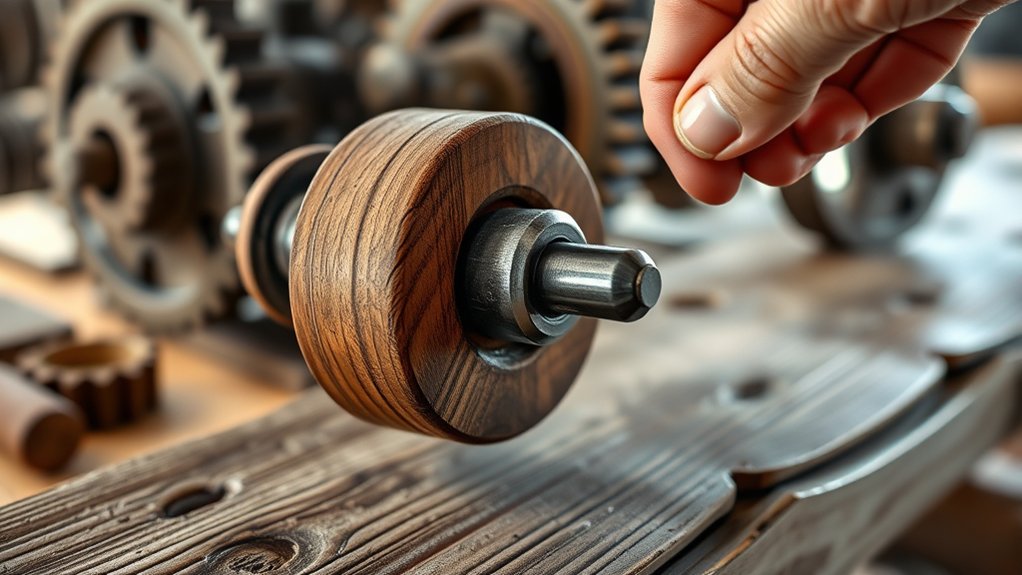
You start by applying force to the wheel and axle, a simple machine that helps make work easier by amplifying force. When you push on the wheel’s outer edge, its larger radius generates torque, which is the rotational force needed to turn the system.
This torque overcomes friction and spins the wheel around the axle, which acts as a pivot point. The axle then transmits this rotational force to connected parts, such as gears or other wheels, moving objects with less effort.
Because the wheel covers more distance per turn, it reduces your effort while increasing the force applied. Keep exploring, and you’ll uncover how these parts make everyday tasks easier.
Key Takeaways
- A force applied at the wheel’s rim creates rotational motion around the axle’s pivot point.
- The larger wheel radius reduces effort by covering more distance per rotation.
- Rotational force (torque) from the wheel transfers directly to the axle through their rigid connection.
- The axle’s smaller radius concentrates force, increasing mechanical advantage for moving heavier loads.
- The axle’s rotation drives connected components, converting rotational motion into useful work or movement.
What Is a Wheel and Axle and How Do They Work Together
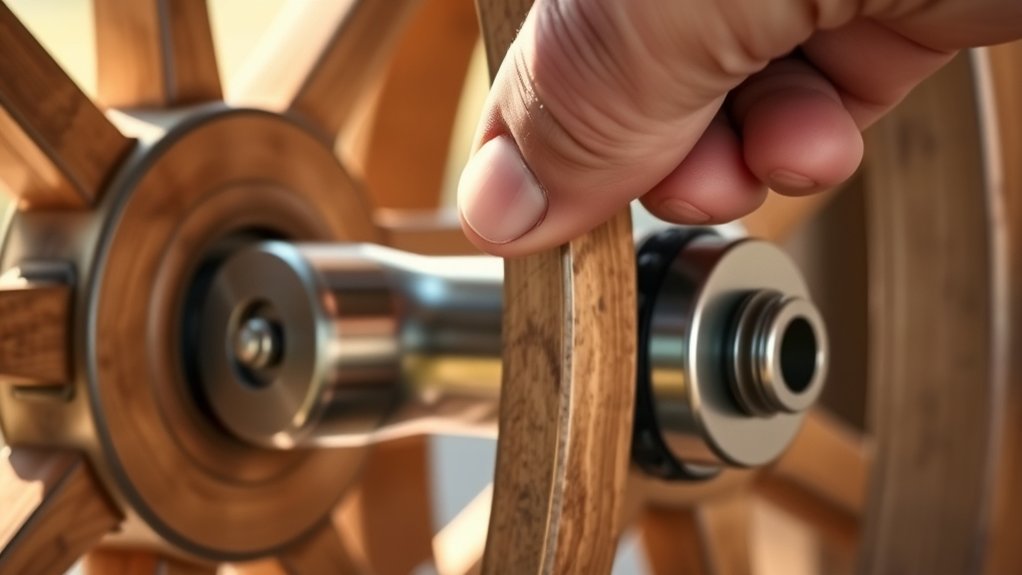
How exactly does a wheel and axle work together to make tasks easier? You’ll find that the wheel, a circular frame, is attached to a smaller cylinder called the axle. When you turn the wheel, it causes the axle to rotate as well.
This connection allows you to move or lift objects with less effort. The wheel’s larger diameter means it covers more distance per rotation than the axle, so you apply force over a greater distance, reducing the effort needed. This simple mechanism lets you perform tasks like rolling heavy loads or turning screws more efficiently.
How the Wheel and Axle Transfer Force
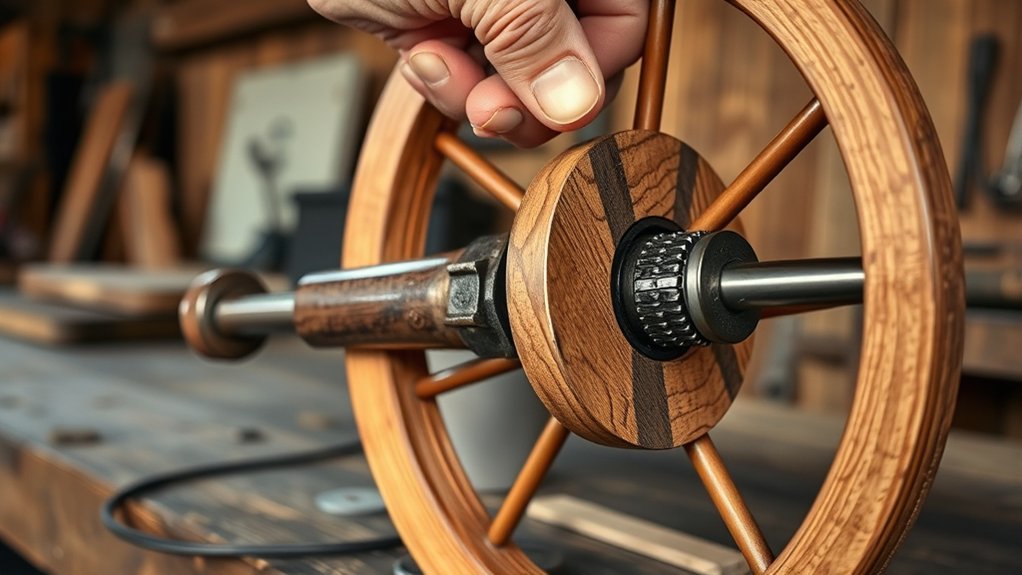
When you turn the wheel, you’re not just moving its outer edge—you’re also causing the axle to spin. This transfer of force happens because the wheel and axle are rigidly connected, so any force applied to the wheel gets passed directly to the axle. The wheel’s larger radius means it covers more distance with less force, while the axle’s smaller radius increases output force but covers less distance.
Here’s how the force transfer works:
- You apply force to the wheel’s rim.
- The wheel’s rotation drives the axle to turn.
- The axle’s smaller radius concentrates the force.
- Mechanical advantage lets you move heavier loads with less effort.
This efficient force transfer is what makes the wheel and axle so powerful.
How You Start the Wheel Turning
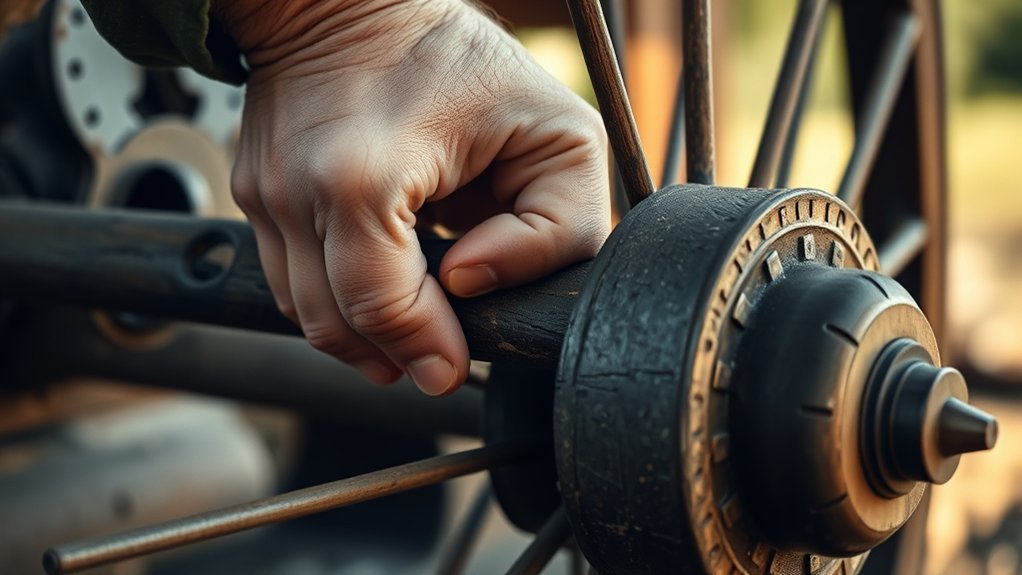
To start the wheel turning, you need to apply an initial force strong enough to overcome friction resistance. You’ll feel that first push is the hardest because friction tries to keep the wheel still.
Once you break through that resistance, the wheel begins to spin more easily.
Applying Initial Force
Where do you apply force to get the wheel turning? You start by pushing or pulling on the outer edge of the wheel rather than the axle. This approach leverages the wheel’s larger radius to multiply your effort, making it easier to set it in motion.
Utilizing force at the wheel’s perimeter allows you to initiate rotation efficiently before the axle follows.
Consider these points when applying initial force:
- Use steady, controlled pressure to avoid slipping.
- Push tangentially to the wheel’s edge for maximum torque.
- Apply force at the point farthest from the axle for mechanical advantage.
- Ensure your grip and stance provide stability as you start turning.
This method helps you overcome the initial resistance and gets the wheel rolling smoothly.
Overcoming Friction Resistance
Once you apply force at the wheel’s edge, the next challenge is overcoming the friction resistance that holds the wheel in place. Friction occurs where the axle meets its support, resisting movement. You need to exert enough torque to break this initial resistance.
If your force is too weak, the wheel won’t budge. To start turning, push steadily and increase your effort gradually until the wheel overcomes that static friction. Once it begins to move, friction shifts to kinetic, which is easier to overcome.
Keeping the wheel turning requires less force than starting it. Lubricants, like oil, reduce friction, making your job easier. So, by applying a strong initial push and minimizing friction, you successfully get the wheel rolling and the axle turning smoothly.
How the Wheel’s Spin Creates Torque
When you spin the wheel, you’re actually generating torque, which is the twisting force that powers the axle. This torque results from the wheel’s rotational motion and the force you apply at its rim. The farther from the center you apply force, the greater the torque produced.
Here’s what happens in detail:
- The wheel’s radius acts like a lever arm, amplifying your applied force.
- As the wheel turns, it creates rotational force around the axle’s axis.
- The friction between the wheel and the surface helps maintain the spin, sustaining torque.
- This torque is transmitted directly to the axle, ready to perform work.
Understanding this helps you see how spinning the wheel effectively converts your effort into mechanical force.
How Torque Moves the Axle
Although you don’t see it directly, the torque generated by the wheel immediately sets the axle into motion. When you apply force to the wheel’s rim, it creates rotational force—torque—that transfers to the axle through their connection. Because the axle is smaller in diameter, the torque causes it to spin with greater force but lower speed compared to the wheel.
As the wheel turns, the axle responds by rotating around its own axis, driven by this torque. This interaction allows you to convert the wheel’s rotational energy into the axle’s movement efficiently. Understanding this transfer of torque is key to grasping how wheels and axles function together to perform mechanical work, even though you can’t directly observe the torque’s effects on the axle itself.
How the Axle Moves What’s Connected
Because the axle is firmly connected to other parts, its rotation directly drives their movement. When you turn the axle, anything attached to it moves as well. This connection is vital in transmitting motion efficiently throughout a machine or vehicle.
You’ll find that the axle often serves as the central link between the wheel and other components, enabling smooth operation.
Here’s how the axle moves what’s connected:
- It transfers rotational force to gears or pulleys linked to it.
- It causes wheels to spin, propelling vehicles forward.
- It rotates connected shafts, powering mechanisms like conveyor belts.
- It moves attached levers or rods, converting rotation into other types of motion.
Understanding this helps you see how rotation spreads through a system.
How the Wheel and Axle Make Work Easier
If you apply force to turn the wheel and axle, you’ll find it reduces the effort needed to move or lift objects. This simple machine works by spreading out the force over a larger distance. When you push the wheel, it turns the smaller axle, which requires less force than moving the axle alone.
Essentially, the wheel’s larger radius allows you to apply less effort while increasing the distance over which the force acts. This mechanical advantage makes tasks like rolling heavy loads or turning screws easier. By using the wheel and axle together, you multiply your input force, making work more efficient.
Everyday Machines That Use Wheels and Axles
The way the wheel and axle reduce effort shows why they’re found in so many everyday tools and machines. When you use these devices, you’re benefiting from a simple yet powerful mechanism that makes tasks easier and faster. You encounter wheels and axles more often than you might think, especially in common objects around your home and workplace.
The wheel and axle simplify tasks, making everyday tools more efficient and easier to use.
Here are some everyday machines that use wheels and axles:
- Bicycles, where the pedals turn the axles connected to the wheels
- Door knobs, which rotate on an axle to open doors
- Rolling office chairs, allowing smooth movement with minimal effort
- Hand drills, where turning the handle spins the drill bit
Recognizing these examples helps you appreciate how this basic mechanism fits into daily life.
Why Understanding Wheels and Axles Helps Solve Problems
When you understand how wheels and axles work, you can quickly identify ways to reduce effort and increase efficiency in many tasks. You’ll see how these simple machines multiply force, making it easier to move heavy objects or speed up processes. This knowledge helps you troubleshoot problems, like why a wheel might be stuck or not turning smoothly.
You can also apply this insight to design better tools or machines, saving time and energy. Whether you’re fixing a bike, building a cart, or improving mechanical systems, knowing the principles behind wheels and axles puts problem-solving in your hands. It empowers you to think critically and innovate practical solutions in everyday situations.
Frequently Asked Questions
What Materials Are Best for Making Wheels and Axles?
You’ll want to choose strong, durable materials like steel or aluminum for axles and sturdy rubber or plastic for wheels. These materials provide good strength, reduce friction, and guarantee smooth rotation for better performance and longevity.
How Do Wheel and Axle Sizes Affect Machine Speed?
If you want your wheel to win a slow-motion contest, make it huge and the axle tiny. Bigger wheels speed things up; smaller wheels slow you down—because who doesn’t love a leisurely ride, right?
Can Wheels and Axles Be Used in Electric Vehicles?
Yes, you can use wheels and axles in electric vehicles. They transfer the motor’s power to the road, letting your vehicle move smoothly and efficiently.
This setup helps reduce friction and improves control during driving.
What Maintenance Is Required for Wheels and Axles?
You might think maintenance is complicated, but it’s simple: regularly check for wear, lubricate bearings, and tighten bolts.
Doing this keeps your wheels and axles running smoothly and prevents costly damage down the road.
Who Invented the Wheel and Axle Mechanism?
You won’t find a single inventor for the wheel and axle since it was developed thousands of years ago by ancient civilizations. Early Mesopotamians are often credited, but it evolved gradually through human innovation and experimentation.
Conclusion
Just like the gears that powered Da Vinci’s inventions, your understanding of the wheel and axle puts problem-solving in motion. When you grasp how torque spins the wheel and moves the axle, you reveal the secret to making work easier.
Whether you’re turning a doorknob or riding a bike, this simple machine quietly transforms effort into motion—showing you that even the smallest parts can drive big change in your everyday world.
By mastering the wheel and axle, you unlock a fundamental principle of physics that enhances efficiency and reduces effort. This knowledge highlights how simple machines play a vital role in engineering and everyday life, making tasks smoother and more manageable.

